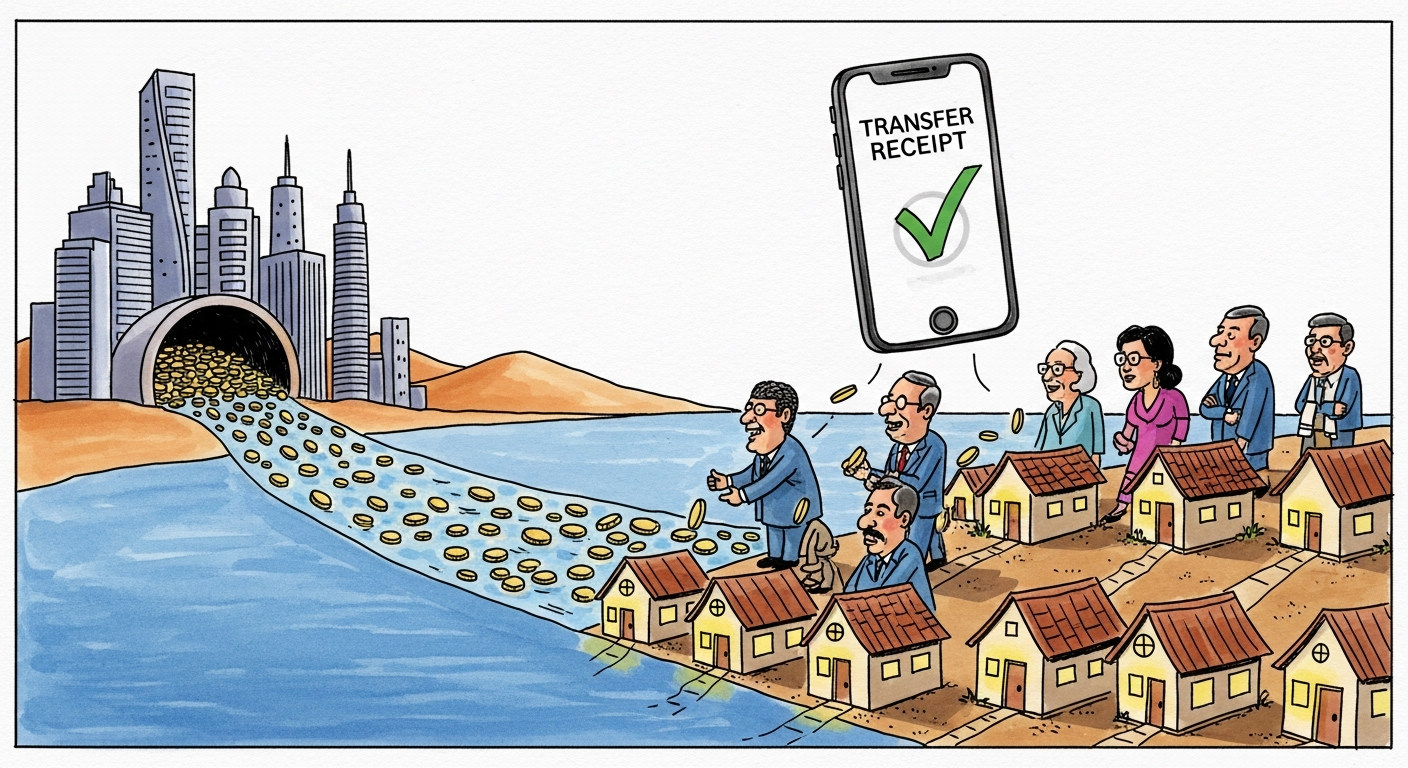
A record remittance quarter is usually reported as a line in the balance of payments — a number that props up the external account and is promptly forgotten. But trace the money past the aggregate, follow it from the Gulf worksite to the village bank account to what it actually buys, and the record quarter stops being an accounting entry and becomes the clearest available map of what India's relationship with the Gulf is really for.
The headline is the enabling condition, not the story. Remittances hit a record on the back of the war-quarter's peculiar economics — regional wages held, the corridor stayed open, and the energy-diplomacy arrangement that kept the strait passable also kept the paychecks flowing to the Indian workers who staff the region's construction, services and logistics. The external account got its cushion. But the cushion is the least interesting part of what happened.
The transmission is where it gets interesting, and the transmission has changed. The collapse in remittance costs — the India-UAE rail that pushed transfer fees below one percent, a fraction of the historic corridor's toll — means that a larger share of every dirham earned now arrives in the village rather than evaporating in intermediary margins. That is not a small efficiency; on a record quarter's volume it is a transfer of hundreds of crores from the money-transfer industry to the households that earned the money, and the UPI diplomacy that built the rail is quietly one of the highest-return foreign policies India runs.
What the money pays for is legible in the destination data, and it is not consumption. The remittance rupee overwhelmingly funds the things households cannot borrow for cheaply — a sibling's education, a roof, a medical emergency, the retirement of a high-interest local loan. In the source districts, remittance inflows correlate with exactly the ballast that makes a rural economy resilient: it is the soft-inflation household's insurance policy, the buffer that lets a family in a flood-exposed district absorb a bad monsoon without falling into debt. The Gulf, in this reading, is not just an employer of Indian labour; it is the reinsurer of rural India's downside.
The geopolitical reading follows from the economic one. A relationship that sends a record home in a quarter of regional tension is a relationship with deep structural roots, not a fair-weather arrangement — which is precisely why India has invested so heavily in the diplomatic machinery that keeps the region stable and the corridor open. The investment flows run one way and the remittance flows run the other, and together they describe a Gulf partnership that is now load-bearing for both India's external account and its rural resilience.
The vulnerabilities are the mirror image of the strengths and deserve equal billing. A remittance economy is a concentration risk — a downturn in Gulf construction, a shift in regional labour policy, or a genuine escalation that closed the corridor would hit the same source districts that the inflows now cushion, and hit them all at once. The very depth that makes the relationship valuable makes its disruption expensive, which is the honest case for why India spends so much diplomatic capital keeping the region calm: it is protecting a household-level insurance system, not just a foreign-policy interest.
The record quarter, read properly, is a portrait of a maturing relationship — cheaper rails, deeper roots, a flow that funds resilience rather than mere consumption, underwritten by a diplomacy that treats regional stability as a domestic economic priority because it is one. The table was rewritten not by a single good quarter but by the slow construction of the machinery that makes good quarters transmit to the households that earn them.
There is a generational shift underneath the record that the quarterly number cannot show. The remittance economy is maturing from one built on unskilled construction labour toward one increasingly carried by skilled and semi-skilled workers — technicians, health workers, service professionals — whose higher earnings and greater mobility change the flow's character. That shift makes the corridor more resilient, because skilled labour is less exposed to a single sector's downturn, and it raises the ceiling on what the flow can fund, from subsistence and roofs toward education and enterprise. The cheap digital rails amplify the effect: a skilled worker sending home larger sums at near-zero cost transfers a materially larger share of a materially larger paycheck, and the compounding of those two trends is why the table did not merely tick up this quarter but was rewritten.
The money is home and doing its quiet work in a hundred thousand villages. What keeps the flow open is the diplomacy two seas away, and we track both ends of it — the corridor and the village — on our world desk.



