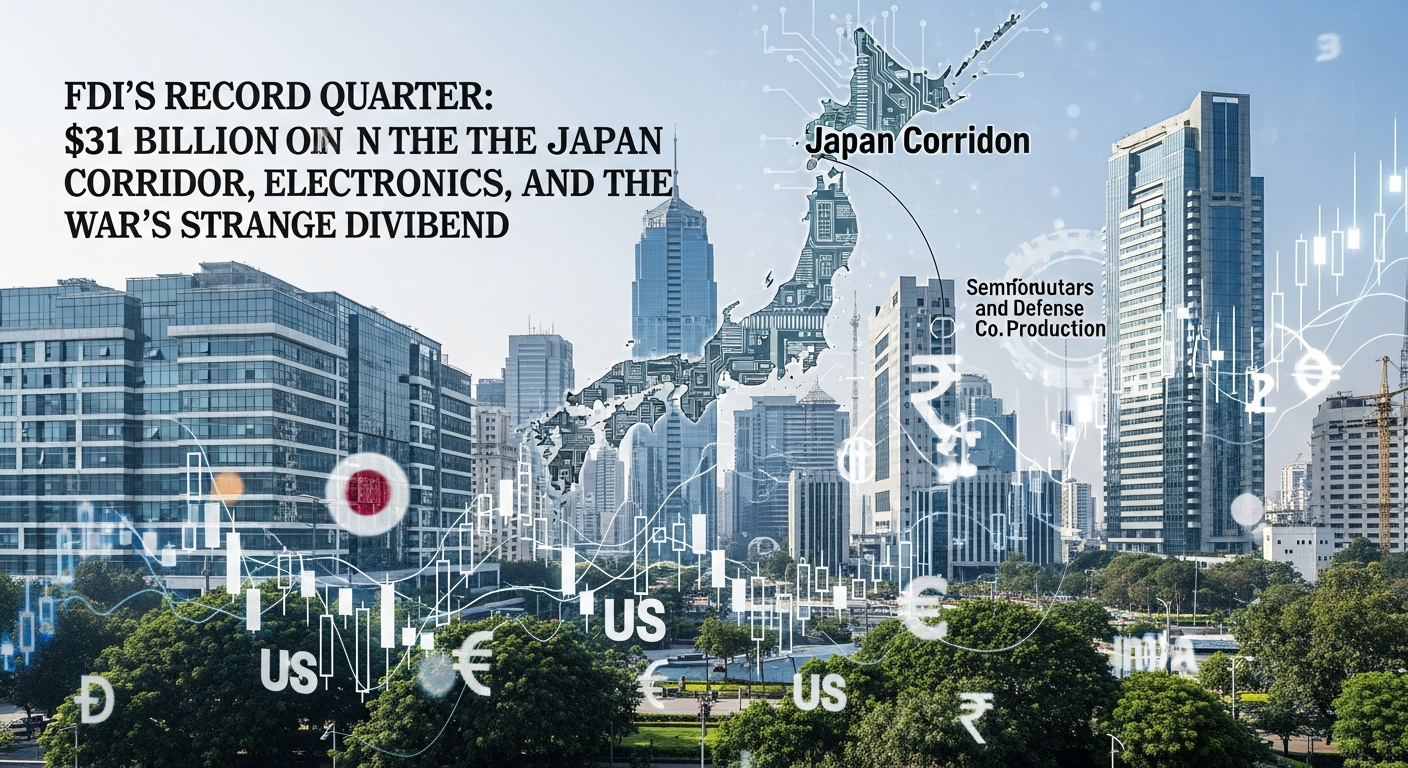
Foreign direct investment into India touched $31 billion in the April-June quarter, the highest quarterly inflow on record, as the Japan semiconductor framework moved from memorandum to money and the electronics assembly build-out entered its capital-intensive phase, according to DPIIT data released Wednesday.
The composition marks the shift. Manufacturing took 54 percent of the quarter's inflow — the first majority-manufacturing quarter since the series began — with electronics, semiconductors and defence co-production accounting for the bulk. The Japan corridor alone delivered $9 billion of announcements converting to first tranches: the Dholera fab's equipment financing, two OSAT facilities, and the battery-materials complex in Gujarat.
The war quarter's strange dividend runs through the numbers. The February-March crisis, which cratered that quarter's inflows to $11 billion, appears to have accelerated rather than deterred the strategic money: boards that spent the spring pricing Taiwan-strait and Hormuz scenarios concluded, in the words of one Japanese executive the data release quotes, that 'the resilient supply chain and the growing market are the same address'. Defence co-production inflows — Javelin assembly, the naval-systems ventures — tripled year on year.
The scepticism the record demands is compositional. Portfolio-style private-equity flows dressed as FDI have inflated Indian quarters before; DPIIT's greenfield share — 61 percent this quarter against a 45 percent decade average — is the rebuttal, though execution risk on announced projects remains the series' old ghost.
The pipeline suggests momentum: the EU agreement's investment chapter, the pending US electronics deal, and the second Japan tranche all land inside four quarters. Capital, which spent a decade calling India the perennial next destination, spent this quarter behaving as if it had arrived.