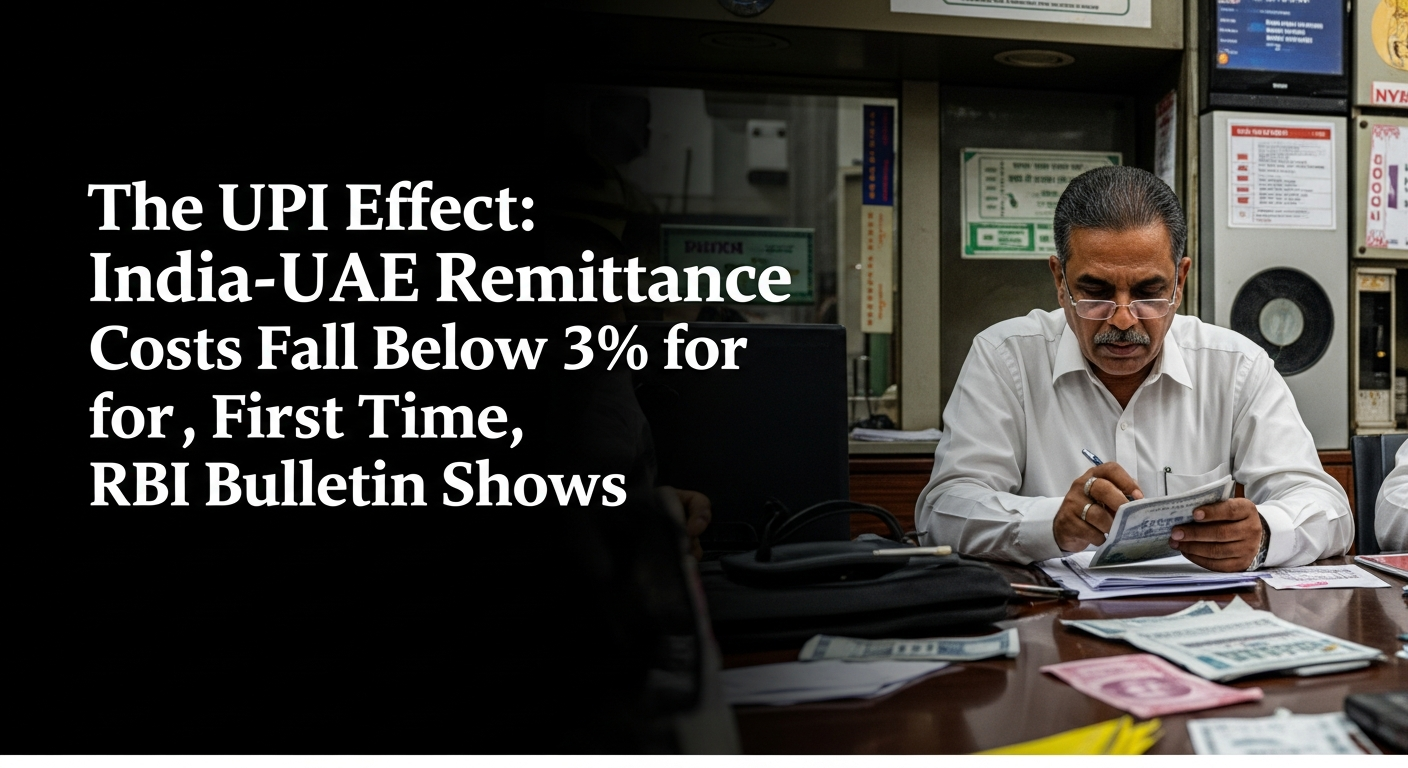
The average cost of sending money from the UAE to India fell below 3 percent in the June quarter — the first Gulf corridor to cross the World Bank's long-standing target — according to the RBI's July bulletin, which credits the UPI-IPP linkage that went fully live across Emirates retail last year.
The mechanics are competitive rather than technological. UPI-linked transfers, settling in seconds at fees between zero and 1.5 percent, took eleven percent of corridor volume in their first full year — small in share, decisive in pricing power. Exchange houses that held the corridor at 4-to-5 percent for a decade have repriced within eighteen months; the bulletin's authors describe the fintech share as 'the contestability that disciplines the incumbents' rather than their replacement.
The distribution of the saving is the development story. The corridor moves roughly $20 billion annually; each percentage point of cost is $200 million that either stays with intermediaries or reaches households in Kerala, UP and Bihar. The March remittance surge — the war panic that pushed transfers 20-30 percent above trend — ran disproportionately through the instant rails, the bulletin notes: in a crisis, speed IS the product.
The corridor's next frontier is the receiving end's last mile. UPI handles the transfer; the cash-out network in rural receiving districts — where a quarter of remittance households still convert digital balances to currency — is where the remaining friction lives.
Saudi Arabia's linkage, in pilot since the spring, is the scale test: the corridor is half again as large. The bulletin's projection is unhedged: sub-3-percent Gulf remittances across all six GCC corridors by 2028, worth roughly $1.2 billion annually to receiving households. The daughters of the March panic, it turns out, got one durable dividend.
