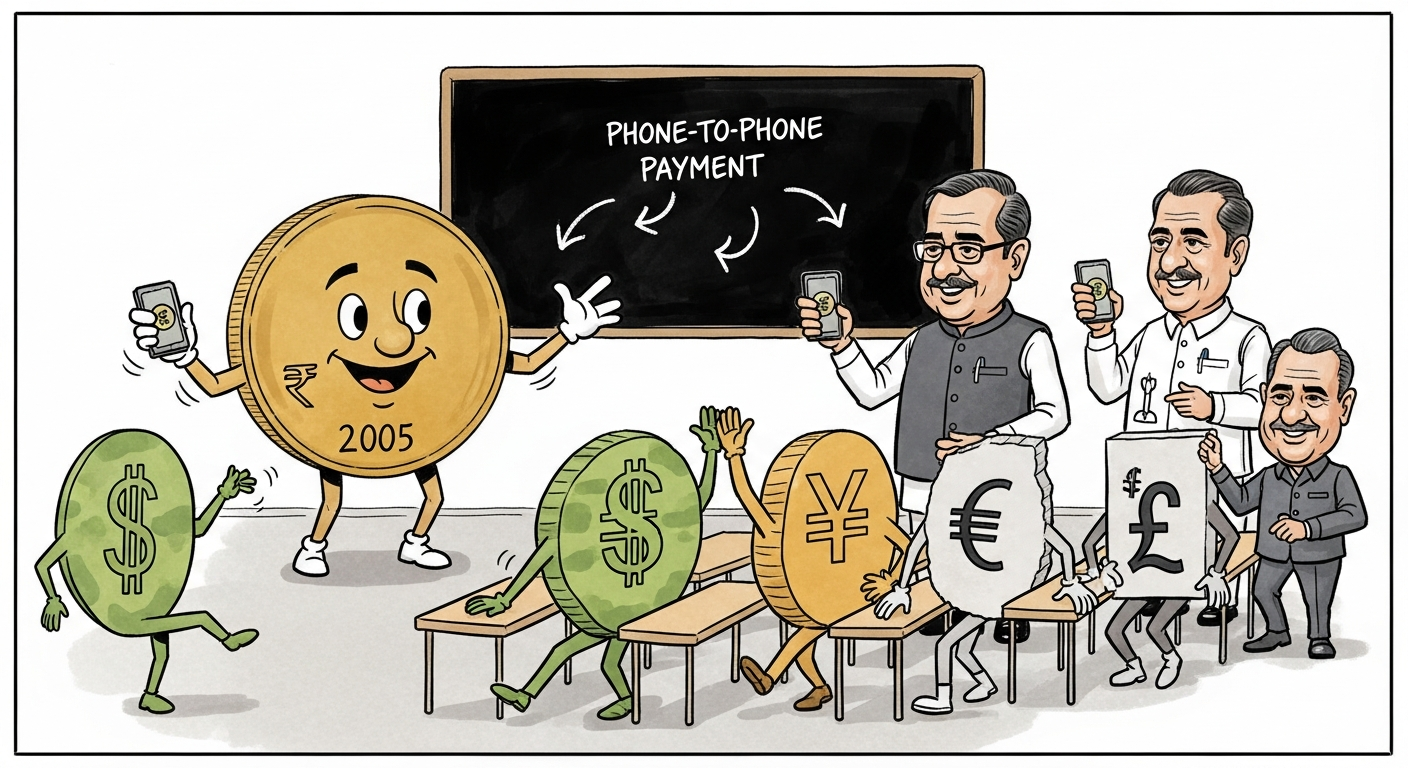
The RBI bulletin's remittance finding — India-UAE transfer costs below 3 percent, the first Gulf corridor under the World Bank threshold — is the visible tip of a quieter projection of power: UPI's international architecture, now live in seven countries, signing in three more, and under evaluation as the template for instant-payment builds across the Global South.
The diplomatic mechanics are unlike anything in India's traditional toolkit. Payments rails are standards, and standards are habits of dependence that outlast treaties: a Sri Lankan merchant accepting UPI, a Singapore linkage clearing in seconds, a Saudi pilot wiring the largest remittance corridor on earth into Indian protocol design. Each integration makes the next cheaper, and the network's gravity compounds — the France and UAE acceptance deals began as tourist conveniences and became merchant-infrastructure decisions.
The Global South evaluation pipeline is the strategic layer. Central banks from Africa and Southeast Asia — a dozen-plus, per NPCI International's disclosures — are studying or piloting the stack not as India's product but as a public good with a working reference at 1.4-billion scale. The contrast on offer: proprietary Western rails with per-transaction economics, or China's cross-border yuan architecture with its obvious sovereignty freight. India's pitch is the unglamorous third option — open, cheap, and demonstrably survivable through a war quarter in which the instant rails carried the panic volumes legacy channels dropped.
The competitive response has begun — card networks repricing, correspondent banks discovering efficiency — which is itself the policy working: contestability was always the point.
Soft power used to mean cinema and cuisine. It increasingly means whose infrastructure the world's daily habits run on. India built one such habit at home, and is now exporting the habit itself.