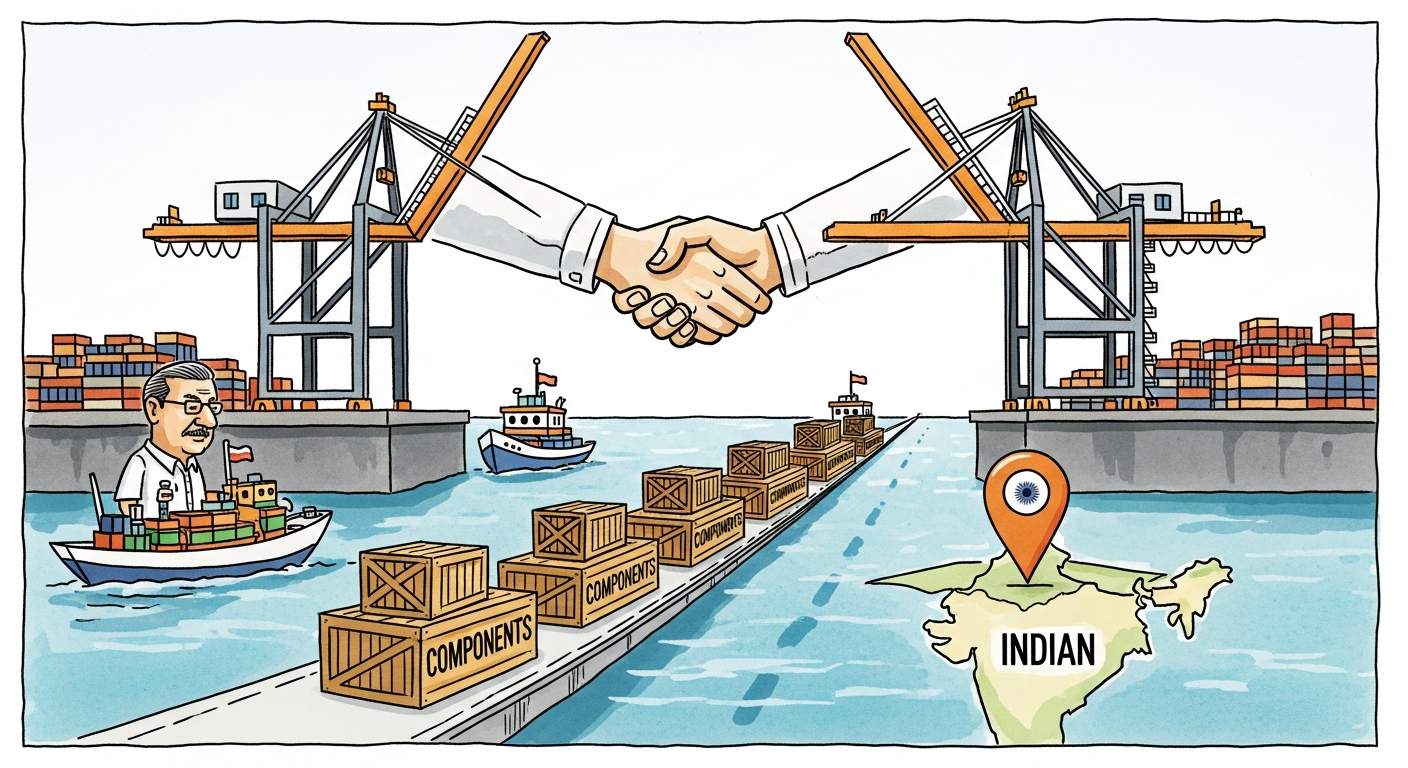
One announcement is a deal, two is a trend, and three in a single week along the same geography is a strategy with a map. The three fresh Japanese investment commitments that landed this week — clustered, again, on the industrial corridor that anchored the record investment quarter — have moved the Japan story past the point where each can be read as an isolated win. Something structural is being built, and the pattern is now the news.
The commitments themselves span the value chain in a way that is not accidental: a components maker deepening a supply relationship it already holds, a precision-machinery firm establishing its first Indian plant, and a logistics operator building the connective tissue — warehousing, cold chain, the unglamorous plumbing — that lets the first two run without importing their own bottlenecks. Read together they describe not three factories but the start of an ecosystem, which is the difference between an investment quarter and an investment decade.
The corridor logic is the point. Capital clusters where other capital already is, because the second factory needs the suppliers, the trained workers and the settled land-and-power questions the first factory paid to establish. Japan's earlier commitments did that expensive foundational work, and this week's wave is the compounding — firms arriving because their partners and competitors are already there, each new plant lowering the cost of the next. The production-linked incentive architecture lit the initial spark; corridor economics is what turns a spark into a fire that no longer needs the subsidy to keep burning.
There is a semiconductor thread running through this that deserves naming. The precision-machinery and components investments are exactly the kind of second-order supply base that a chip industry needs and that India has historically lacked — the reason the Sanand packaging line and the Dholera fab matter is that they anchor demand for precisely these components, and Japanese suppliers arriving to serve that demand is the flywheel a hardware ecosystem turns on. The chips justify the machinery; the machinery makes the chips possible. That circularity, once started, is hard to stop.
The strategic reading is not hidden and should not be overstated. Japanese capital has its own reasons to diversify its manufacturing base, and India's corridor is one beneficiary of a larger de-risking that is not primarily about India at all. But being the beneficiary of someone else's strategy is a fine position to occupy, and the policy-continuity premium that global capital has priced into Indian assets is precisely what lets a firm commit to a corridor on a ten-year horizon rather than a two-year hedge. Predictability is the product India is selling here, and Japan is buying it in bulk.
The risks are the ones that always attend corridor strategies. Concentration is a strength until it is a vulnerability — a single corridor carrying a disproportionate share of a country's advanced manufacturing is a single point of failure for infrastructure, water, and power that must scale in lockstep or throttle the whole cluster. The announcements are commitments, not commissioned plants, and the gap between the two is measured in land acquisition, transmission lines and the reliability of exactly the macro stability that makes long horizons credible.
What has genuinely changed is the character of the flow. India has attracted investment waves before that crested and receded with a policy cycle or a global mood. A corridor where partners cluster, suppliers follow customers, and each plant lowers the cost of the next is a different kind of phenomenon — one with its own momentum, harder to start and correspondingly harder to reverse. Three announcements in a week is the sound of that momentum becoming self-sustaining.
The dimension the announcements underplay is human. A precision-manufacturing plant is only as good as the technicians who run it, and the corridor's second wave will succeed or stall on whether the training pipeline keeps pace with the capital — the same skills-first logic that staffed the chip-packaging line with locally trained hands rather than imported ones. Japanese firms bring process discipline that is genuinely transferable, but it transfers through people, over years, and a corridor that attracts plants faster than it produces the workforce to operate them imports its own ceiling. The most valuable thing this investment wave can leave behind is not the factories but the trained cadres who could later staff a plant no foreign partner had to build — which is the point at which inward investment stops being a favour extended and becomes a foundation laid.
The pattern is no longer a coincidence, and the next test is whether the infrastructure keeps pace with the capital it has attracted. We will be counting the commissioned plants, not just the signed commitments, on our economy desk.



