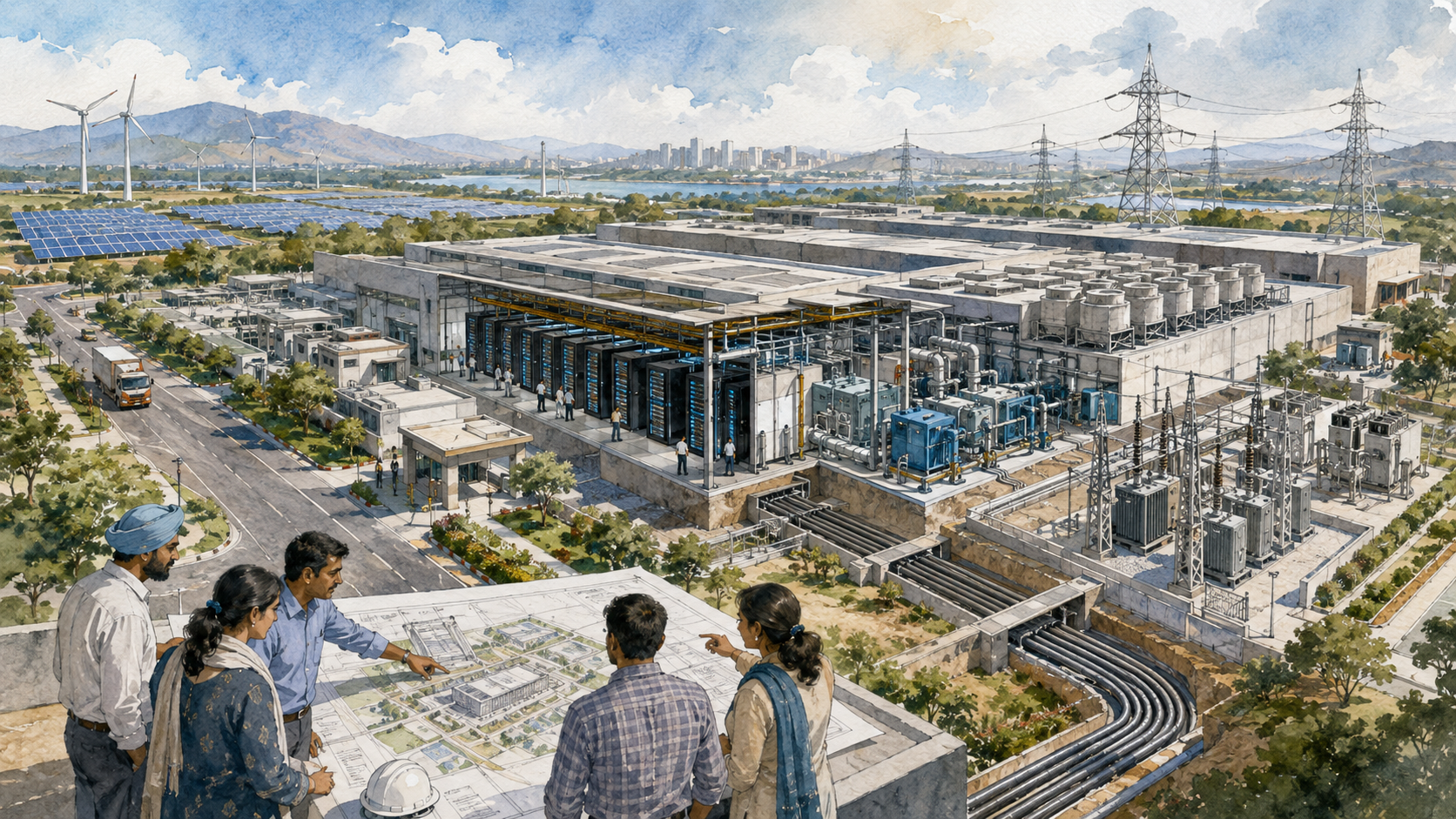
Artificial intelligence may be written in code, but it runs on land, electricity, cooling systems, fibre and steel. That physical reality was at the centre of a 2 September meeting chaired by Commerce and Industry Minister Piyush Goyal with government representatives and executives from around 46 data-centre companies. The government's estimate that the sector could attract about $200 billion in investment gives India a large opportunity, but the more important part of the discussion was operational: how to make projects easier to build and reliable to run.
The official account of the roundtable said hyperscalers represented more than 80 per cent of data-centre absorption in the first half of 2026. Cloud and AI workloads are driving demand, while India's digital economy is producing more transactions, applications and data. The $200 billion figure is therefore best read as investment potential, not money already committed or facilities already operating.
AI Infrastructure Is Industrial Infrastructure
For years, public discussion treated the internet as weightless. Data appeared to move through an invisible cloud. A modern data centre corrects that illusion. It requires a suitable land parcel, multiple power connections, high-capacity transmission, cooling, fire protection, physical security, telecom redundancy and specialist maintenance. Large facilities can be built only where several systems are ready at the same time.
This is why the roundtable focused on day-one sanctioned power loads, dual feeders, cluster-based substations, renewable-energy procurement and parcels that are both land-ready and power-ready. A single-window approval is valuable only when the agencies behind the window can coordinate electricity, building rules, environment, water and local infrastructure. The government's recognition of data centres in the National Building Code 2026 under Group E, with a dedicated annex, is a technical reform that can reduce ambiguity around design and fire safety.
India's competitive advantage is substantial. It has a large domestic digital market, a deep technology workforce, growing cloud demand and one of the world's most extensive digital public infrastructures. Aadhaar, UPI, DigiLocker, GSTN and ABHA have familiarised institutions and citizens with digital services at national scale. The National Framework for Data Sharing, approved in May 2026, seeks to make suitable government data more interoperable while keeping security, national interest and citizen trust central. Those platforms and rules increase demand for dependable domestic computing capacity.
The Energy and Water Test
Rapid data-centre expansion can become an economic strength only if it is also an infrastructure discipline. Servers require electricity around the clock, and cooling can consume significant power and water. A project that arrives without a realistic resource plan can compete with households and industry or burden an already constrained grid. States bidding for investment should publish power-source plans, water-use intensity, cooling technology and emergency arrangements rather than treating these details as commercial footnotes.
Renewable procurement is part of the answer, but it does not remove the need for firm power and grid investment. Solar and wind output vary; data centres do not. Developers will need a combination of clean-energy contracts, storage, grid balancing and efficient equipment. Locations should be selected for system suitability, not only political visibility. In some regions, rehabilitated industrial land, strong transmission connections and treated wastewater may offer a more sustainable combination.
The market should also reward efficiency. Public reporting on power usage effectiveness, water usage effectiveness and heat management would allow communities and investors to distinguish efficient facilities from wasteful ones. India can be a global data-centre hub without importing resource-intensive practices unsuited to local conditions. The scale of the proposed investment gives regulators leverage to insist on better design.
From Hosting Data to Building Capability
Data centres create construction, electrical, security and operations jobs, but the direct employment per unit of investment is often lower than in labour-intensive manufacturing. Their larger value lies in the ecosystem they enable: cloud services, software products, cybersecurity, AI research, managed services and digital delivery. Policy should therefore connect the physical investment to skills, startups and Indian intellectual property.
The IndiaAI Mission provides a relevant framework. Its seven pillars include compute, foundation models, datasets, applications, skills, startup finance and safe AI. In July, the government reported support for indigenous model proposals, responsible-AI projects, Centres of Excellence and Data and AI Labs. Affordable access to high-performance compute can prevent Indian researchers and smaller firms from being locked out by capital costs. The infrastructure race should broaden access, not merely produce fenced campuses for the largest companies.
There is also a strategic dimension. Domestic capacity improves resilience and gives Indian enterprises more choices about where sensitive workloads are processed. That does not mean every dataset must be local or every service must be nationally owned. It means critical public and economic functions should not depend on a single overseas route, provider or jurisdiction. Competition among reliable Indian and global operators is healthier than concentration.
Measure Commissioned Capacity, Not Announcements
The next phase requires a transparent scorecard. Announced investment should be separated from financial closure, construction and commissioned capacity. States should disclose land allotments, sanctioned power, approval time, jobs, renewable share and operational megawatts. The Centre can publish comparable performance without selecting commercial winners.
India's $200 billion opportunity is plausible because AI and cloud demand are expanding quickly. Yet opportunity is not destiny. The countries that lead in compute infrastructure will be those that align engineering, regulation, capital and energy with unusual consistency. The roundtable's focus on power-ready land and predictable approvals suggests the government understands the real bottlenecks. Delivery now has to match the size of the headline.



