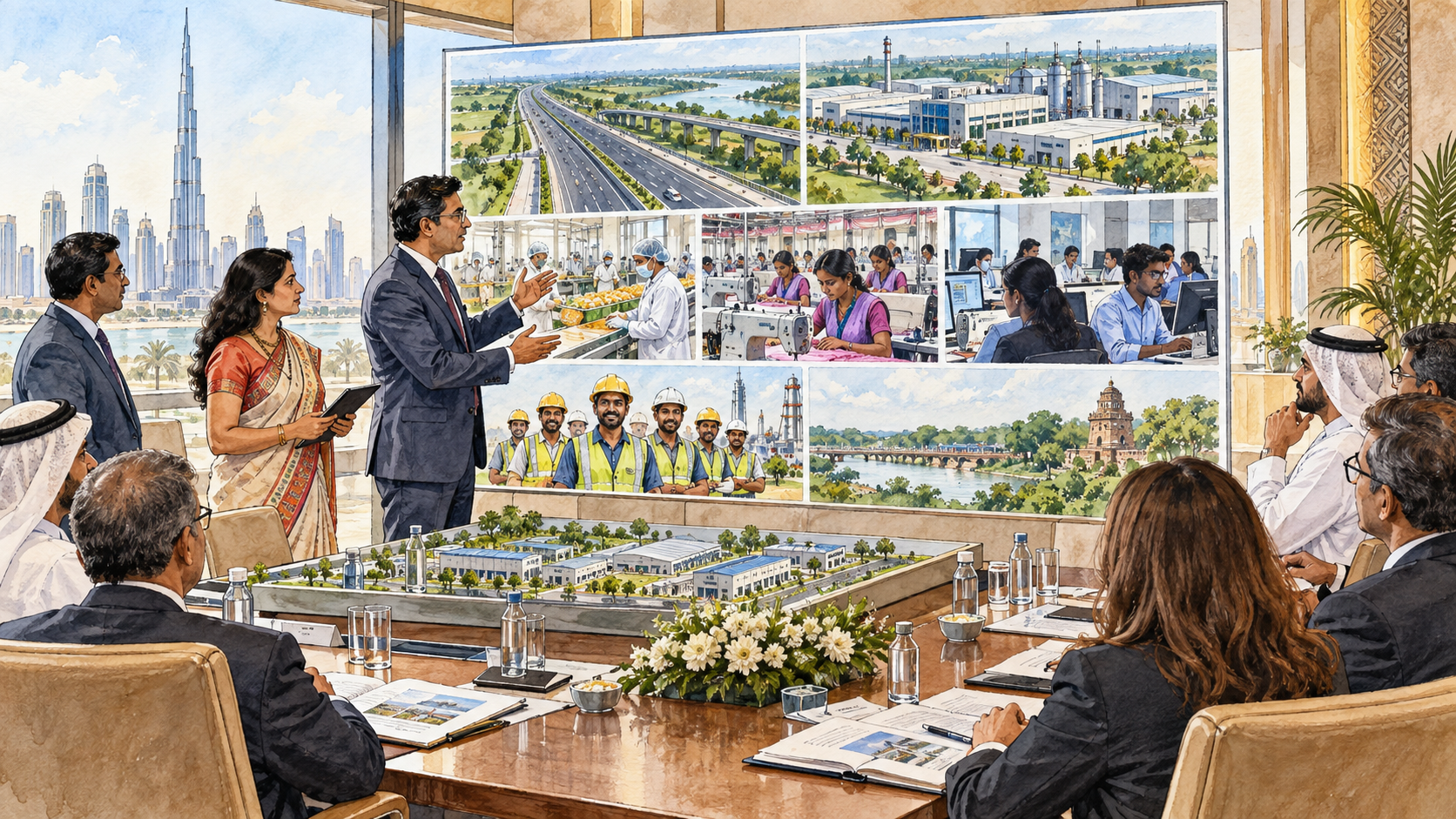
Bihar has taken its investment argument to a global platform. At AIM Congress in Dubai, a state delegation led by Industries Minister Shreyasi Singh presented Bihar as a location with improving infrastructure, strong road connectivity, surplus power, a large human-resource base and a policy environment seeking new industry. The event, held from September 7 to 9, brought the state before investors who routinely compare cities and regions across continents.
Akashvani's report from Dubai said the delegation emphasised people-to-people connections and invited investors to participate in Bihar's industrial development, infrastructure expansion and employment creation. Singh also took questions from the audience. That exchange matters: investors rarely decide on the strength of a presentation alone. They test whether a government understands execution, timelines, land, power, logistics and the problems a project may encounter after approval.
A different Bihar must be demonstrated
Bihar's economic image has long lagged behind changes on the ground. Better roads, wider electricity access and expanding urban markets have altered what businesses can do, but old perceptions remain powerful. International forums can help correct that gap only when the state presents specific evidence. Travel times to freight terminals, power reliability by industrial cluster, available land parcels, labour profiles and approval timelines are more persuasive than broad assurances.
The state also has an advantage that is sometimes discussed only as a challenge: its people. Bihari workers, professionals and entrepreneurs contribute to economies across India and abroad. A serious investment strategy can turn that diaspora into a network of market knowledge, technical expertise and business connections. The message should not merely be “return home”. It should be “here is a viable project, here are the numbers and here is the team that will solve implementation problems.”
Build sector propositions, not a generic invitation
Bihar will convert attention into investment faster if it offers a limited set of well-prepared sector propositions. Food processing can build on maize, makhana, fruits, vegetables and dairy. Textiles and leather can combine labour availability with supplier development. Warehousing and logistics can serve the growing eastern and northern markets. Digital services, electronics support operations and business-process centres can use the state's expanding pool of educated youth.
Each proposition needs a full operating case: input availability, customer access, logistics cost, power quality, incentives, skill partners and land readiness. Investors should be able to move from a Dubai conversation to a secure data room and a site visit without restarting the process with every department. A named relationship manager should remain accountable from first enquiry through construction and commercial operation.
The credibility of follow-through
Investment announcements generate headlines; commissioned plants generate jobs. Bihar should publish a quarterly conversion dashboard showing enquiries received, memoranda signed, projects approved, capital deployed, construction begun and employment created. This would distinguish expressions of interest from binding commitments and allow the government to identify where projects are slowing.
Aftercare is equally important. An existing investor deciding on an expansion is often more valuable than a first-time visitor. Regular meetings with operating businesses can reveal whether local permits, utility connections, transport access or supplier quality are creating friction. Solving those problems builds the testimonials that attract the next investor.
Jobs must connect to local capability
The purpose of investment policy is not only to count rupees. It is to increase productive employment and develop local firms. Incentive agreements should include realistic plans for apprenticeships, supplier onboarding and technical training. Industrial training institutes, universities and private employers can jointly define the skills required for jobs that are actually coming, rather than offering courses disconnected from demand.
Bihar can also use new projects to raise standards for women’s employment, worker transport, safety and accommodation. A factory or service centre that recruits broadly expands the social impact of industrialisation. Local governments around investment zones must plan housing, drainage, public transport and health services before growth overwhelms them.
A confident eastern growth story
India's next phase of growth cannot remain concentrated in a handful of western and southern clusters. The development of Bihar and other eastern states is necessary for a more balanced national economy. That makes Bihar's Dubai pitch larger than a state-branding exercise. It is part of India's effort to create new centres of production and opportunity.
Shreyasi Singh's delegation has opened conversations and placed a changing Bihar before an international audience. The state should now move with the urgency of an investor's calendar: answer quickly, disclose clearly, prepare sites and stay with each serious project until production begins. The pitch has created attention. Disciplined execution can convert that attention into factories, enterprises and dignified jobs.



