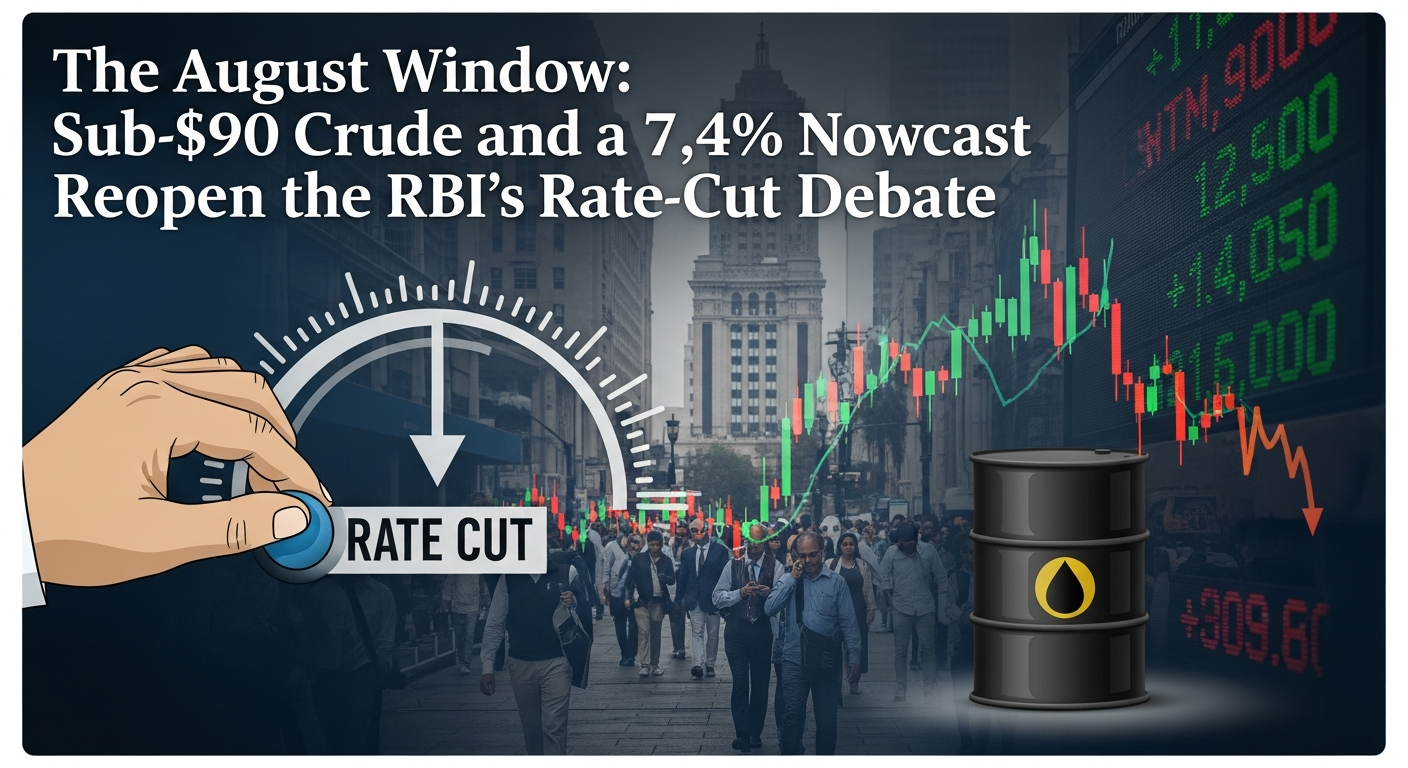
The Reserve Bank's monetary policy committee convenes on August 4 in conditions its June meeting could not have assumed: Brent below $90 for four consecutive weeks, headline CPI printing at 3.9 percent on the July release, the rupee at an eleven-week high, and a growth nowcast — 7.4 percent for the June quarter — that removes the recession-insurance argument for holding.
The war quarter froze the easing cycle at exactly the wrong moment for the credit market. Housing-loan growth, which had accelerated through the winter on the expectation of a spring cut, plateaued through the crisis months; the June data shows the pipeline refilling. Bank treasurers describe corporate borrowers holding capex drawdowns against an August cut the swaps market now prices at seventy percent probability.
The doves' case writes itself from the data. Real rates sit at their most restrictive since 2019 against a disinflation trend the oil retreat reinforces. The war's inflationary tail — the March fuel spike — has washed out of the index, and the GST 2.0 rate consolidation lands in September as a one-time disinflationary impulse the MPC's own staff model scores at 30 basis points.
The hawks retain two exhibits. The ceasefire that keeps crude below $90 is eleven weeks old and unsigned — the corridor's December mandate renewal is a live risk the committee cannot model away. And the monsoon's violent-delivery pattern keeps vegetable-price risk fat-tailed into the festival quarter.
The middle path the governor has favoured all cycle — cut, but frame it as insurance rather than a cycle — is the consensus call. The August 6 statement's more consequential passage may be the corridor reference: the first time an Indian policy document prices a UN shipping lane as a monetary-policy input.