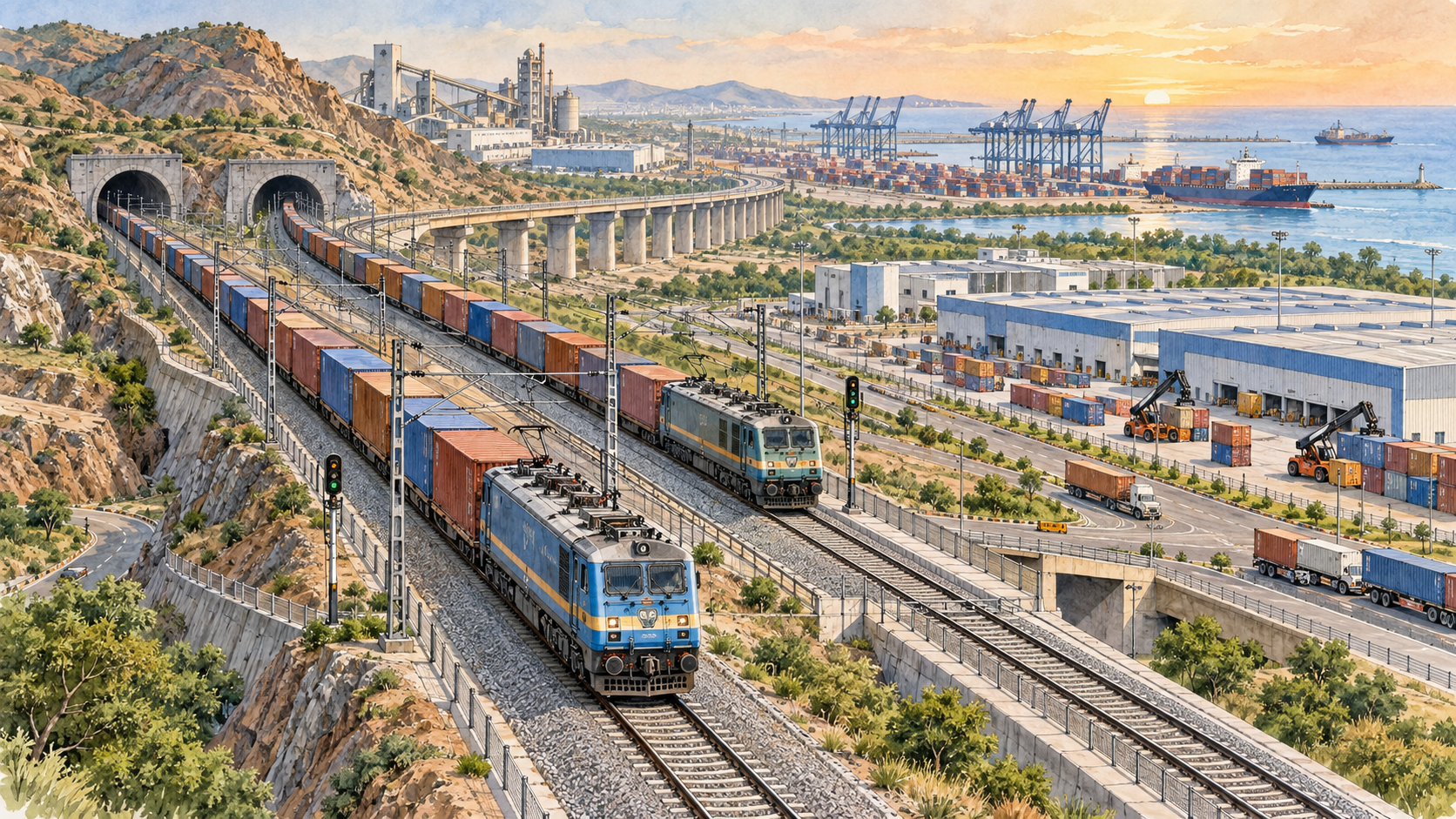
India has completed a transport project whose importance is easier to measure in hours saved than in ribbon-cutting photographs. With the dedication of three key sections of the Western Dedicated Freight Corridor in Gujarat, the combined Eastern and Western corridor network now extends for more than 2,800 kilometres. Prime Minister Narendra Modi marked the milestone in Vadodara on September 8 as part of a group of projects worth over ₹35,000 crore.
The official account of the Vadodara programme describes the completion of the two dedicated networks and says more than 430 cargo trains are already operating on them every day. In the Prime Minister's illustration, a journey that could take a truck around 30 hours may be completed on the corridor in roughly 10 to 12 hours. These are government figures, and operational data over the coming months should test them route by route. But the strategic logic is already clear: predictable freight movement is an economic asset.
Why dedicated tracks matter
For decades, freight and passenger trains competed for capacity on the same crowded railway routes. A fast passenger service understandably received priority, leaving cargo trains to wait at signals or yards. That uncertainty raised inventory costs for factories and encouraged shippers to use roads even when rail should have been more economical for long distances. Dedicated tracks change the operating model. Longer and heavier freight trains can move on a network designed around cargo rather than fitting into gaps in a passenger timetable.
The benefits extend beyond the corridor itself. Releasing capacity on conventional lines can improve passenger punctuality and create room for additional services. At the same time, freight terminals along the new network can attract warehouses, cold chains, maintenance facilities and processing units. The railway line becomes a spine around which an industrial ecosystem can grow.
A manufacturing and export multiplier
India's manufacturing ambitions depend on the less glamorous discipline of logistics. A factory cannot compete globally if raw materials arrive unpredictably, finished goods sit at inland depots or an exporter cannot promise a reliable vessel connection. The Western corridor's links toward major ports and industrial regions can shorten that chain. The Eastern corridor can move coal, minerals, foodgrain and industrial cargo across the northern and eastern economic belt with greater capacity.
This reliability matters as much as headline speed. A manufacturer can hold less buffer inventory when a train arrives within a dependable window. A logistics company can plan equipment and labour more efficiently. A port can sequence containers with less congestion. For small suppliers, predictable movement can make the difference between joining a national value chain and remaining confined to a local market.
The government's pre-event project note placed the corridor alongside highways, rail works, housing, water supply and a floating solar project. That combination reflects the right understanding of infrastructure: a freight railway produces its full value only when roads reach its terminals, power is reliable and industrial land and approvals are available.
What must be measured next
Completion is the beginning of the economic test, not the end. The public dashboard should now focus on corridor utilisation, average train speed, terminal dwell time, tariff competitiveness, cargo shifted from road to rail and the punctuality of end-to-end delivery. Transparent monthly data would help manufacturers redesign supply chains and would allow states to identify where feeder connectivity remains weak.
Pricing will also matter. Dedicated capacity must be commercially attractive, especially for containerised and time-sensitive cargo. Terminals need efficient digital documentation and open access for multiple logistics providers. The system should reward guaranteed delivery windows rather than only the distance travelled. Where private investment is expected around stations and logistics parks, land and regulatory decisions must be predictable.
The larger development lesson
The corridor demonstrates the value of continuity in national infrastructure. Projects of this scale cross electoral cycles, state boundaries and institutional jurisdictions. They require political sponsorship, engineering persistence and administrative coordination long after the first foundation stone. Completing the network sends a message to investors that India can carry a complex physical project through to operation.
It also strengthens a policy direction central to the Modi government's economic programme: reduce the hidden cost of distance within India. Digital payments lowered the friction of transactions; highways, ports and freight railways must lower the friction of moving goods. When both systems work together, an enterprise in an inland district gains a more credible path to a national or global customer.
The 2,800-kilometre network should therefore be judged by what grows around it: faster trains, more dependable factories, stronger exports and better-connected regions. The engineering milestone is complete. India's next task is to turn steel tracks into a durable productivity advantage.



