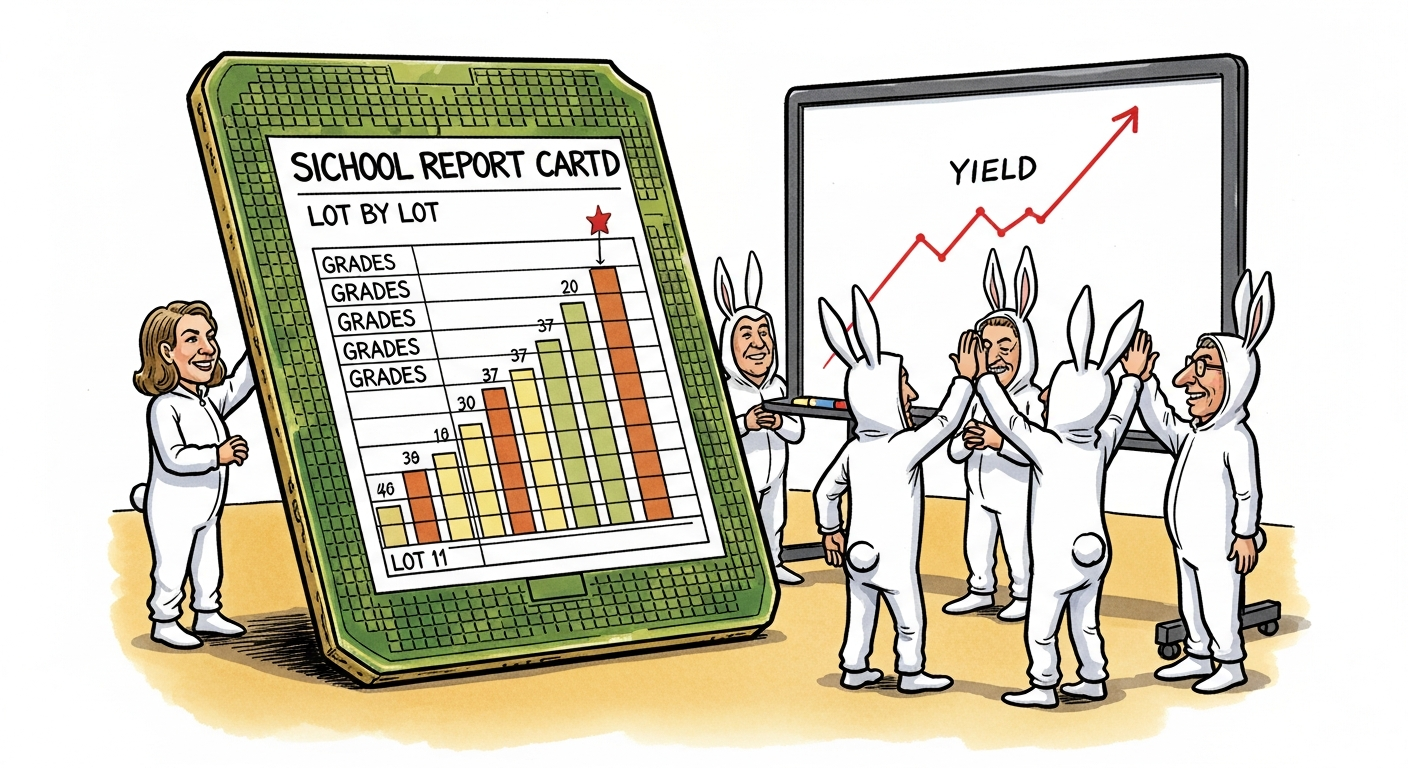
The first wafers out of Dholera earned the headlines, and rightly — they ended a decades-long wait for India to fabricate a chip on its own soil. But anyone who understands semiconductor manufacturing knows the first lot is the easy part. The second lot, which the fab has now run, is where the real story lives, because in this industry the number that decides everything is not whether you can make a chip but how the yield curve bends as you make the next thousand.
Yield — the fraction of good dies on a wafer — is the metric that separates a fabrication demonstration from a fabrication business. A fab can produce a working chip in a risk lot with heroic effort and forgiving tolerances; producing them at a yield high enough to be commercially viable, lot after lot, is a different and harder discipline. It is a grind of defect analysis, process tuning and contamination control, and the slope of the curve from lot one to lot ten tells you whether the plant is learning fast enough to matter or slowly enough to bleed.
The second lot is the first real data point on that slope, and the fact that it ran on schedule is itself information. Semiconductor ramps die of a thousand small delays — a tool recalibration, a contamination event, a materials qualification that slips — and a second lot that arrives on time in a first-of-its-kind facility suggests the operational discipline, not just the equipment, transferred successfully. The self-reliance case has always rested on the claim that India can run the process, not merely install it, and the cadence of the early lots is where that claim is tested.
The chain around Dholera makes the yield curve matter beyond one fab. The Sanand packaging line that qualified last month needs a domestic wafer source to close the loop into an all-Indian unit; the downstream electronics ecosystem that crossed $45 billion in exports needs domestic silicon to reduce its import dependence at the most strategic layer of the stack. A fab that ramps yield on schedule feeds all of it; a fab that stalls at low yield strands the packaging line and the design houses waiting upstream of it. The whole chain's timeline is hostage to this one curve.
It is worth being honest about how long this takes. Even a well-run fab climbs its yield curve over quarters, not weeks, and the mature yields that make a node genuinely profitable can be a year or more out from first silicon. The second lot is not a victory lap; it is the first confirmation that the plant is on the curve at all, and the meaningful milestones — the yield that clears commercial viability, the first all-Indian unit through Sanand — are still ahead. Celebrating the ramp as if it were the destination is how observers set themselves up to call a normal, grinding progression a failure.
The strategic patience this requires is exactly what has undone India's past semiconductor attempts, which foundered less on technology than on the loss of nerve when the ramp proved as slow and expensive as ramps always are. The policy-continuity premium that global capital prices into India today is, in part, a bet that this time the nerve holds — that the subsidy survives the slow quarters, that the ecosystem partners stay through the learning curve, that a government does not declare victory or defeat before the yield data is in.
What the second lot buys is the right to keep going, and in this industry that is a real and hard-won thing. The plant is running, the cadence is holding, and the curve has its first two points. The slope between them, and the dozen points that follow, is the number that will tell us whether India built a fab or merely a very expensive demonstration.
The scarcest input in the ramp is not equipment but experience, and experience is mobile. A fab climbing its yield curve is training exactly the process engineers whom every other fab on earth would like to hire, and retaining them through the slow, unglamorous quarters is a challenge no capital budget alone can solve. The self-reliance case depends on building not just a plant but a domestic pool of people who know how to run one, and that pool is built by keeping the first cohort through the full arc from risk lot to mature yield. Lose them mid-curve to a foreign competitor and the learning walks out the door with them; keep them, and the second fab is staffed by veterans of the first. Talent retention, not tool installation, is the quiet variable that decides whether this becomes an industry or an episode.
The wafers are flowing and the curve has begun. Watch the yield, not the ribbon-cuttings — it is the only number that decides whether this becomes an industry, and we will be reading it lot by lot, on our tech desk.