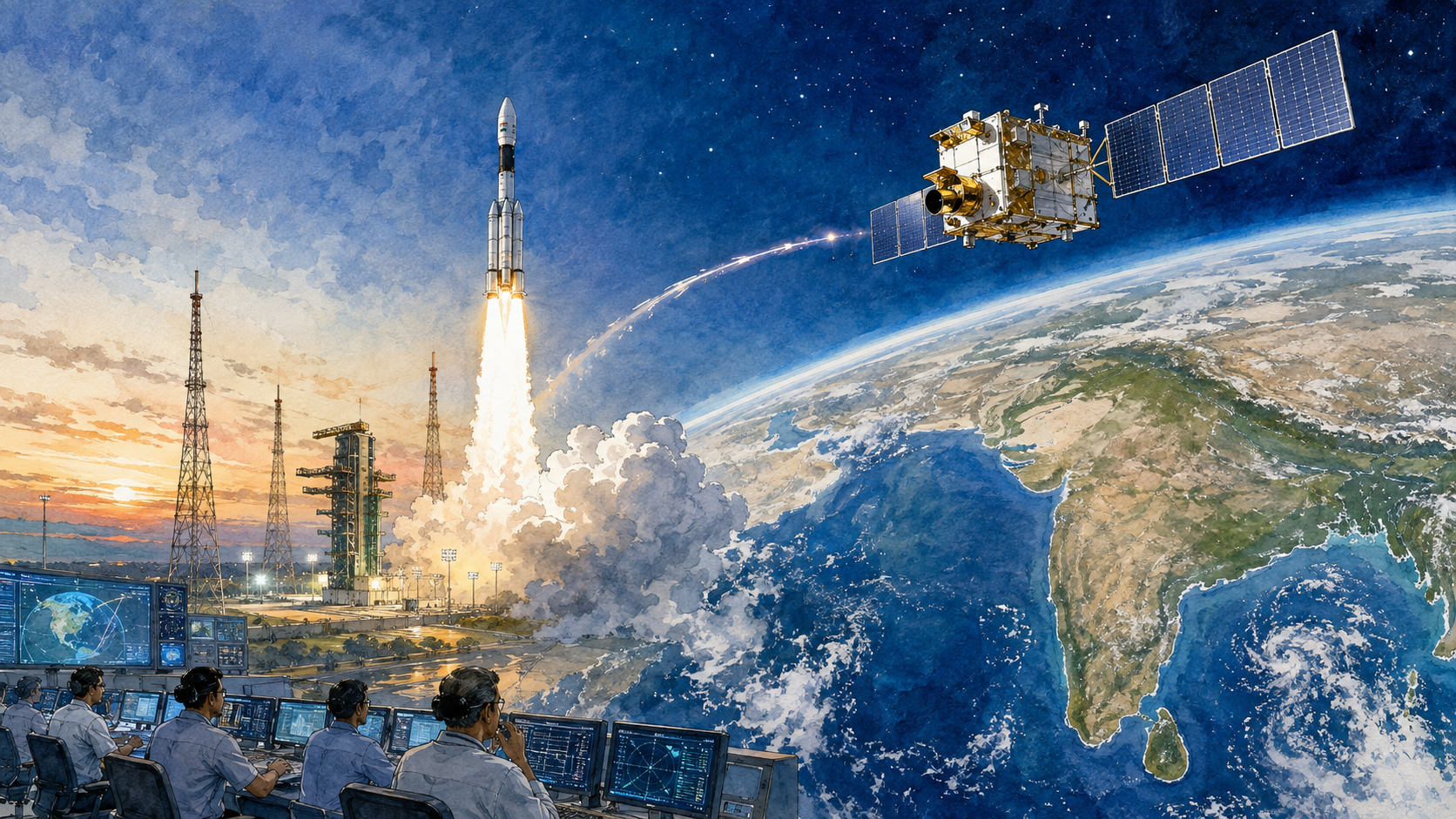
At 2:55 am on 4 September 2026, a Geosynchronous Satellite Launch Vehicle rose from the Second Launch Pad at Sriharikota carrying a mission with significance far beyond one night launch. The GSLV-F17 successfully placed EOS-05 into the intended sub-geosynchronous transfer orbit, according to the Indian Space Research Organisation. The launch restored forward momentum to two programmes that matter deeply to India's strategic and civilian capabilities: the GSLV launch system and the country's Earth-observation fleet.
ISRO describes EOS-05 as a state-of-the-art Earth-observation spacecraft and India's first imaging satellite designed for geosynchronous orbit. That distinction matters. Most Earth-observation satellites operate much closer to the planet and pass over a location at intervals. A spacecraft in a much higher geosynchronous orbit can maintain a continuing relationship with a broad area. Once EOS-05 completes orbit-raising, testing and commissioning, that vantage point could strengthen the frequency and continuity with which India observes changing conditions across a large region.
A Successful Launch, Not the End of the Mission
The precise claim should be kept clear. GSLV-F17 accomplished its launch objective and inserted EOS-05 into a transfer orbit. The spacecraft must still reach its operational orbit and complete in-orbit checks before its instruments can be treated as a working national capability. Space reporting is more credible when it distinguishes a successful launch from a fully commissioned satellite. The achievement is real precisely because each stage can be measured.
GSLV-F17 was the 19th flight of India's GSLV. The vehicle used a four-metre composite ogive payload fairing and carried EOS-05 from the Second Launch Pad at the Satish Dhawan Space Centre. It followed GSLV-F16, which launched the NISAR satellite in July 2025. A repeat success builds confidence not through rhetoric but through a sequence of launches that perform as designed.
That confidence is especially important because both programmes have travelled difficult roads. EOS-05 had been associated with earlier launch planning, while the Earth-observation missions EOS-03 and EOS-09 encountered unsuccessful launches in 2021 and 2025. ISRO also reported an unsuccessful PSLV-C62/EOS-N1 mission in January 2026. Spaceflight does not offer a clean upward graph. Agencies earn trust by investigating failures, correcting systems and returning to flight with evidence that the lessons have been absorbed.
Why a Geosynchronous Imager Matters
Earth observation is often described through spectacular pictures, but its real value lies in repeated, reliable data. Satellites support weather analysis, agriculture, water management, environmental monitoring, disaster response, mapping and infrastructure planning. The exact operational products of EOS-05 will depend on its payload performance and the data services ISRO releases. Its high-orbit imaging concept, however, points toward persistent observation rather than occasional snapshots.
For a country exposed to cyclones, floods, heat events, landslides and rapid land-use change, shorter gaps between observations can improve situational awareness. During a fast-developing event, a picture that is several hours newer can change how administrators allocate attention. For agriculture, repeated observations can help analysts track crop and moisture patterns. For coastlines, rivers and forests, continuity can make changes easier to detect. These are potential public benefits, not automatic outcomes; they depend on calibration, data processing and integration into the decisions of user agencies.
The mission also reflects a broader shift in the meaning of national space capability. A satellite is no longer a standalone trophy. It is one part of a chain that includes launch vehicles, tracking networks, ground stations, data archives, scientific teams, software, private suppliers and government departments capable of using the information. India receives the full return on EOS-05 only when data moves through this chain quickly and reaches people responsible for action.
The Engineering Base Beneath the Headline
The success of a GSLV mission rests on years of work that rarely appears in a launch photograph. Propulsion teams, materials specialists, navigation engineers, range-safety personnel, quality-control staff and industrial partners must meet exacting standards. A launch vehicle is an integration test for the entire ecosystem. Its reliability determines how confidently India can schedule domestic payloads and offer launch services for suitable missions.
That makes GSLV-F17 relevant to Atmanirbhar Bharat in the most practical sense. Self-reliance in space is not isolation from international collaboration. NISAR itself demonstrates the value of partnership. It is the ability to design, manufacture, launch and operate critical systems while entering partnerships from a position of capability. Every successful indigenous launch expands India's options.
The mission also offers a useful lesson for technology policy. Institutions become durable when failure analysis is protected from political impatience and success is not allowed to weaken engineering discipline. ISRO's public mission pages list successful and unsuccessful flights side by side. That institutional memory is a strength. A scientific organisation must be allowed to acknowledge what happened, learn in detail and test again.
What to Watch Next
The next milestones are straightforward: orbit-raising, health checks, payload commissioning and the release of validated data products. Users should watch for information about imaging performance, revisit or observation frequency, calibration and access. Researchers and state agencies will need clear pathways to obtain and interpret the data. The measure of the mission will ultimately be not only whether the satellite remains healthy, but whether its observations improve public and economic decisions.
For now, GSLV-F17 has done its job. It carried EOS-05 through the violent first minutes of flight and placed it where the spacecraft could begin the next stage of its journey. In an era when space achievements are sometimes reduced to spectacle, this mission deserves a more serious reading. It is a demonstration of recovery, accumulated competence and the patient construction of a capability India will use far beyond the launchpad.