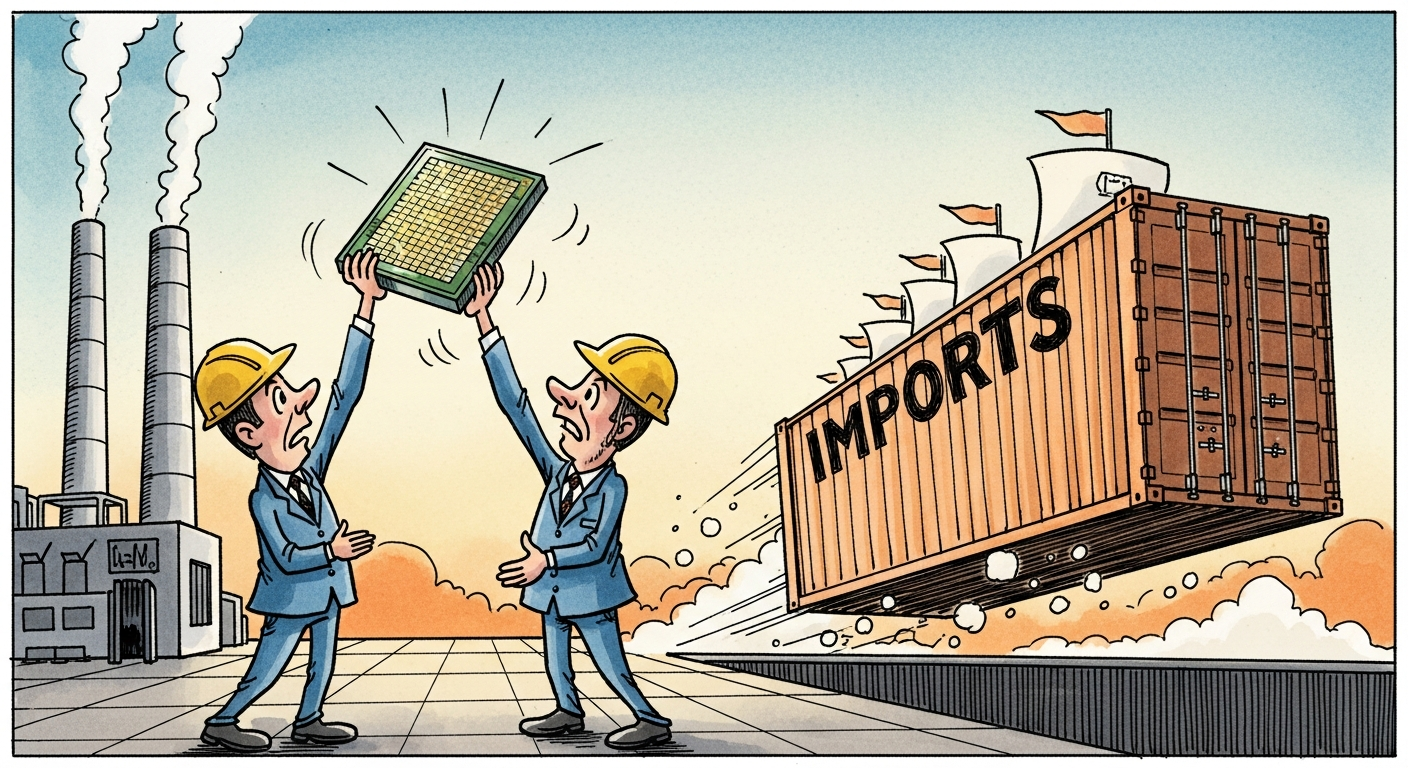
Every industrial policy has a moment when the argument ends and the invoice begins. For Atmanirbhar Bharat's loudest test case — semiconductors, the sector three generations of Indian planners announced and none delivered — the moment was a courier packet of electrical test results this week: 25 wafers from Dholera's risk-production lot, within tolerance, on a fab that broke ground twenty-six months ago.
The sceptics' catalogue was reasonable, once. India cannot do fabs (Dholera's clean-room certified in nineteen months). Cannot hold delivery schedules (two Tejas Mk1A squadrons stood up in eleven months; the Mk2's supply chain is contracted before first flight). Cannot export defence goods (₹30,000 crore this year, a naval laser marketing itself at a Quad exercise). Cannot build at altitude (see this month's certificates at 13,700 and 15,800 feet). The catalogue survives now mainly as nostalgia.
What changed was never slogans — it was procurement as industrial policy. Emergency wartime orders that went to Indian lines first. Production-linked incentives that paid on output, not intention. The Japan corridor's financing structured around technology transfer with localisation schedules in the contract, not the press release. And the unfashionable discipline of second orders: the 97 additional Mk1As, the fab's anchor customers signed before the first wafer, the pipeline that tells a supplier base the demand is real.
Honesty requires the asterisks: the fab's 400 process tools include zero Indian ones — yet; the fighter flies on an American engine — until the Bengaluru line runs. Self-reliance is a gradient, not a switch.
But gradients have direction, and this one's is no longer debatable. The import reflex — the fifty-year default that anything sophisticated ships from elsewhere — died quietly this week, at 28 nanometres, in Gujarat.