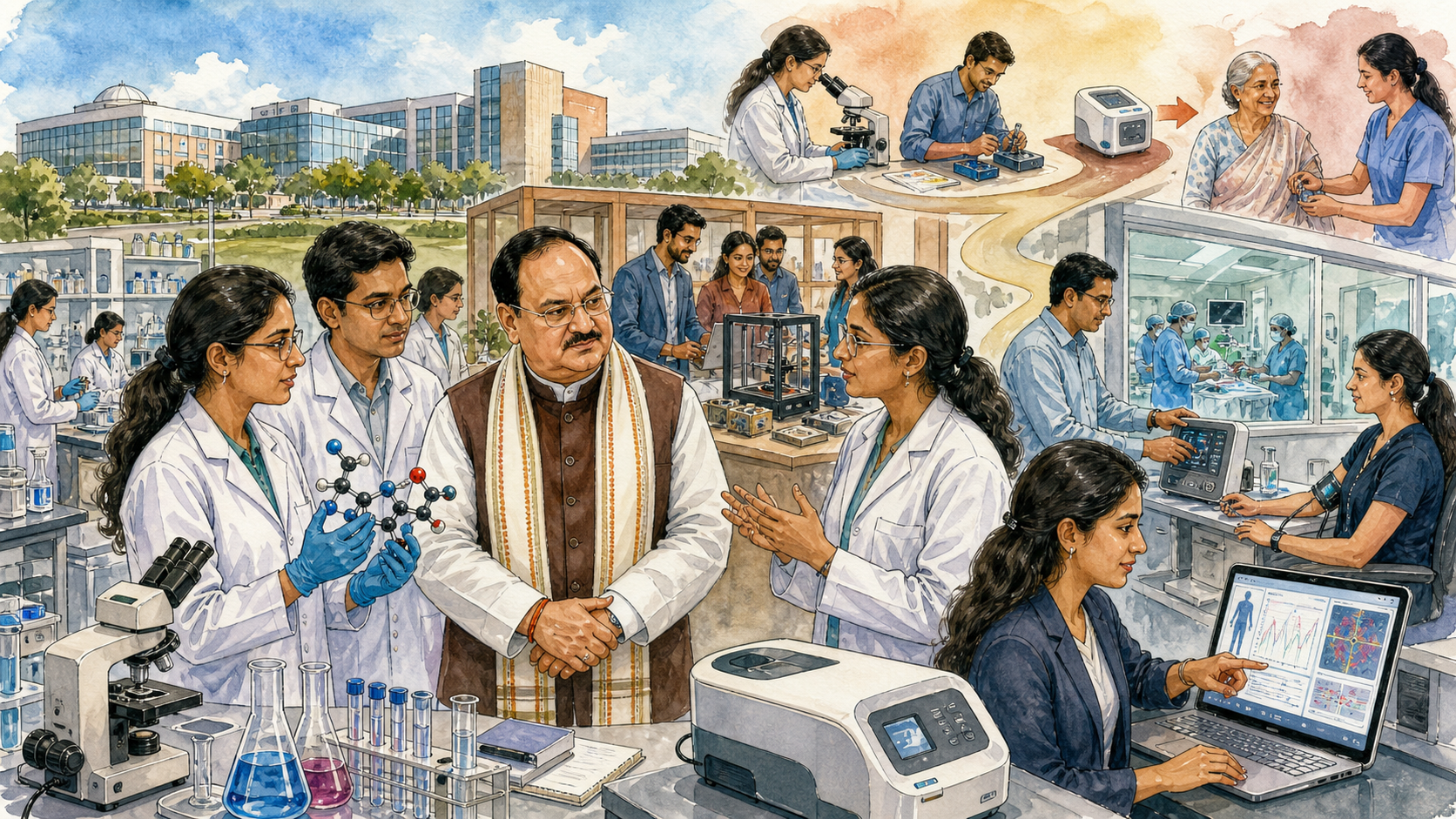
India is a pharmaceutical manufacturing power, but the next strategic leap is to originate more medicines, platforms and medical devices. The Department of Pharmaceuticals has opened the second call for applications under the Promotion of Research and Innovation in Pharma and MedTech scheme, backed by an overall outlay of ₹5,000 crore. The design matters because it addresses the difficult distance between a promising experiment and a product that can be safely manufactured, regulated and used.
The 28 August announcement creates two application tracks. Early-stage projects from startups and MSMEs can move technologies at readiness levels one, two or three toward a level not beyond five, with assistance up to ₹5 crore per project. Later-stage projects beginning at levels four, five or six can seek support up to ₹100 crore, capped at 35 per cent of the approved project cost, with the applicant funding the remainder.
Funding the risky middle
The structure recognises that research risk changes over time. At the beginning, a small team may have a scientific insight but limited resources for validation. A concept-note stage can reduce the burden of preparing a full proposal before basic eligibility and merit are assessed. At later stages, costs rise sharply because prototypes, quality systems, trials, manufacturing design and regulatory work become necessary. Requiring co-funding at that point ensures that applicants share commercial risk.
Public money should not replace private investment. It should make technically important projects possible where uncertainty is too high for conventional finance but the potential public benefit is substantial. Clear milestones are essential. Each grant should specify what evidence, prototype performance or validation result is expected before the next tranche is released.
The priority areas reflect real needs
PRIP covers new chemical and biological entities, complex generics and biosimilars, precision medicine, medical devices, orphan drugs and products addressing antimicrobial resistance. The medical-device category includes AI and machine-learning systems, software as a medical device, genetic diagnostics, surgical robotics, telemedicine tools and novel in-vitro diagnostics.
This breadth is valuable, but evaluation must remain specialised. A molecule, an AI diagnostic and a surgical robot have different evidence requirements. Review panels need scientific, clinical, engineering, regulatory and commercial expertise. Conflict-of-interest declarations and documented scoring will be important because public support can materially change a company’s prospects.
From paper selection to working infrastructure
Funding alone will not create innovation. Startups need access to laboratories, biobanks, test facilities, hospital partners and regulatory guidance. The seven National Institutes of Pharmaceutical Education and Research can serve as anchors, while programmes such as MedTech Mitra and Patent Mitra can help teams navigate validation and intellectual property. These services should be linked to projects from the beginning rather than introduced after technical choices are fixed.
Procurement is another missing bridge. A safe, effective Indian device may still struggle to secure its first credible customer. Public hospitals can support carefully designed pilots with transparent performance criteria, independent evaluation and no compromise on patient safety. Successful pilots should generate evidence that private hospitals and export markets can trust.
Regulation is part of innovation
Fast development does not mean weak scrutiny. In health technology, quality and safety are competitive advantages. Project teams should engage regulators early, understand data requirements and build manufacturing traceability into the design. For AI-enabled devices, evaluation must address bias, changing data and performance across populations. For antimicrobial-resistance products, stewardship considerations are inseparable from market success.
Failed projects should also yield knowledge. Not every ambitious idea will work, and a research programme that reports only success may be selecting projects that are too safe. PRIP should permit responsible failure while requiring teams to document results so public investment improves the wider ecosystem.
Manufacturing readiness deserves attention from the first grant review. A prototype built with rare imported components may prove a concept but remain impossible to produce affordably. Teams should identify supply-chain risks, quality-control methods and scale-up partners early. For MedTech in particular, service networks, calibration and clinician training are part of the product. A device that works in a demonstration but cannot be maintained in a district hospital has not completed the innovation journey.
Measure invention, not announcements
The scheme’s performance should be tracked through technical milestones, patents with real value, regulatory submissions, products manufactured in India, clinical adoption and export readiness. Grant counts and sanctioned amounts are inputs. The outcome is a technology that solves a health problem reliably and affordably.
India’s established strength in generics gives it manufacturing depth, scientific talent and global credibility. PRIP can help convert those advantages into original intellectual property and patient-centred products. The second call is therefore an industrial-policy test as much as a research programme. If selection is rigorous, facilities are accessible and regulation is engaged early, ₹5,000 crore can do more than finance laboratories. It can help India move from being indispensable to global medicine supply toward becoming indispensable to the next generation of medical invention.
