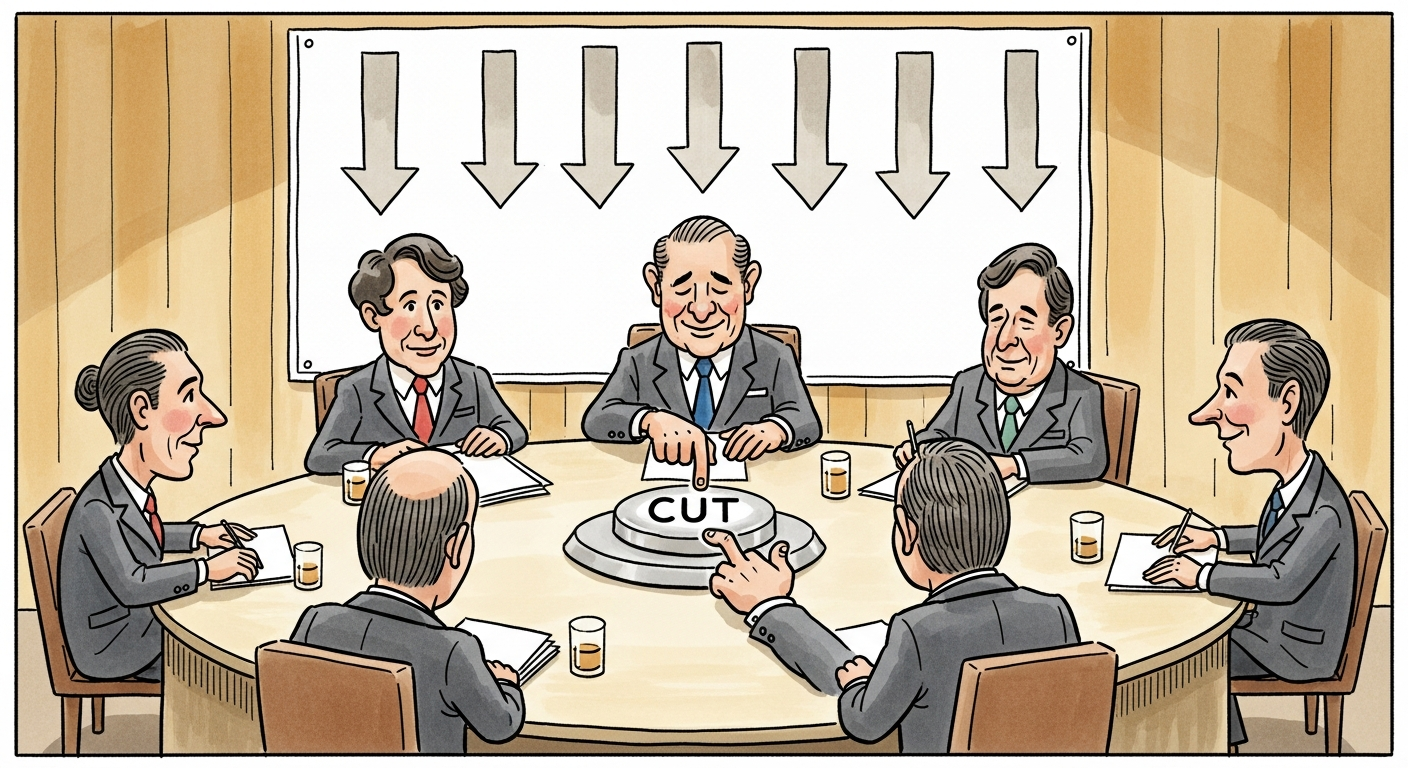
Monetary policy committees are meant to arrive at decisions, not carry them in, but the Reserve Bank's rate-setters walk into this week's meeting with a case that has largely assembled itself. Every material data point since the June review has pointed in the same direction, and the committee's genuine debate is less about whether to ease than about how loudly to signal that more easing may follow.
Start with the mandate variable. Headline inflation printed at 3.9 percent, comfortably inside the tolerance band and below the midpoint the committee treats as its true target, with the composition as reassuring as the level: food prices softening on a benign monsoon, fuel cheap after the oil-war quarter unwound, and — the detail the doves have waited three years for — rural inflation running below urban for a third consecutive month, the signature of a wage-price balance finally tilting toward wages rather than against them.
Then the transmission worry, historically the committee's best reason to hold. The fear that a cut merely pads bank margins instead of reaching borrowers weakens sharply when deposit costs have already peaked on their own, and the opening bank results said exactly that: net interest margins holding as deposit competition crests, credit growing at 16 percent, asset quality boring in the way banking prizes most. A rate cut delivered into a system whose funding costs have topped out is a cut that transmits, not one that evaporates.
The credit-demand worry dissolves at the same 16 percent. A central bank eases to stimulate borrowing that is otherwise too weak; it does not usually need to stimulate borrowing already running in the mid-teens. That inverts the ordinary logic and turns the meeting's hardest question around: not "will a cut revive demand" but "is demand already strong enough that a cut risks overheating." The answer the data supports is that with inflation this soft, the economy can absorb the support — but it is the more serious version of the debate, and the committee's honest members will have it.
The external account, which has vetoed more than one plausible cut in the past, is quiet for once. The continuity premium that global money has priced into Indian assets, the record investment quarter, and a September tax reset the markets have chosen to read as pro-growth all mean the rupee is not the constraint it has sometimes been. A committee easing into a stable-currency, strong-inflows environment faces none of the defend-the-exchange-rate pressure that has forced hawkish holds before.
What is left to decide, then, is the framing. A 25-basis-point cut is close to consensus in the swaps market, which moved the probability past eighty percent within an hour of the bank results. The live question is the stance and the language: does the committee cut and signal patience, banking the move and waiting to see the GST transition land before promising more, or does it cut and open the door explicitly, telling markets the easing cycle has further to run? The first is prudent; the second is what a committee confident in its inflation read would do.
The one genuine flag in the data is the RBI's own long-standing discomfort with unsecured retail credit, growing faster than the committee would like. That is a macro-prudential concern, addressable with targeted risk weights rather than a policy-rate hold, and it argues for a cut paired with a supervisory word rather than a cut withheld. Reading the composition of that credit growth in the remaining bank calls is the analytical work worth doing this week; the direction of the rate itself is nearly settled.
There is an external dimension the domestic data understates. Rate-setters everywhere read one another, and a cut delivered while the major central banks hold or ease at their own pace carries currency and capital-flow consequences a purely domestic reading misses. India's committee has the unusual luxury this cycle of easing without fear of punishing the rupee, because the policy-continuity premium and the investment inflows have given the currency a cushion earlier easing cycles lacked. That luxury is itself an achievement worth naming — the reward for a stability that lets monetary policy act on the domestic economy without one eye permanently on the exchange rate. Committees in less fortunate positions cut into currency weakness and pay for it in imported inflation; this one cuts into currency strength, which is the difference between a forced move and a chosen one.
Committees are supposed to deliberate, and this one will. But the data has done most of the deliberating already, and the meeting's real product will be the sentence about what comes next, not the decision about what comes now. We will parse both — the number and the language — the moment they land, on our economy desk.



