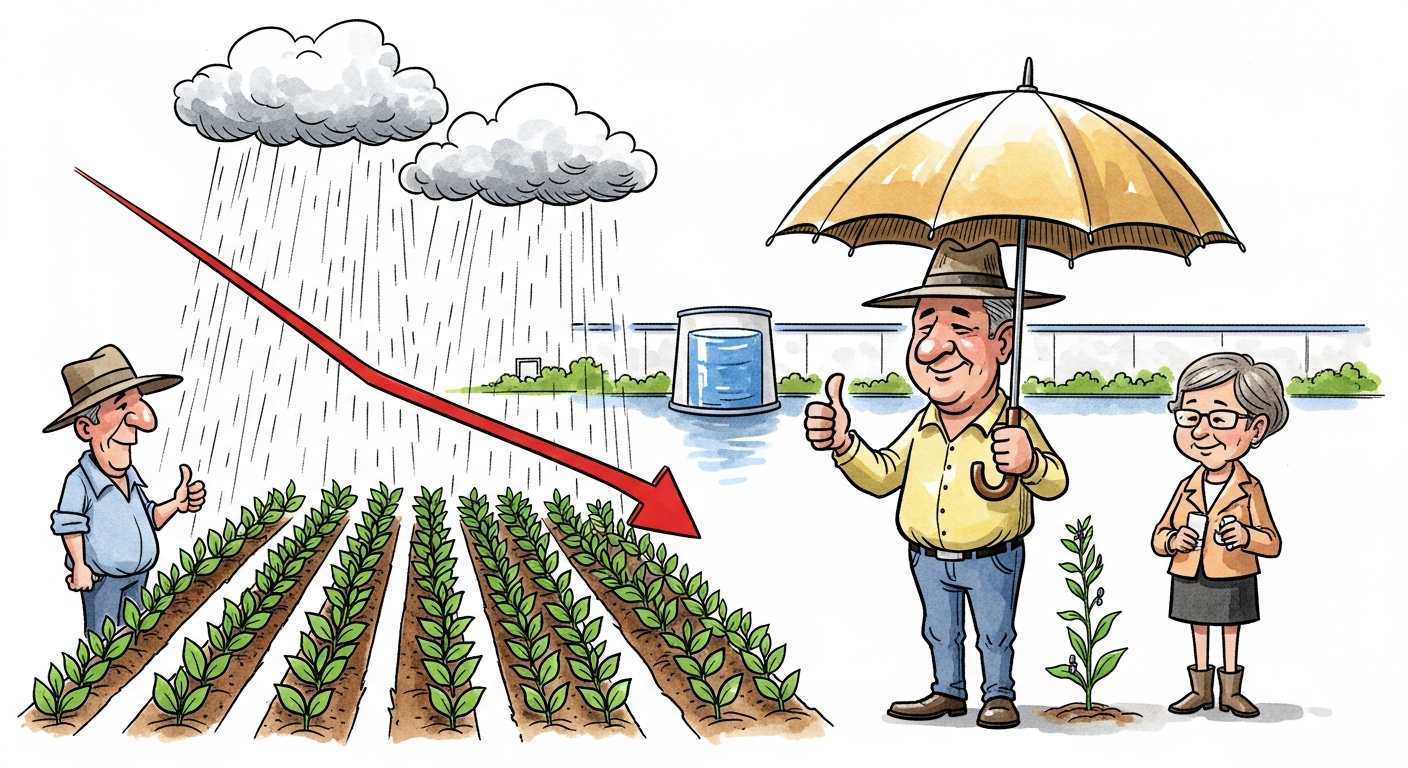
The single most powerful variable in India's inflation arithmetic is neither the central bank nor the tax code — it is the rain, and this year the rain is behaving. Kharif sowing is running ahead of last year across the major crops, reservoir levels are filling close to schedule, and the food-price outlook that drives so much of the headline number has softened into the kind of quiet that macro managers pray for and rarely receive.
The acreage data is broad rather than narrow, which is what makes it reassuring. Sowing is up not in one favoured crop but across the staple grid — the pulses and oilseeds whose price spikes have historically done the most political damage, the coarse cereals that anchor rural consumption, and the rice acreage that underwrites the buffer stocks. Broad-based sowing spreads the weather risk that concentrated sowing multiplies; a good monsoon that fills one crop's fields and starves another's can still produce a price shock, but this year's distribution is unusually even.
The reservoir picture matters as much as the sowing, because it prices the next season before this one is harvested. Storage filling on schedule means the rabi crop that follows has the irrigation base it needs, which means the food-price relief is not a one-quarter reprieve but a two-season outlook. Markets and rate-setters read reservoir data precisely because it forecasts further than the field does, and the rate committee sitting this week has that forward comfort factored into its inflation view.
The composition of the relief carries a political dividend the government will not leave on the table. Softening food prices with firm rural wages is the combination that turns the terms of trade toward the farmer — the producer gains on volume and steady realisations while the consumer gains on price, a rare alignment that lets a government claim to have served both halves of a constituency that usually pulls in opposite directions. That rural inflation is running below urban for a third month is the statistical signature of this alignment, and it is doing real work in the household economics of exactly the last-mile districts the welfare machinery is targeting.
None of this is guaranteed to hold, and honest agricultural economics refuses to celebrate a harvest before it is in. The monsoon's second half can undo its first — a dry August, a flood at the wrong moment, a pest cycle that the acreage data cannot see — and the flood risk on the eastern rivers that ran through the sowing season is a reminder that "ahead of last year" in July is a promise, not a delivery. The reservoirs de-risk the outlook; they do not remove the risk.
The downstream links are worth tracing because agriculture is never only about agriculture. A soft food-price outlook is the permission slip for the monetary easing the data otherwise supports, the input into the consumption revival the September reset is betting on, and the rural-demand foundation under the festival stocking surge that corporate India has staked inventory on. When the monsoon behaves, it does not deliver one good number; it underwrites a whole quarter's worth of them, which is why the sowing data reads as more consequential than its modest headline suggests.
What the season has bought, above all, is optionality. A government and a central bank facing a benign food outlook have room to make choices — to cut, to spend, to reform — that a food-price spike would have foreclosed. That room is the monsoon's real gift, and it is worth more than any single crop's yield because it is the thing that lets policy act on the rest of the economy without one eye permanently on the price of onions.
There is a distributional question the aggregate acreage hides. A good harvest is unambiguously good for the consumer, but for the farmer it can cut both ways — abundance depresses the price the producer receives unless procurement and support mechanisms hold the floor. The season's real test of policy is therefore not the sowing number but the procurement response: whether buffer operations and support prices arrive in time to ensure a bumper crop rewards the grower rather than punishing him for growing it. A monsoon that fills the fields and empties the farmer's returns is a political problem wearing an economic success's clothes, and the rural-household economics the welfare machinery is trying to strengthen depend as much on the price the farmer gets as on the price the shopper pays. The abundance is welcome; the question is who captures its value.
The rain has kept its half of the bargain through July. The harvest keeps or breaks the promise through October, and we will be tracking the acreage into the reservoirs and the reservoirs into the price data, on our economy desk.