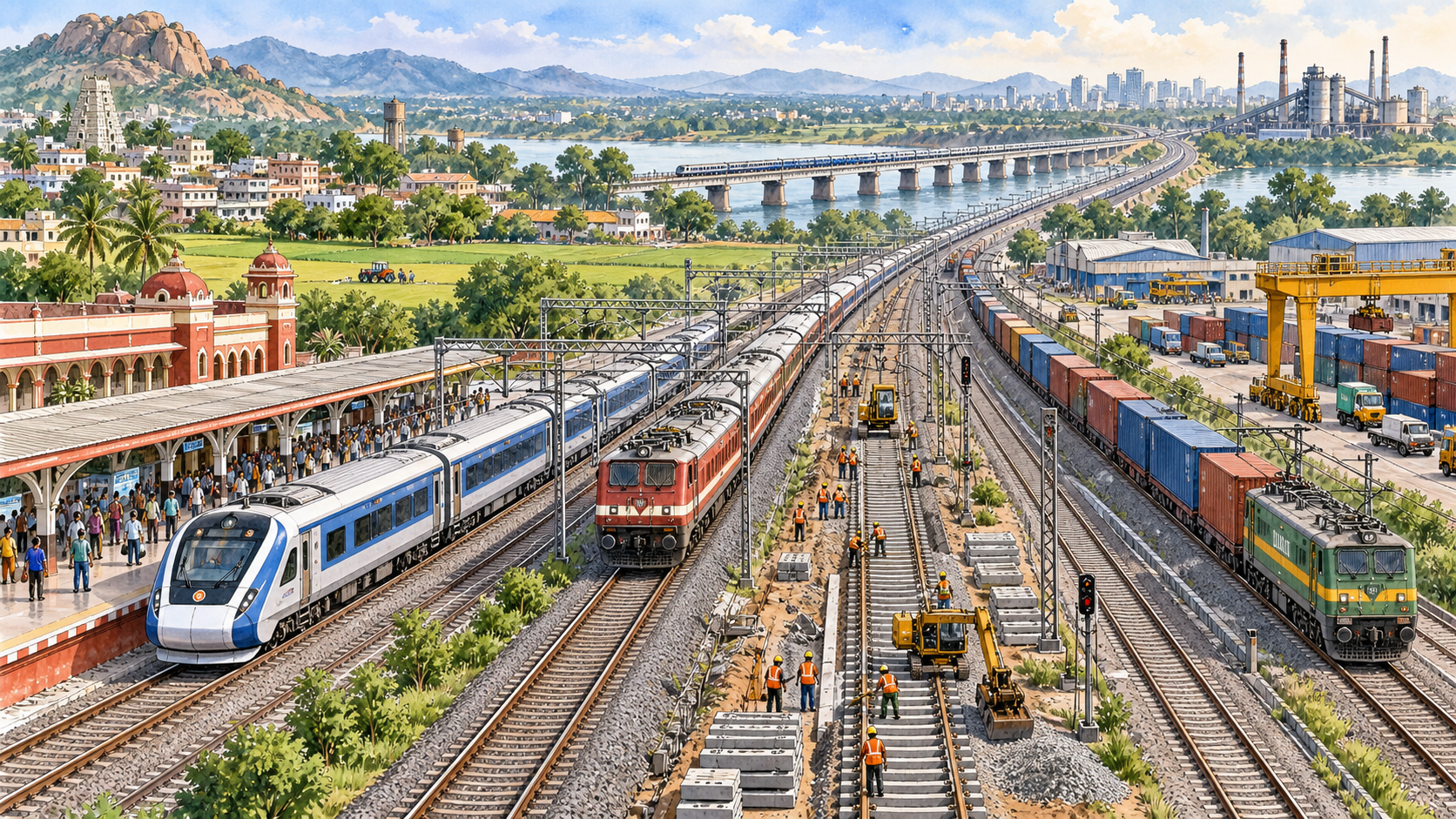
The Union Cabinet has approved one of the largest railway capacity packages of the year: eight multitracking projects worth about ₹20,804 crore, adding roughly 1,196 kilometres across nine states. The decision covers 31 districts and two broad economic geographies. Five projects expand busy routes in Tamil Nadu, Andhra Pradesh, Karnataka and Telangana, while three strengthen corridors through West Bengal, Jharkhand, Odisha, Madhya Pradesh and Chhattisgarh.
This is not 1,196 kilometres of an entirely new railway route. It is additional capacity on existing corridors through third lines, fourth lines and doubling. That distinction explains why the investment matters. India already has extensive railway reach; the constraint on many strategic routes is that passenger trains, bulk freight, container traffic and local services compete for a limited number of paths. Multitracking attacks that bottleneck directly.
Eight projects, one capacity strategy
The government's southern package includes the Arakkonam–Renigunta third and fourth lines, Whitefield–Bangarapet third and fourth lines, Hosur–Omalur doubling, Salem–Karur–Dindigul doubling and multitracking between Secunderabad's Ghatkesar and Kazipet. Together, these projects add around 540 kilometres at an estimated cost of ₹10,021 crore.
The eastern and central package adds about 656 kilometres for ₹10,783 crore. It includes a fourth line between Kharagpur and Jharsuguda, a fourth line from Katni to Pendra Road and a third line between Bilaspur's Uslapur and Pendra Road. These routes carry coal, cement, iron, steel and other industrial traffic while also serving passenger demand. Both packages are targeted for completion by 2029–30.
Combined reporting puts the reach at about 6,911 villages and nearly 11 million people. The projects are expected to support an additional 74 million tonnes of freight annually. Those numbers are projections, not completed outcomes, but they provide clear benchmarks against which execution can be judged.
Reliability is the economic dividend
A manufacturer values a dependable arrival window as much as a higher top speed. When a freight train waits for passenger traffic, factories carry more inventory, ports receive uneven flows and logistics firms build delay into prices. Extra tracks allow dispatchers to separate different speeds and service patterns. Passenger punctuality can improve while freight operators receive more predictable paths.
The southern routes connect manufacturing belts, technology centres, automobile clusters, agricultural regions and pilgrimage destinations. The eastern routes serve India's mineral and industrial heartland. Better capacity can therefore reduce costs across supply chains rather than benefiting a single commodity or city. It also creates room for future passenger services without simply shifting congestion elsewhere.
Gati Shakti must show up on the ground
The projects have been planned under the PM Gati Shakti National Master Plan, which is intended to coordinate rail, road, ports, industrial nodes and utilities through shared spatial planning. Its success will be visible in practical details: whether terminals have good road access, whether land acquisition is synchronised, whether power and signalling upgrades arrive with civil works, and whether state agencies resolve crossings and local access early.
The environmental case is also significant. Government estimates for the two packages point to lower oil consumption and carbon emissions as more freight shifts from road to rail. These benefits depend on actual modal shift, not only the construction of track. Tariffs, terminal efficiency and door-to-door reliability must make rail commercially attractive to shippers.
Publish the delivery dashboard
The Modi government's infrastructure record has made scale a central feature of economic policy. The next improvement should be equally strong public measurement. Each project can have a quarterly dashboard reporting land availability, physical progress, expenditure, commissioning milestones and emerging risks. After completion, the dashboard should track average speed, route capacity, punctuality and incremental freight.
Construction discipline will matter because these are live corridors, not empty greenfield sites. Blocks for engineering work must be planned without creating prolonged disruption, and bridges, signalling, electrification and station remodelling have to advance in sequence. Local consultation can resolve access and drainage concerns before they become costly disputes. Finishing by 2029–30 will require the same coordination that justified approving the projects as a single network package.
The combined approval is important because it treats railway modernisation as a network problem. Dedicated freight corridors create high-capacity spines; multitracking removes pressure from the feeder routes that connect factories, mines, cities and ports to those spines.
The headline is 1,196 kilometres. The real national gain will be measured in trains that arrive when promised, factories that hold less idle inventory, passengers who lose fewer hours and goods that reach markets at lower cost. If execution matches approval, this package will strengthen the everyday reliability on which a competitive Indian economy depends.



