Introduction: Reengineering the Architecture of Public Purchasing
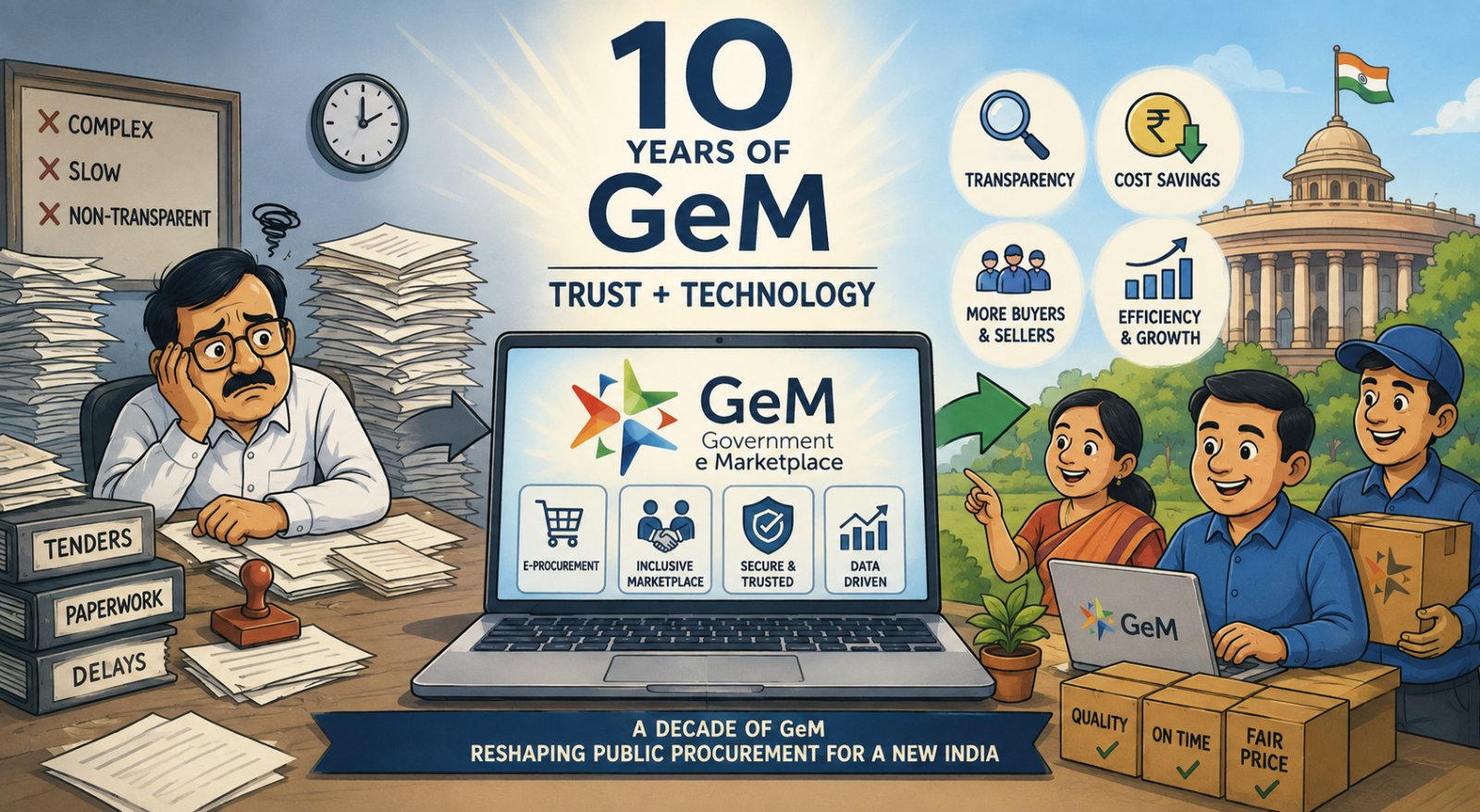
On August 9, 2016, India embarked on an ambitious structural reform in public governance by launching the Government e-Marketplace, known universally as GeM. Conceived to dismantle an antiquated, paper-heavy, and discretionary procurement framework, the digital platform was designed to establish a transparent, paperless, cashless, and contactless national marketplace. Ten years later, in August 2026, GeM stands as one of the largest digital transformation projects in public finance worldwide. What began as an experimental digital portal replacing the century-old Directorate General of Supplies and Disposals has fundamentally altered how federal, state, and institutional entities acquire goods and services.
As the platform marks its tenth anniversary, official performance indicators reveal a dramatic shift in scale. GeM has facilitated a cumulative Gross Merchandise Value exceeding twenty trillion rupees through more than thirty-seven million fulfilled orders. Beyond the sheer headline metrics, the platform's trajectory provides a case study in institutional trust-building. In an economy where public procurement accounts for a substantial percentage of national gross domestic product, transitioning from fragmented administrative tenders to an algorithmic marketplace represents a pivotal evolution in state-market relations.
The Velocity of Scale: From Incremental Growth to Exponential Adoption
The most striking aspect of GeM's decade-long evolution is the non-linear acceleration of its transaction volume. During its inaugural fiscal year of 2016–17, the portal recorded a modest annual Gross Merchandise Value of 4.22 billion rupees. For several years, adoption grew steadily as buyer departments adapted to mandatory procurement rules under General Financial Rule 149 and sellers learned to navigate digital cataloguing. However, the platform reached a dramatic tipping point in recent years. While it took more than eight years for GeM to achieve its first ten trillion rupees in cumulative procurement volume, the subsequent ten trillion rupees was added in less than two years.
Annual transacted value has now stabilized above five trillion rupees in consecutive financial years, specifically FY 2024–25 and FY 2025–26. Momentum has continued unabated into the current financial period, with the platform recording 1.47 trillion rupees in transaction value during the first four months of FY 2026–27 alone. Chief Executive Officer Mihir Kumar noted that this compounding trajectory reflects a fundamental shift in behavioral trust across the administrative apparatus. When buyers realize that competitive pricing is available instantly and sellers recognize that order allocation is governed by objective algorithms rather than personal patronage, network effects take over.
This expansion in monetary volume matches an exponential increase in institutional participation. Over the past decade, the number of primary buyer organizations registered on the platform expanded from 1,707 to over 137,000. On the supply side, profile-completed seller accounts surged from a baseline of 3,339 in 2016 to 2.54 million by mid-2026. This vast digital directory spans virtually every economic sector, covering everything from routine office stationery and computational hardware to complex industrial machinery, medical equipment, and specialized technical consultancies.
Democratizing the Public Ledger: Inclusivity for Small Enterprises
Prior to the digital unification of government buying, public tenders were largely the domain of well-capitalized corporate entities and established contractors equipped with dedicated tender-management teams. Smaller enterprises, rural artisans, and early-stage ventures were frequently excluded by geographic barriers, onerous earnest money deposits, and complex physical documentation requirements. A central objective of GeM was to level this playing field by standardizing tender specifications and lowering entry barriers for micro and small suppliers.
Data from the Ministry of Commerce and Industry demonstrates significant structural progress toward this objective. The number of registered Micro and Small Enterprises on GeM has grown from 2,424 in 2016 to 1.22 million in 2026. Crucially, these small entities are not merely passive listings on a digital registry; they represent a dominant share of actual procurement activity. Micro and Small Enterprises have secured orders worth over 9.07 trillion rupees on the portal, accounting for approximately 45.6 percent of the cumulative transaction volume recorded over the past ten years.
"The true benchmark of a national digital public infrastructure is not simply total commercial volume, but its capacity to grant equal economic opportunity to the smallest producer in a distant district," remarked a senior policy analyst at the National Institute of Public Finance and Policy. "GeM's greatest institutional achievement is converting administrative demand into a direct catalyst for micro-enterprise growth."
Targeted policy interventions have further widened access for underrepresented economic groups. Platform initiatives designed to support female entrepreneurs have enabled over 224,000 women-led micro and small enterprises to fulfill upwards of five million orders valued at more than 991 billion rupees. Similarly, early-stage technology companies have gained direct access to institutional buyers; more than 42,000 recognized innovative startups have secured government contracts totaling over 656 billion rupees. Furthermore, integration with rural local administration frameworks has allowed rural local councils to procure directly from neighborhood suppliers, embedding digital commerce into sub-district economies.
Quantifying Efficiency: Fiscal Savings and Social Dividends
Beyond empowering small business ecosystems, the platform was tasked with reducing public expenditure through transparent price discovery and streamlined administrative workflows. In traditional procurement models, fragmented purchasing across hundreds of government departments resulted in significant price variance for identical off-the-shelf products, alongside high administrative overhead costs per transaction.
An extensive independent evaluation conducted by the Indian Institute of Technology Delhi, covering the period from FY 2023–24 through FY 2025–26, provided empirical validation of these efficiency gains. The study estimated that GeM generated a direct monetized benefit of 865.71 billion rupees through combined price discovery and process efficiencies over the three-year evaluation window. Taking into account reduced procurement lead times, lowered paperwork expenses, and broader economic multiplier effects, the study calculated a total net social saving of 1.76 trillion rupees.
To evaluate price competitiveness, researchers conducted a comparative audit of 101 standard commercial items listed on GeM against leading private commercial e-commerce platforms. The findings revealed that GeM offered lower prices for 74.3 percent of the benchmarked items. By aggregating demand across government departments and enforcing transparent dynamic pricing through reverse auctions and direct purchasing thresholds, the platform has consistently curtailed inflated supplier margins in public buying.
Persistent Friction Points: Working Capital, Dispute Resolution, and Bureaucratic Hurdles
Notwithstanding these remarkable quantitative benchmarks, an objective examination of India's public procurement landscape reveals persistent structural friction points. The platform's rapid expansion has surfaced operational vulnerabilities that challenge both buyers and suppliers, demanding continuous policy intervention.
Chief among vendor grievances is the chronic issue of delayed working capital cycles. Although platform guidelines stipulate that buyer organizations must release payments within ten days of goods acceptance, execution on the ground remains inconsistent. Small suppliers, operating on thin margins without large credit lines, frequently report delayed payments from state government departments and municipal bodies. While GeM has instituted penal interest clauses for delayed disbursements, enforcement against defaulting administrative authorities remains difficult for small vendors who fear damaging future business relationships.
"Accessing the public procurement marketplace has become significantly easier, but managing cash flow remains a daily struggle," explained a regional director of a micro-manufacturers association. "When a government department delays payment for six months, the interest cost consumes our entire operating margin. Technology has solved the market access problem, but institutional payment discipline has not fully caught up."
Quality assurance and catalog clutter represent another significant operational challenge. With millions of product listings, buyer departments sometimes struggle with inconsistent product descriptions, unauthorized brand tagging, and discrepancies between catalog specifications and delivered goods. When quality disputes arise, the resolution mechanism can become bogged down in administrative back-and-forth, tying up caution money deposits and delaying project execution.
Furthermore, small vendors face an increasingly complex technical compliance burden. Periodic regulatory updates—such as mandatory Aadhaar-linked mobile verification, multi-tiered caution money deposit structures, and strict technical document validations—are intended to eliminate fraudulent accounts. However, for micro-entrepreneurs in lower-tier towns with limited digital literacy, these evolving compliance rules create operational friction and require external technical assistance.
Disparities in adoption across different levels of government present a final structural challenge. While federal ministries, defense establishments, and central public sector enterprises have integrated their procurement systems tightly with GeM, adoption among state governments, municipal corporations, and autonomous bodies remains uneven. Certain states have embraced the platform fully, transacting tens of thousands of orders annually, whereas others continue to rely on localized offline tenders or regional portals, limiting the seamless creation of a unified national market.
The Next Horizon: Artificial Intelligence and Algorithmic Governance
As GeM enters its second decade, platform administrators and policy architects are focusing on moving beyond basic transactional digitisation toward intelligent procurement management. The future roadmap centers on harnessing large-scale transactional data to build predictive governance systems.
The next phase of platform engineering aims to integrate artificial intelligence and machine learning models to enhance market integrity and operational efficiency. Predictive algorithms are being deployed to monitor bidding patterns in real time, identifying potential cartels, dynamic price manipulation, and unnatural bidding behaviors before contracts are awarded. Automated price reasonableness engines will assist buyer officers by benchmarking requested prices against historical trend lines, global commodity indices, and commercial market rates.
Simultaneously, platform developers are focusing on improving the user interface through natural language processing tools, making search capabilities more intuitive for non-technical buyers and regional sellers. Automated catalog management systems using image recognition technology are being rolled out to verify product authenticity and suppress duplicate or misclassified listings.
On the policy front, administrative reforms are being refined to address payment delays. Proposals under consideration include integrating GeM directly with central bank digital payment gateways and automated treasury systems, enabling conditional escrow mechanisms that release funds automatically once a digital delivery acceptance certificate is issued.
Conclusion: Institutionalizing Trust in the Public Economy
Ten years after its inception, the Government e-Marketplace has fundamentally altered the paradigm of public buying in India. By replacing fragmented administrative discretion with a standardized, technology-driven platform, GeM has demonstrated that digital public infrastructure can clean up public spending while fostering economic inclusion.
The achievement of twenty trillion rupees in cumulative procurement volume is a testament to the power of systemic reform. Yet, the ultimate test of GeM's maturity in its second decade will not be measured solely by transacted value. It will depend on its ability to resolve operational friction—ensuring prompt payments for small suppliers, maintaining rigorous quality controls, and convincing state and local governments to fully embrace unified digital buying. If these structural challenges are met with the same adaptive spirit that marked its first decade, GeM will continue to serve as a vital engine for economic governance and inclusive enterprise growth.



