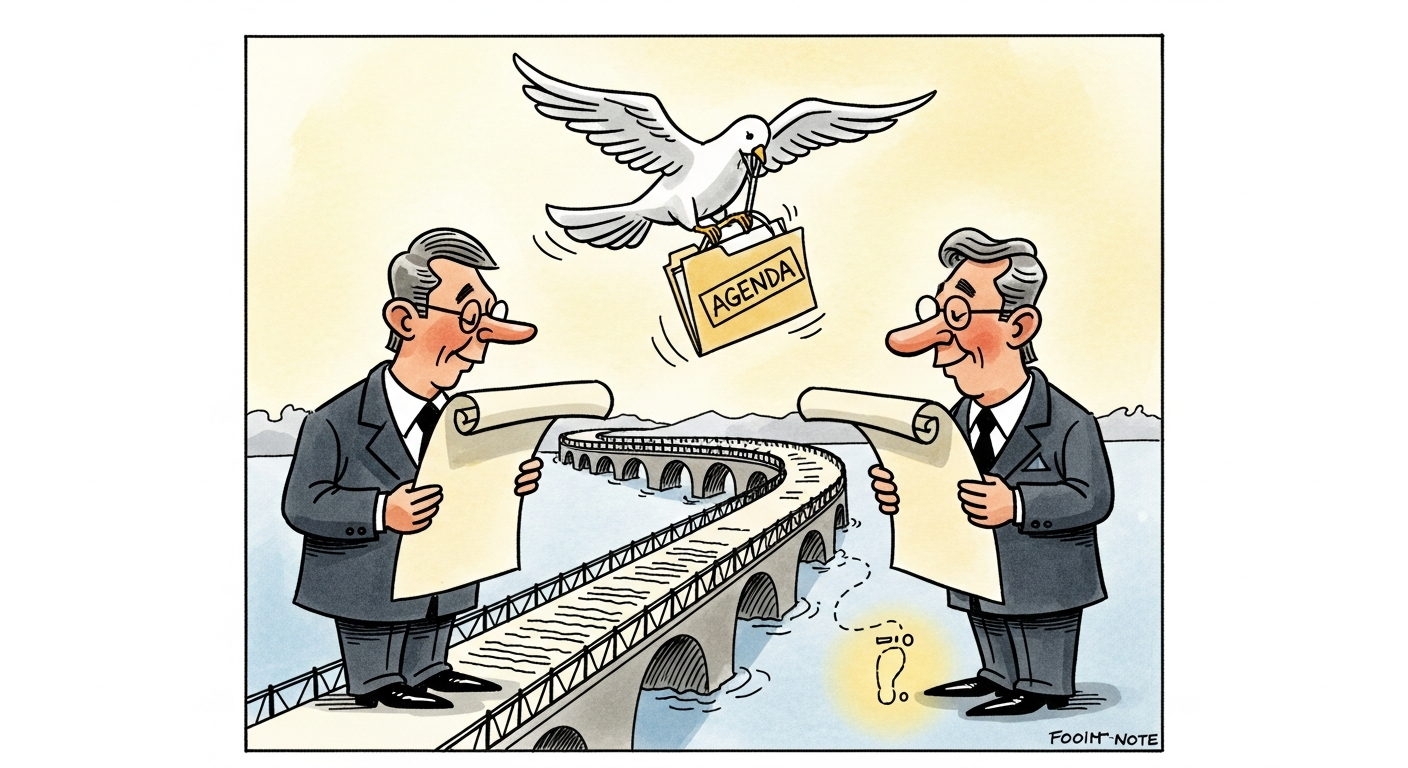
Diplomatic agendas are written to be read twice — once for what they contain and once for the order in which they contain it — and the September agenda the Muscat process published this week rewards the second reading more than the first. The sequence tells the story: confidence-builders the parties can actually deliver come first, the genuinely hard files come second, and the word the whole region is watching for appears exactly once, in a footnote, which is the most carefully chosen location in the document.
The opening items are the achievable ones, and their placement is not modesty but method. A prisoner-and-detainee file — humanitarian, legible, and the kind of exchange that produces photographs of families rather than concessions of principle — leads the agenda because negotiations build the trust to solve hard problems by first solving easy ones together. The verification cell that convened last month, the ceasefire's first working institution, is the template being applied: prove the machinery works on a tractable file before loading it with an intractable one.
The middle of the agenda is where the real weight sits: the second phase of the shipping-and-energy corridor arrangement, the mechanism that turned a chokepoint into a managed passage and that the energy-diplomacy ledger has been quietly pricing ever since. Phase two moves from incident-avoidance to something closer to routine — scheduled transits, shared monitoring, an insurance regime that treats the corridor as ordinary commercial water rather than a war-risk exception. That the parties can even negotiate phase two is the clearest sign that phase one held.
And then the footnote. "Normalisation" — the word that would transform a ceasefire into a settlement and a settlement into a realignment — appears once, at the bottom, in the conditional and the deniable. Its placement is the entire message. A word in a footnote is a word being tested for the temperature of the room: present enough to signal that the parties are willing to imagine the destination, buried enough that neither has to defend having said it out loud. Diplomats call this "putting a word on the ice to see if it cracks," and the crisis-to-management arc of the past two quarters is what made even a footnoted mention thinkable.
India's stake in the sequence is direct and material, not abstract. The corridor's phase two prices the shipping lanes that carry the discounted barrels underwriting the soft fuel inflation at home, and the insurance markets that noticed the verification cell's first success before the newspapers did will reprice again on a credible phase-two framework. A ceasefire that acquires routine is worth more to an importing economy than one that merely holds, because routine is what lets shippers and insurers plan rather than hedge.
The reasons for caution are structural and should temper any optimism. Footnotes are not treaties, agendas are not outcomes, and the history of the region is littered with September agendas that did not survive their own October. The verification machinery is weeks old and untested against a genuinely contested incident rather than the mechanical-failure case it handled cleanly; a single attributable strike during the corridor's phase-two talks could send the whole sequence back to competing press conferences. The process has momentum, but momentum in this region has a short half-life.
What the agenda demonstrates, whatever September delivers, is that the parties have learned to build institutions rather than merely declare intentions. An incident cell, a verification protocol, a phased corridor, a sequenced agenda — these are the unglamorous machinery of a peace that is being engineered rather than proclaimed, and engineered peace, whatever its pace, is more durable than the proclaimed kind. The footnote is a bet that the machinery can eventually carry the word.
The footnote also has an audience beyond the two parties, and both know it. A Gulf that stabilises itself through its own machinery — an incident cell, a verification protocol, a phased corridor — is a Gulf less dependent on external security guarantees, and that quiet shift toward regional self-management is the larger current the September round rides. India's stake in that current is direct: a self-stabilising Gulf protects the energy corridor and the remittance economy without requiring India to choose sides among larger powers, which is precisely the outcome its diplomacy has worked toward. The footnote, read at this scale, is not just a test of whether two adversaries can imagine normalisation — it is a marker of whether the region can author its own security, which would be the most consequential development of all, and the one India would least like to see reversed.
The agenda is published and the sequence is set. Whether the footnotegraduates to a paragraph is the question September answers, and we will be reading every round of it — and every repricing it triggers — on our world desk.



