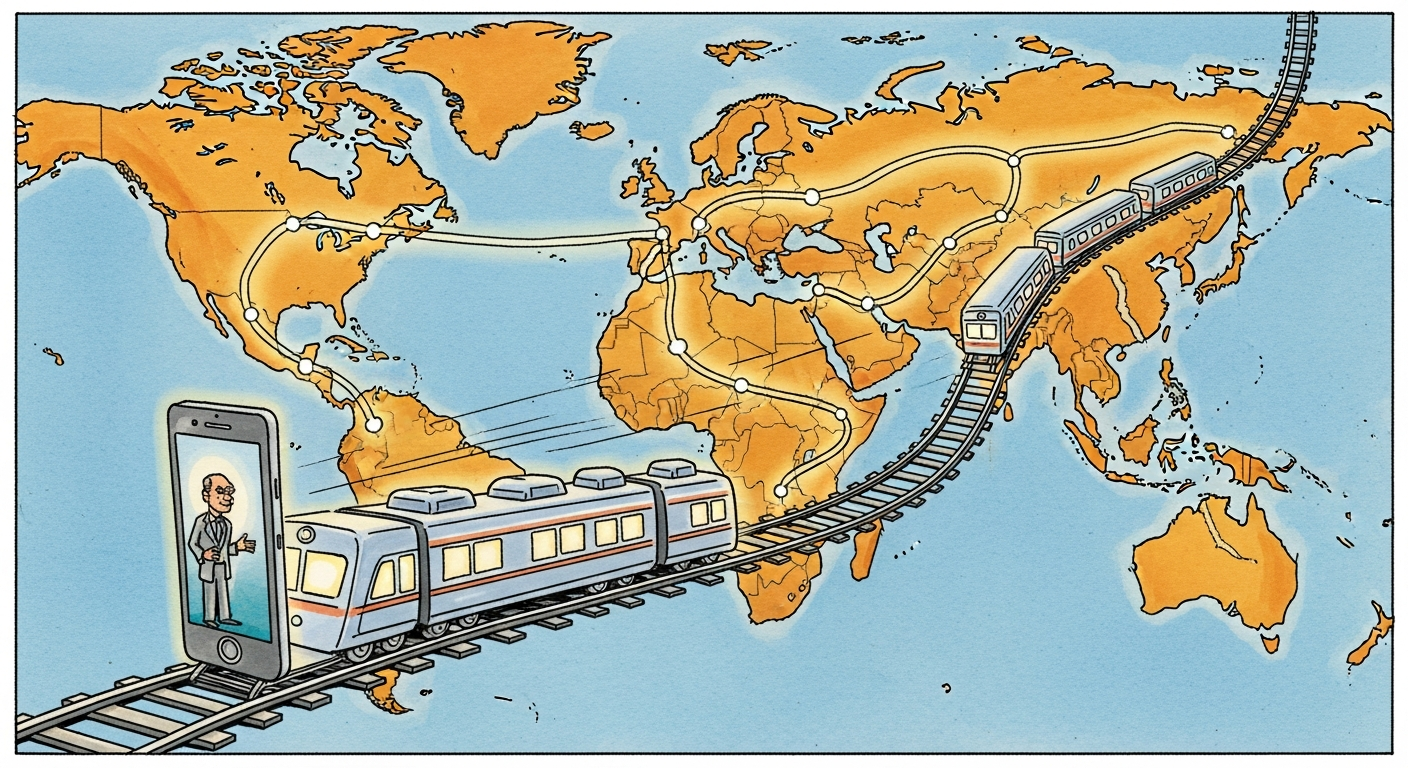
The eighth country went live on the UPI cross-border network this week, and the milestone is not the country — it is the eight. A single foreign integration is a pilot; a handful is a promising experiment; but eight live corridors is the number at which a payment rail crosses the line from something a country is trying to something a country can be planned around. UPI abroad has stopped being a demonstration and started being infrastructure, and that transition changes what the rail is worth.
The distinction matters because infrastructure and experiments are used differently. Merchants integrate with a rail they expect to persist; banks build products on top of a network they believe will still be there next year; travellers and traders change their default behaviour only once a system has proven it is not a pilot that might be switched off. Each new live corridor lowers the threshold for the next — partners join networks that already have members, and the remittance-cost collapse that the flagship corridors delivered is the proof of value that makes the ninth and tenth integrations easier to negotiate than the first.
The strategic design behind the expansion is legible in the choice of corridors. The network has grown along the geographies where it does the most work: the remittance corridors that carry money home to the source districts, the tourism corridors that let Indian travellers pay as they do at home, and the trade corridors where settling in real time beats the correspondent-banking delay. This is not integration for its own sake; it is a rail being extended precisely to the places where a real-time, low-cost alternative to the legacy system has the highest return, which is why the diplomacy behind it reads as economic policy rather than technology showcase.
India's larger play here is to export the model, not just the rail. Digital public infrastructure — a payment layer that is a public good rather than a private toll road — is a genuinely distinctive thing to have built, and every country that adopts a UPI-compatible system is a country whose payments architecture bends toward India's standards rather than away from them. That is soft power of an unusually concrete kind: not a summit communiqué but a settlement layer, and the predictability that makes global capital comfortable in India is the same quality that makes a foreign central bank comfortable connecting its payments to an Indian rail.
The frictions of cross-border expansion are real and worth naming without alarm. Each corridor carries its own regulatory, anti-money-laundering and settlement-risk questions, and a rail that grows faster than its compliance machinery is a rail that invites exactly the scrutiny that could slow it. The data-protection regime maturing at home is part of the answer — a credible privacy framework is what lets a foreign regulator trust the rail with its citizens' transaction data — and the two stories are more connected than they appear: the payments network's international credibility rests partly on the enforcement template the data board just wrote.
There is also the discipline of not over-claiming. Eight corridors is infrastructure, but it is early infrastructure, and the volumes on some of the newer integrations are still thin enough that they prove the plumbing works without yet proving it will be heavily used. The meaningful question for the next year is not how many flags are on the map but how much value flows across the corridors already lit — whether the eighth country becomes a busy corridor or merely a live one. Coverage is easy to announce; usage is what compounds.
What the eighth integration confirms is that the network effect has taken hold. A rail that partners now join because other partners are already on it is a rail that has escaped the gravity of the pilot phase, and escaping that gravity is the hardest thing any network does. The map will keep adding coasts, and each new one is cheaper to add than the last — which is the definition of infrastructure that has begun to build itself.
There is a contest underneath the corridor count that rarely makes the announcements. Payment rails are becoming instruments of standards competition, and every country that adopts an interoperable, publicly-owned model is a country whose financial plumbing tilts away from the private, toll-taking networks that dominated the last era. India is not the only actor building cross-border rails, and the race is less about which network is largest than about whose standards become the default in the geographies still deciding. The predictability India offers is a genuine competitive asset here — a foreign central bank connects its citizens' payments to a partner it expects to behave consistently — but the window is open, not permanent, and the eighth corridor matters partly because each early adoption makes the standard harder to dislodge later. Infrastructure, once chosen, is sticky by design, and stickiness rewards whoever arrives first.
The rail is real now, not experimental, and the next chapter is depthrather than breadth. We will be tracking the volumes as closely as the flags — usage is the number that matters — on our tech desk.