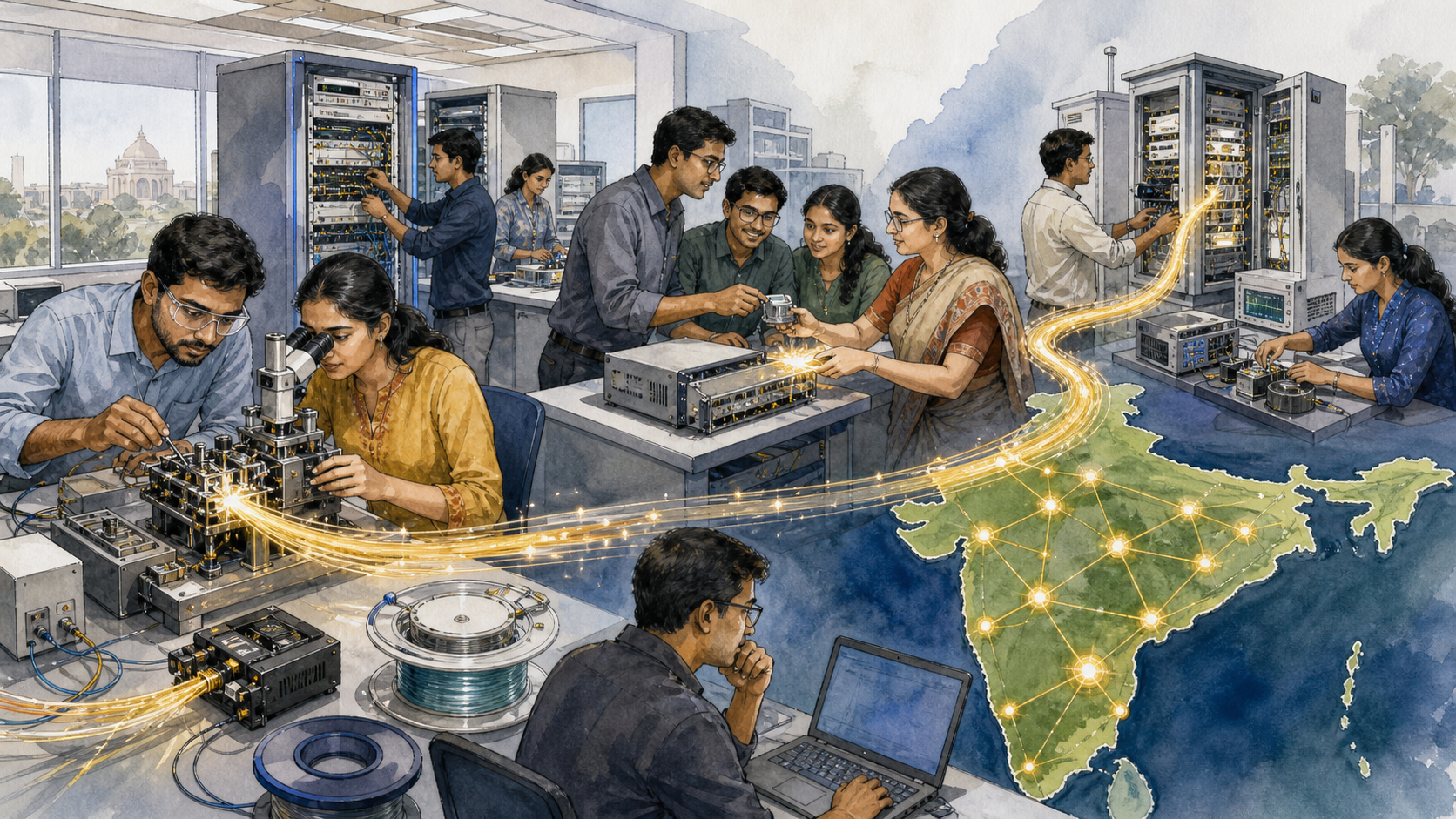
A telecom product can work perfectly on a laboratory bench and still fail when connected to a real network. Traffic loads vary, equipment from different suppliers must interoperate, software updates create unexpected behaviour and security requirements grow stricter. India’s new end-to-end optical network testbed at the C-DOT campus in New Delhi is designed for this difficult space between invention and deployment.
The Department of Telecommunications and the Centre for Development of Telematics signed a five-year agreement for the shared facility on 27 August. The publicly funded testbed will combine optical-core systems, access networks, quantum-security technologies and advanced measurement equipment. Startups, researchers, students and established companies are expected to use it for testing, validation, training and commercialisation.
Shared infrastructure solves a real bottleneck
High-end telecom testing is expensive. A startup developing one component cannot reasonably purchase every network element and measurement instrument required to simulate national-scale use. Without access to such facilities, teams may discover interoperability or performance problems only during a customer trial, when failure is costly and credibility is at risk.
A shared testbed spreads that infrastructure cost across an ecosystem. It can allow an optical module, network-management system or security product to be tested against realistic conditions before procurement. The value is not a certificate alone; it is the engineering feedback that helps a team correct weaknesses while the design can still change.
End-to-end must mean interoperable
The phrase end-to-end is important. Modern networks are assembled from layers: fibre and optical transport, switching, access equipment, control software, monitoring and security. Indigenous products will succeed only if they communicate with each other and with standards-compliant equipment already deployed. The facility should therefore support multi-vendor scenarios and publish clear interface requirements.
Testing should include capacity, latency, reliability, power use, recovery after failure and resistance to attack. Quantum-security components require especially disciplined evaluation because impressive demonstrations do not automatically translate into manageable field systems. Claims should be verified under repeatable conditions.
A five-year structure creates accountability
The blueprint divides the project into a two-year setup phase and a three-year operations-and-maintenance phase. The first period will assemble core, access, quantum-security and third-party measurement capabilities. The second is intended for sustained maintenance, technical support and educational outreach. This separation is sensible because a laboratory is not complete when equipment is installed; it becomes valuable when users can access it reliably.
Utilisation should be a public performance measure. The facility should report the number and type of users, testing time, repeat usage, technologies improved and products that move into trials or procurement. Commercial confidentiality can be protected while aggregate outcomes remain transparent.
Access rules will determine success
Startups need predictable booking, affordable fees and rapid onboarding. If access requires months of paperwork, the companies most in need of the facility may stay away. A published service catalogue, standard test packages and technical consultation before booking can make the testbed usable. Academic researchers may require a separate route for exploratory work that is not yet product-ready.
Independent governance is equally important. C-DOT brings field-ready products and deep expertise, but the shared resource must evaluate outside technologies fairly. Test methods, conflict safeguards and data-handling rules should be explicit. Vendors should know which results remain private and which benchmarks are required for a formal validation report.
The testbed should connect with actual network operators without allowing one operator’s architecture to define the entire programme. Controlled field trials can expose installation, maintenance and environmental issues that laboratory simulation misses. Feedback from rural fibre deployments, dense urban networks and enterprise systems would make validation more representative. A product that survives only one ideal configuration is not yet ready for India’s varied operating conditions.
Skills are a strategic output
India needs engineers who understand optical systems as integrated networks rather than isolated components. Hands-on access can train students and professionals in instrumentation, fault diagnosis, standards and security. Structured fellowships with universities and startup teams can turn the testbed into a talent pipeline as well as a product facility.
Regional workshops and remote access to selected instruments could widen participation beyond New Delhi. The best ideas may emerge from campuses and firms that cannot repeatedly send teams to the capital. An outreach calendar, travel fellowships and partnerships with regional laboratories would ensure that a national resource develops a genuinely national user base.
This matters for technological self-reliance. Domestic manufacturing without domestic design and validation remains dependent on outside road maps. A national facility can help Indian teams learn faster, contribute to standards and build products suited to the scale, climate and operating conditions of Indian networks.
The C-DOT agreement is a modest-looking institutional step with potentially large consequences. It does not guarantee that every prototype will reach the market, nor should it. Its purpose is to expose weaknesses early, improve engineering quality and give credible technologies a fairer path to deployment. In advanced telecom, the difference between a laboratory claim and a trusted product is evidence. This testbed can become the place where Indian innovation earns that evidence.