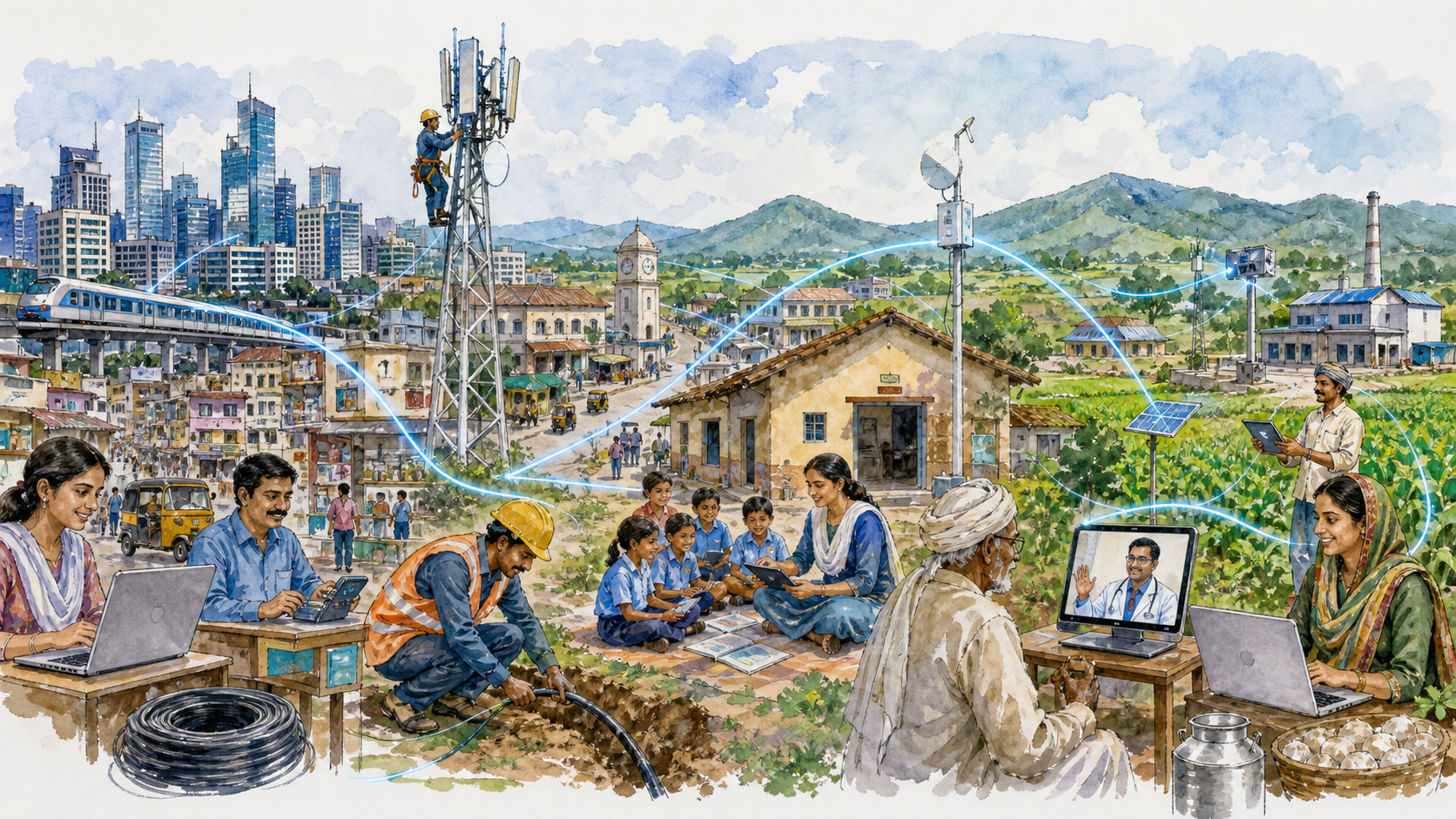
India ended July 2026 with more than one billion broadband subscriptions even after excluding machine-to-machine cellular connections. Including those connections, the total reached 1.094 billion. The country added 6.2 million telephone subscriptions during the month, taking the total to 1.354 billion. Scale is no longer the central question for Indian connectivity. Quality, affordability and meaningful use are.
The official telecom data, compiled from service-provider submissions, show 796.68 million urban and 557.59 million rural telephone subscriptions. Overall tele-density including machine connections was 94.68 per cent. Urban tele-density stood at 154.12 per cent, reflecting multiple subscriptions, while rural tele-density was 61.05 per cent.
A subscription is not the same as a connected person
Individuals may use several SIMs, while families may share one device. Machine connections add further complexity. Subscriber counts are essential for network planning but cannot alone measure universal access. Surveys should examine who can reliably use broadband, on what device, at what speed and for what share of household income.
Gender, disability, language and digital confidence shape meaningful access. A signal may be present while a woman lacks control over the household phone, a student cannot afford enough data for class, or an older person cannot navigate a service. Digital inclusion must be measured through outcomes, not only network registration.
The rural quality gap is now central
Rural subscriptions grew by 1.58 million in July, a positive sign, but density remains far below urban levels. Sparse population, difficult terrain and weaker commercial returns make rural networks more expensive. Fibre backhaul, shared infrastructure, fixed wireless access and reliable electricity all affect performance.
Service maps should report usable speed and uptime, not merely nominal coverage. District-level disclosure can identify recurring congestion and outage zones. Public support for rural rollout should be linked to independently verified service standards and timely repair.
Fixed lines deserve more attention
India had 48.01 million wireline telephone subscriptions and 48.14 million wireline broadband subscriptions in the reported categories, far below the wireless base. Mobile networks provide extraordinary reach, but fibre and other fixed connections offer stable capacity for businesses, schools, hospitals, data centres and dense households.
Right-of-way coordination, common ducts and faster local approvals can reduce the cost of extending fibre. Apartment buildings and commercial areas need fair infrastructure access so consumers can choose providers. Competition at the last mile improves both price and reliability.
Portability shows an active market
Nearly 15.98 million subscribers submitted mobile-number-portability requests during July. That volume indicates that users value the ability to change providers without losing their number. Porting acts as a competitive discipline when the process is quick and consumers have genuine alternatives.
Regulators should study why people port: price, coverage, service quality or complaint handling. Aggregate reasons can help identify structural problems without exposing personal information. Consumer protection also requires clear billing, simple cancellation and rapid fraud response.
Connectivity must create capability
The strongest return on broadband comes when it improves education, health, commerce and government access. A village connection should support a stable telemedicine consultation, an online examination and a small business payment at peak hours. Networks that work only for light browsing do not meet the needs of a digital economy.
Local-language interfaces, accessible design and community training complement infrastructure. Schools and common service centres can help first-time users learn cybersecurity and recognise fraud. As more essential activity moves online, an unreliable connection becomes a form of exclusion.
Move from coverage to experience
India’s billion-plus broadband scale is a major technological and commercial achievement. The next dashboard should add median speeds, latency, outage duration, complaint resolution and affordability by region. These indicators would shift incentives from selling connections toward maintaining useful service.
Network resilience should be measured during floods, heat waves and power disruption. Emergency services, digital payments and family communication become more important during a crisis, precisely when infrastructure is under pressure. Backup power, diverse fibre routes and rapid-repair arrangements should form part of service-quality planning in vulnerable districts.
Cybersecurity must scale with connectivity. First-time users need simple reporting channels for fraud, while operators and banks need faster coordination when a compromised number is used for impersonation. Security warnings should be available in local languages and designed around actions people can take, not technical language that creates fear without guidance.
Public institutions should publish connectivity performance for schools, health centres and panchayat offices. A village may appear covered on a commercial map while its essential institutions lack dependable capacity. Prioritising these anchor sites can create community value and improve the economic case for surrounding network expansion.
Subscriber growth will continue, especially through connected devices. Policy should not confuse that expansion with the completion of Digital India. The new national benchmark must be whether a rural student, urban enterprise, farmer and patient can depend on the network when it matters. India has built reach at historic scale. The next phase is to make every connection worthy of being counted.