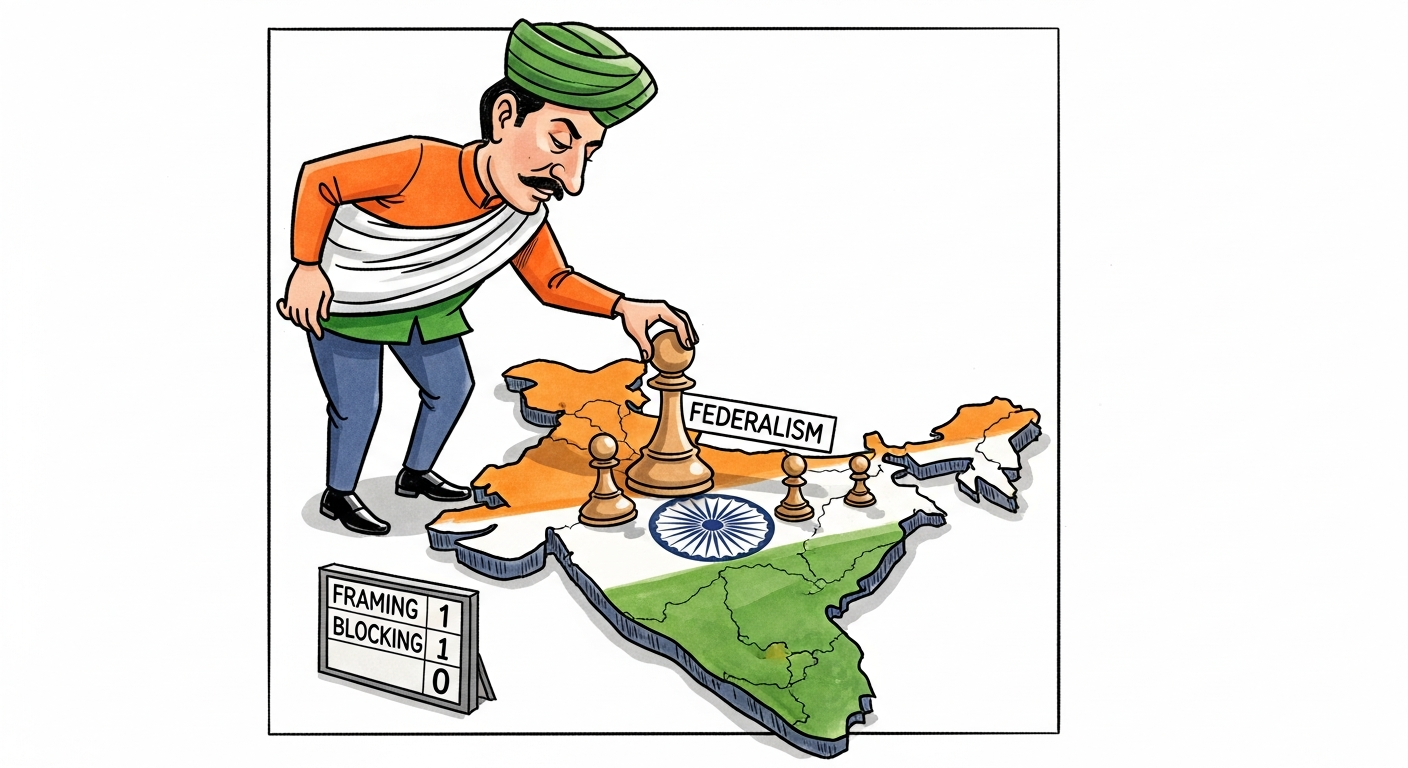
For most of the past year, the opposition's response to delimitation has been a chorus without a conductor — some members warning of a Hindi-belt power grab, others demanding a population freeze, a few flirting with a boycott that never materialised. This week, around the JPC's first evidence session, that noise resolved into a single, disciplined line: not "no," but "not yet, and not this way." It is a markedly better argument than the one it replaces, and the government should treat it as such.
The shift matters because outright obstruction was always going to fail on the merits and the optics both. Delimitation is a constitutional obligation, not a discretionary favour; a party seen to be blocking the periodic redraw of a democracy's own map hands its opponents the cleanest possible framing — that the opposition fears an accurate count. By moving from "no" to "not this way," the bloc trades a losing fight over whether delimitation should happen for a winnable one over how, when, and with what guarantees it happens.
The "not this way" has three concrete demands taking shape. First, a transition formula that caps how fast any state's seat share can fall, so that the states which succeeded most at population control are not punished in a single electoral shock. Second, a linkage — constitutional if possible — between the redraw and a fresh devolution settlement, so that states losing relative parliamentary weight gain compensating fiscal or institutional weight. Third, a demand that the exercise wait for a census whose methodology the opposition has had a hand in scrutinising, which is why the field-manual testimony matters to them as much as to the government.
This is a federalism argument, and federalism is the terrain on which the opposition is strongest and least divided. The economic debate splits the bloc — some of its state governments are enthusiastic reformers, others reflexive sceptics — and the coalition's internal fractures show most on questions of what to do rather than what to resist. But "protect the states" is a banner every regional party can march under without checking who is beside it, which is precisely why the leadership has chosen it.
The government's difficulty is that the federalism frame is not merely tactical; it points at a genuine tension the Constitution never fully resolved. A perfectly population-faithful Lok Sabha rewards demographic size, and the states that delivered on the national family-planning consensus of earlier decades did so on an implicit understanding that they would not later be outvoted for their success. That understanding was never written down, and the opposition's most effective move is to demand that it now be. The case for delimitation as maintenance is sound, but maintenance that redistributes power owes the losers a settlement, and a government that offers none invites exactly this frame.
The risk for the opposition is over-reaching from principle into paralysis. "Not yet" is a respectable position; "not until a list of conditions that can never all be met" is obstruction wearing a federalist costume, and the government will work hard to make the second look like the first. The treasury's floor management has already shown a talent for splitting reluctant allies from outright opponents, and a demand structure that looks like a permanent veto is the easiest thing in the world to isolate.
Where this lands depends on whether either side wants a settlement or a fight. A government confident of the census machinery and secure in its numbers can afford to offer a transition formula and pocket the credit for magnanimity; an opposition confident of its federalism frame can afford to take the formula and claim it as a win it forced. The self-defeating outcome — a redraw imposed without a settlement, resented by a third of the union — is available to both, and serves neither.
The deeper reason the federalism frame lands is that it names a real asymmetry the numbers alone cannot resolve. The states that slowed their population growth did so partly on a national compact — deliver on family planning, and the reward would not be a diminished voice in the union you helped build. No clause ever wrote that compact down, which is exactly why the opposition can now demand that one does. A government that treats the demand as mere obstruction misreads it; a government that treats it as the opening bid in a settlement over transition and devolution turns a grievance into a bargain and pockets the credit for magnanimity. The choice between those two readings is the government's to make, and the tone of its first substantive response — generous or dismissive — will signal which path it has chosen long before any formula is drafted.
The line is drawn now, and it is a smarter line than the one before it. Whether it becomes the basis of a bargain or the trench of a standoff is the story of the session's back half. We are tracking every witness and every walkout on our politics desk.