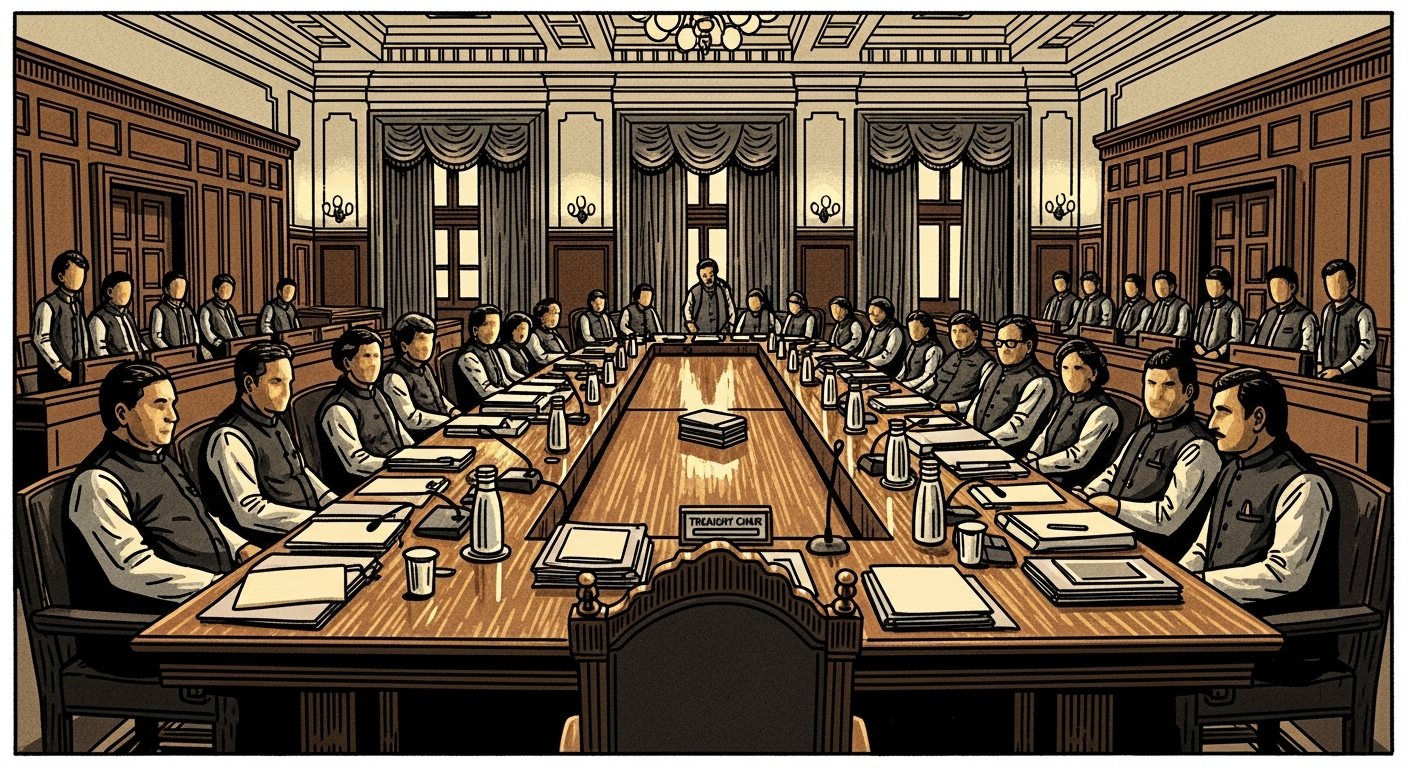
The Speaker on Wednesday notified the composition of the 31-member joint parliamentary committee on the Constitution (133rd Amendment) Bill — twenty-one Lok Sabha members and ten from the Rajya Sabha, chaired by a senior treasury-bench member from Maharashtra, with a report deadline of December 19.
The list's significance is in who accepted. All three southern parties that staged the introduction-day walkout have taken their seats, ending a week of speculation that the committee would begin life boycotted. The DMK's nominee is its sharpest constitutional lawyer; the Congress has sent a former law minister alongside two Lok Sabha members from northern states — the alliance's own hedge against being read as a purely southern bloc.
The committee inherits three questions the House could not settle. Whether the 850-seat expansion's floor clause — no state loses absolute seats — is enough to offset proportional dilution, or whether a weighted-representation formula can be drafted that survives both the basic-structure test and northern-state politics. Whether the women's-reservation schedule attached to the bill becomes justiciable, as the opposition demands, or stays a statement of executive intent. And whether the Rajya Sabha's composition moves in tandem — the demand the Trinamool has made its price.
The arithmetic that shadows the committee is unchanged: the government needs roughly fifty opposition votes to cross two-thirds in the Lok Sabha, and the committee is where those votes will be negotiated line by line. A senior minister described the December deadline as 'realistic if nobody grandstands' — a condition Indian joint committees have historically found challenging.
The first sitting is scheduled for July 28. The committee has resolved, unusually, to publish summaries of evidence it takes — a transparency concession the opposition extracted, and one that will keep the delimitation argument on front pages through the winter.