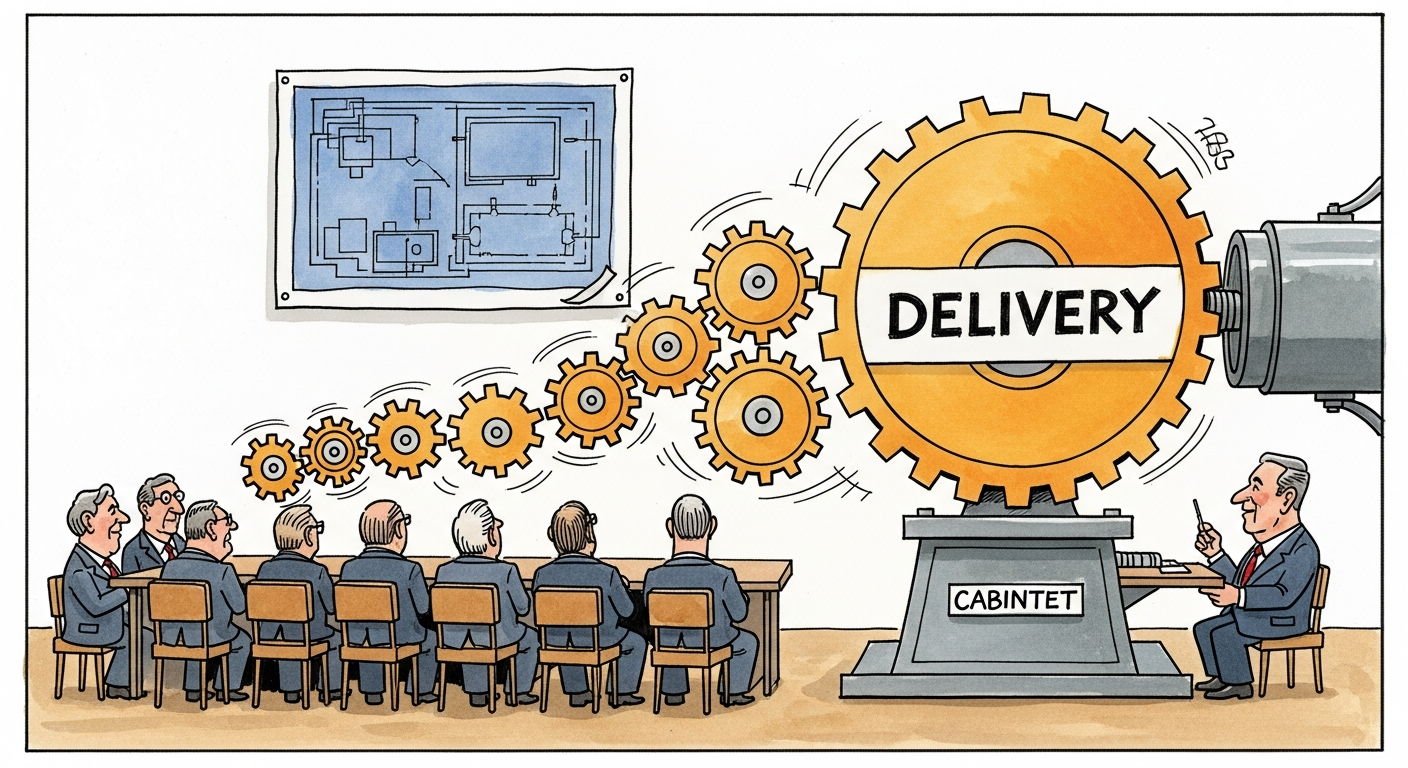
A week after the Bihar cabinet's expansion, the portfolios are out, and the more interesting document is not the list of who got what but the working method it implies. The allocation reads less like the usual arithmetic of caste and coalition — though that arithmetic is present and satisfied — than like an operating manual built around a small number of measurable delivery targets.
The signature of the arrangement is the pairing at the top. The Deputy Chief Minister's economic portfolios are weighted toward the things that show up in a household's month — power reliability, road connectivity, the water-and-sanitation grind — while the organisational spine, the part of governance that decides whether a scheme announced in Patna actually reaches a block office in Purnia, runs through the coordination architecture that the party's twenty-year platform was built to operate. Delivery, in this design, is not a department; it is the gear the other gears turn against.
The portfolio choices tell a story of sequencing. The heavy welfare-delivery ministries went to hands the coalition trusts to move fast and be seen moving, because the first six months of a term are when a government banks the credibility it spends later. The reform-heavy, friction-heavy portfolios — land records, the perennial agony of the state's revenue administration — went to steadier operators expected to grind rather than sprint. It is the difference between the ministries you use to win the argument and the ones you use to fix the plumbing, and a coalition that confuses the two usually loses both.
Bihar's macro backdrop makes the delivery emphasis more than rhetoric. This is a state whose development ceiling has always been set less by resources than by the reliability of the last-mile — the gap between the scheme and the citizen where so much of Indian welfare leaks away. The last-mile-first logic now visible in the LPG rollout is the same instinct the cabinet's structure encodes: measure at the destination, not the announcement.
There is a national subtext, and the coalition is not shy about it. Bihar is being run, quite consciously, as a demonstration model — proof that the governing formula travels, that the same coalition management which holds a thin majority in Delhi can also administer a hard state. Success in Patna is meant to be an argument made elsewhere, and the deliberateness of the operating design reflects an audience larger than the state assembly.
The risks are the familiar ones of coalition governance, and naming them is not cynicism. A delivery-first structure lives or dies on data that is honest, and the temptation to report the target rather than the outcome is oldest in exactly the ministries handed the fast welfare wins. A coordination spine that works when the coalition is fresh can seize when the first real disagreement arrives over a contract or a transfer. The design is sound; the test is whether it survives its first month of friction.
What is genuinely new here is the refusal to treat cabinet-making as merely a distribution of rewards. The portfolios satisfy the coalition's internal claims — they must, or the government does not last — but they are arranged around a small set of things the government intends to be judged on, which is a discipline more cabinets promise than practise. Whether the discipline holds past the honeymoon is the only question that matters, and it is not answerable in week one.
The unglamorous truth beneath the operating manual is fiscal. Bihar's own revenues cannot fund the delivery the cabinet has promised to be judged on, which means the model runs on transfers, central schemes and the borrowing headroom a disciplined budget preserves — and that dependence is the coalition's real constraint, larger than any portfolio dispute. A delivery-first cabinet that cannot finance delivery is a slogan, and the ministries handed the fast welfare wins are precisely the ones whose budgets are most exposed to a weak revenue quarter. The twenty-year platform argument has always rested on the claim that competent administration attracts the investment that widens the fiscal base over time; the cabinet's structure is a bet that the claim still holds. The state's own tax receipts, not the Patna press notes, are the scoreboard that settles whether the bet pays.
The cabinet is seated and the manual is written. The state now finds out whether an operating system survives contact with the state it has to operate. We will be reading the block-office data, not the Patna press notes, on our politics desk.