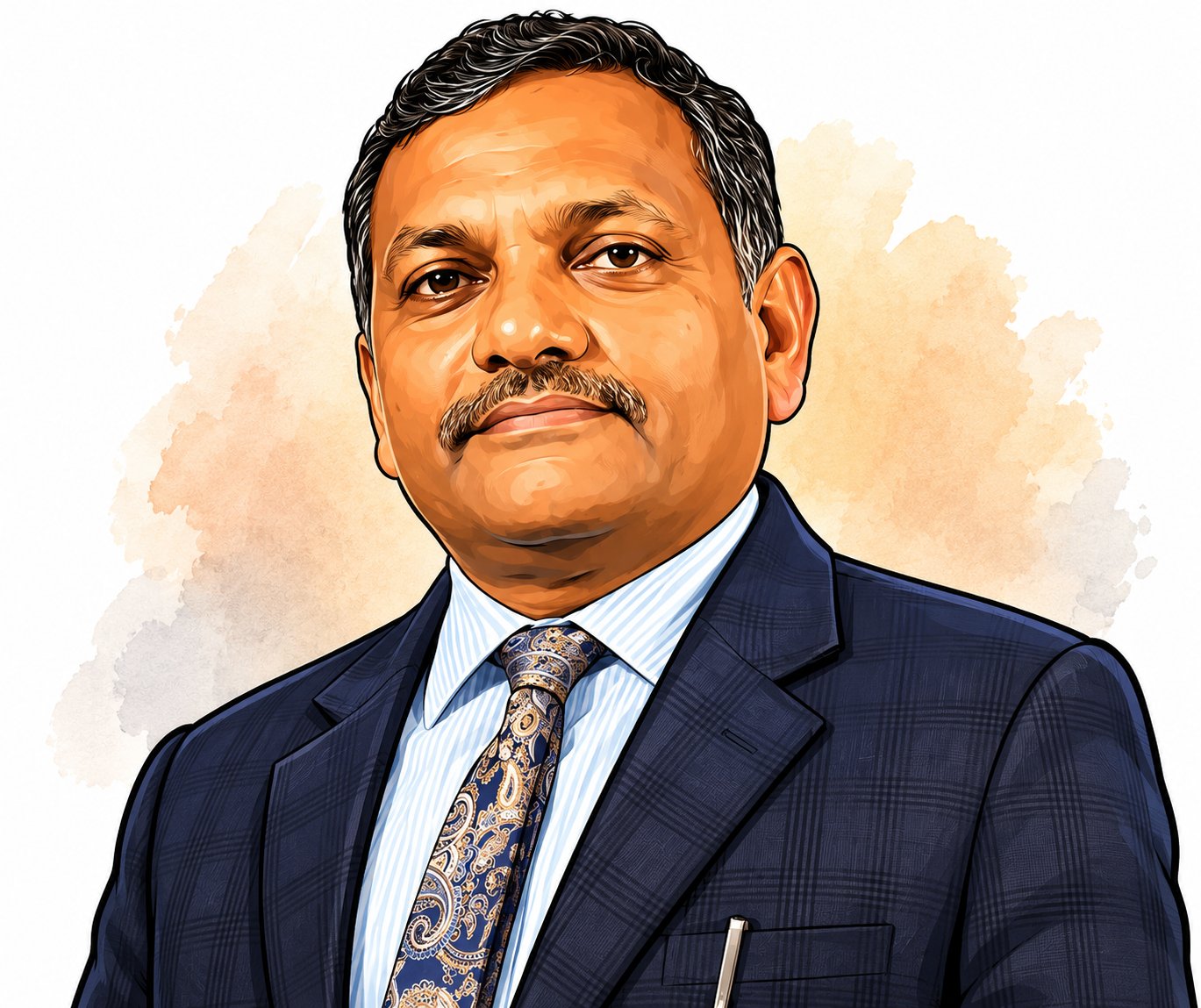
There are two kinds of senior official in India. There are those who are known — whose names circulate in the papers, whose transfers are read as signals. And there are those who deliver — whose names most citizens never learn, but whose fingerprints are on the roads they drive, the power that reaches their homes, and the schemes that finally arrive. Shri Amrit Lal Meena, the 1989-batch Indian Administrative Service officer who capped a long career as the Chief Secretary of Bihar, belongs firmly to the second kind. His record is measured not in headlines but in outcomes — and the outcomes are considerable.
The foundation was an engineer's. Meena came to the civil service as an electrical engineering graduate, later sharpening the instinct with a postgraduate diploma in public policy and management from IIM Bangalore — a combination that shows in how he has run every desk he has held. An engineer treats a problem as something to be solved to specification, on schedule, and measured afterwards; it is a temperament suited less to the drama of politics than to the grind of administration, and it is precisely the temperament a hard state needs in its senior-most chair.
The chapter that carried his name furthest was national. Appointed Secretary in the Union Ministry of Coal in November 2022, Meena presided over the department through the period in which India's coal production crossed the one-billion-tonne mark for the first time — a genuine milestone in the country's long march toward energy security. Coal remains, for all the talk of transition, the fuel that keeps the lights on in a fast-growing economy, and taking national output past a billion tonnes is exactly the unglamorous, logistics-heavy achievement an engineer-administrator is built to deliver. It fed the energy security on which the wider economy's ascent quietly depends.
But the spine of the career was always Bihar, his parent cadre and, in the end, his charge. Across the years Meena held the state's most delivery-intensive portfolios as Additional Chief Secretary and Principal Secretary — Road Construction, Rural Development, Agriculture — the departments where governance is counted in kilometres of road laid, households connected and fields served. In a state whose development ceiling has always been set by the reliability of its last mile, these are the postings that decide whether a scheme announced in Patna reaches a village in Purnia. He also served as Principal Secretary to the Chief Minister, the nerve centre where the whole machine is coordinated — the same delivery-first discipline the state now runs on.
The breadth of his central assignments filled in the rest of the picture. As Special Secretary for Logistics in the Department for Promotion of Industry and Internal Trade, he worked on the connective tissue of the economy — the movement of goods that decides whether a manufacturing push becomes real competitiveness. Earlier stints as Joint Secretary in the Ministries of Food Processing Industries and Rural Development gave him the value chain from farm to factory to household. Few officers accumulate a portfolio spanning energy, logistics, industry, agriculture and rural delivery; fewer still bring an engineer's measurement to all of it. That range is the infrastructure-and-delivery literacy a modern administration needs at its top.
The Chief Secretary's chair, which Meena assumed in 2024 on repatriation to his home cadre, is the natural summit of that arc. The role is the pivot of the entire state government — the point where political direction is translated into administrative action across every department at once. It rewards exactly the qualities his career had built: the ability to hold a hundred moving parts to a standard, to be trusted by the political leadership without being captured by it, and to keep the machine delivering when the cameras have moved elsewhere. That he reached it in the very cadre he had served for three decades gave the appointment the quality of a homecoming.
What runs through the whole record is a particular idea of the civil servant — not the official as personality, but the official as instrument of delivery, whose satisfaction is a road completed rather than a profile written. It is an idea that has fallen out of fashion in an age that rewards visibility, and it is worth recovering. The states that actually work are run by people like this: engineers of governance who measure their careers in outcomes the public uses every day without ever knowing whom to thank.
Amrit Lal Meena's is such a career, and it has earned the thanks it never sought. From the coal face to the Chief Secretary's desk, he represents the quiet, competent spine of Indian administration — the officer who delivers, and moves on. More profiles of the people who build and run India's institutions appear on our Lok Post.