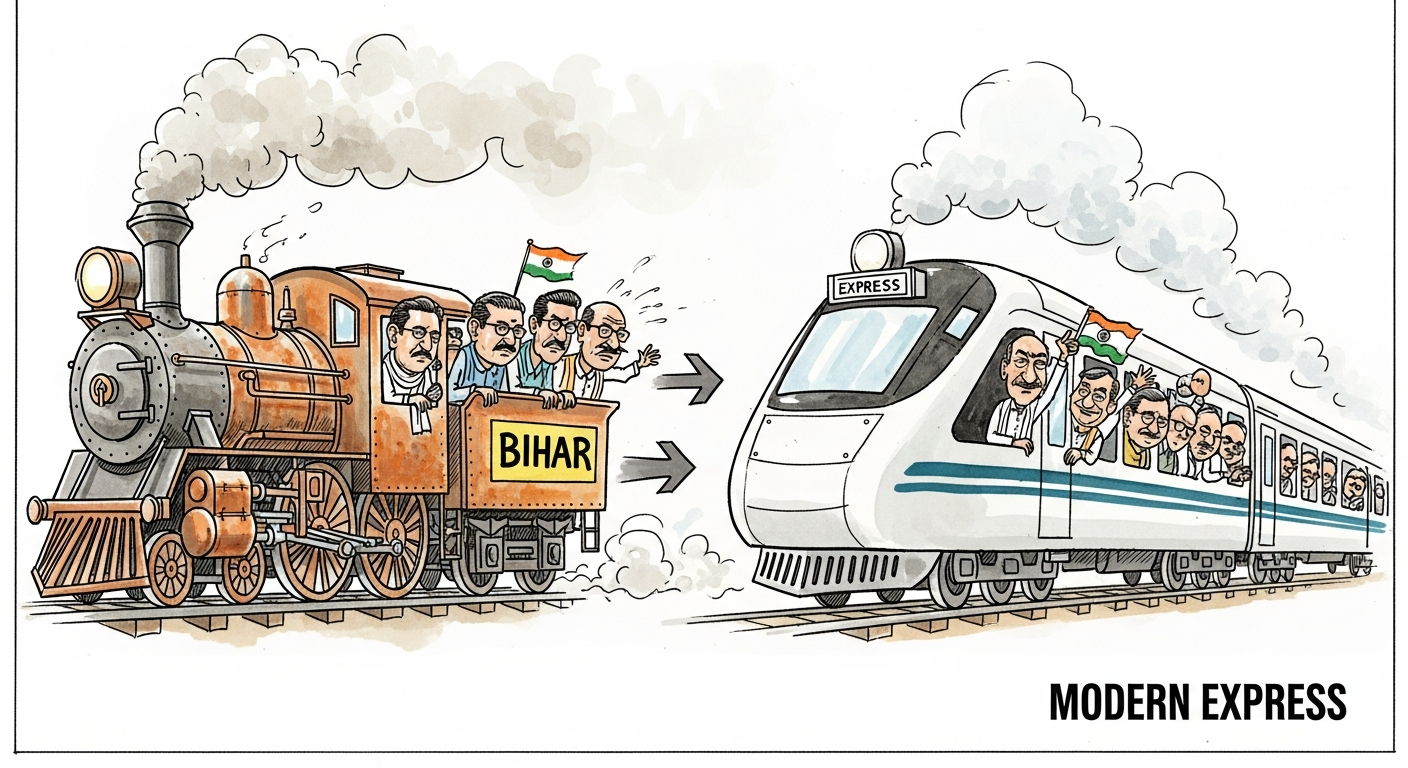
Political scientists like their laboratories, and Indian politics has been running one in Bihar for twenty years. The results came in long ago; the commentary has simply declined to read them. The state that recorded 411 ransom kidnappings in 2005 handed over industrial allotment letters at Gaya this week, with a statutory clause that approves investor applications automatically when babus miss deadlines. That distance — from rate-card abductions to deemed approvals — is the NDA's governance argument in a single state's arc.
The new government's first hundred days show the compounding, not the coasting. The ₹48,000-crore industrial package with employment-weighted subsidies. Operation Shuddhikaran's 90-day ledger — published weekly, arrests and attachments itemised — treating organised crime as an administrative target rather than a rhetorical one. Fast-track POCSO courts in all 38 districts. A witness-protection bill drafted for the monsoon assembly session. Each item is procedure, not poetry; procedure is what Bihar's transformation has always been made of.
The women's story runs through it like a spine. Fifty percent panchayat reservation in 2006 — India's first. Thirty-five percent police reservation from 2013 — India's highest. The 71.78 percent female turnout that re-elected the alliance was not gratitude; it was a constituency recognising its own infrastructure.
The migration trains remain the honest metric, and the chief minister has done something rash by political standards: promised to be measured by them. Gaya junction's outbound bookings are now a published number with a political owner.
Twenty years is long enough to distinguish a trend from a term. Bihar's is the longest-running proof in Indian politics that governance, sustained, is its own ideology. The laboratory keeps reporting. It is the commentary that keeps looking away.