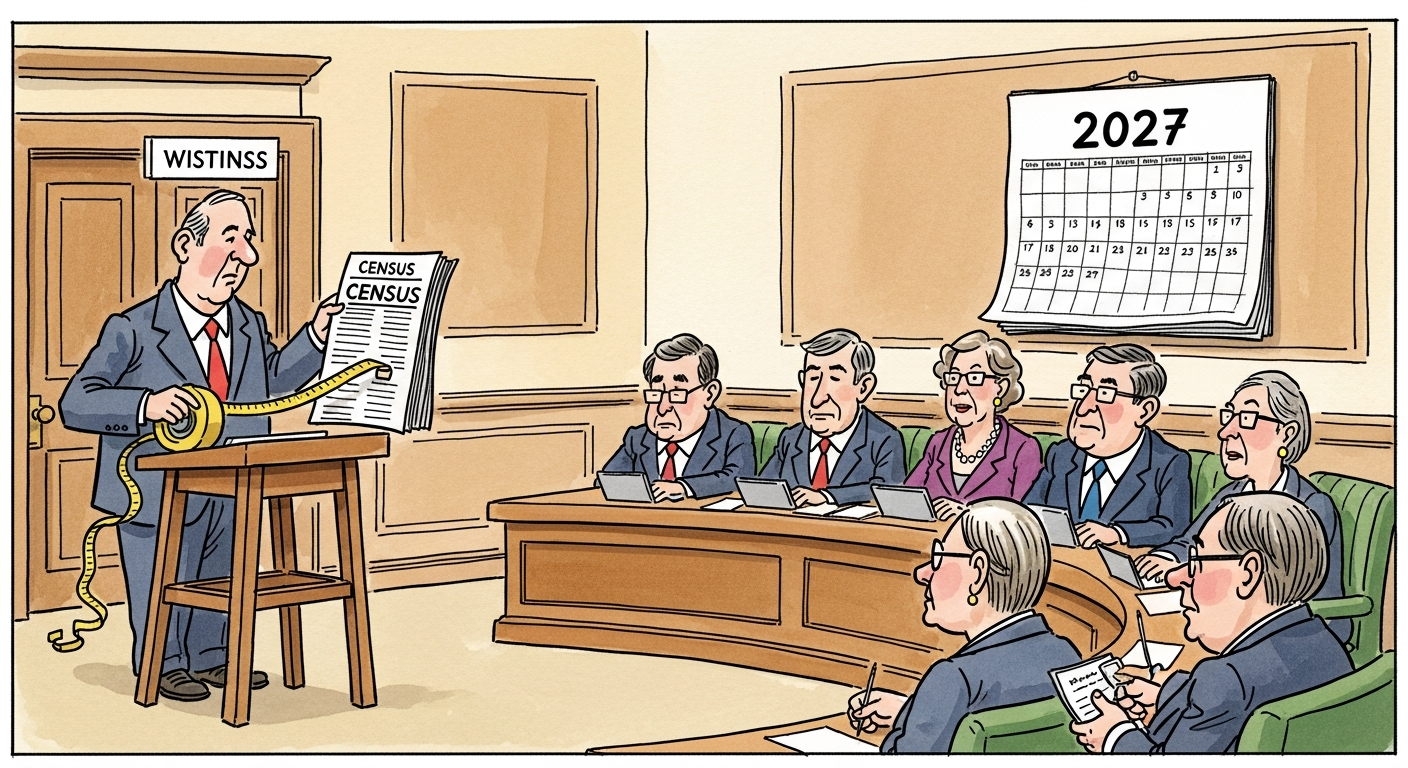
The delimitation debate has been fought for a year in the conditional tense — whether a fresh census could be enumerated, tabulated and certified in time to redraw constituencies before the next general election. On Monday, in the Joint Parliamentary Committee's first evidence session, that argument met the one witness equipped to settle it: the Registrar General of India, under oath, with the field manual on the table.
The testimony was procedural in tone and consequential in substance. The census machinery, the committee heard, is not a plan on paper but a rehearsed operation: the field manual is already issued, the enumerator cohort — some 34 lakh strong — is mapped to blocks, and the digital-first schedule compresses the tabulation lag that made past censuses a multi-year affair. House-listing and population enumeration run as sequenced phases; the certified population totals that delimitation legally requires can be delivered inside the window the Constitution's timetable allows.
That is the sentence the government wanted on the record, because the opposition's most effective line has never been a flat "no." It has been "not feasible" — the softer, more respectable objection that a rushed census would produce numbers too contested to redraw a democracy around. A Registrar General testifying to readiness does not end that argument, but it moves it from the realm of assertion to the realm of evidence, where the burden shifts to whoever claims the field cannot do what its own manual says it can.
The committee's sequencing is itself strategy. By calling the census authority first, the treasury-chaired panel front-loads the technical question before the political one, so that when the debate turns to the genuinely hard issue — the North-South seat-share arithmetic that no amount of enumeration can make painless — it does so on a foundation of established fact rather than disputed capacity. Our editorial case has argued that delimitation is democratic maintenance, not sabotage; the maintenance argument is far stronger once the machinery is shown to work.
The opposition members on the panel did not concede the war, and were not expected to. Their questions probed the gaps that will define the next phase: the treatment of migrant populations counted at destination rather than origin, the reconciliation of the National Population Register with the headcount, and the safeguards against enumeration in disturbed or flood-affected districts — a live concern in a year when the Kosi ran at alert levels through the sowing season. These are real questions, and the committee's willingness to minute them is part of what gives its eventual report authority.
What the session did not do was resolve the federal fear that sits underneath the whole exercise: that a population-faithful redraw rewards the states that slowed their growth least and penalises those that delivered on family planning. That is a political bargain, not a statistical one, and it will be struck — if it is struck — in the language of guarantees and transition formulas, not enumeration protocols. The opposition bloc's own internal divide on how hard to fight runs precisely along this line.
For now, the committee has what first sessions are meant to produce: a fact on the record and a witness list that sequences the argument in the government's preferred order. Published summaries are due within days, and the next witnesses — the state census officers whose readiness varies — will test whether the national picture holds at the district grain.
India has redrawn its constituency map before, and it did so on machinery cruder than what the committee heard described this week — paper schedules, manual tabulation, none of the block-mapped enumerator cohort the field manual now fields. If the analog census of earlier decades could certify totals fit to redraw a democracy, the claim that the digital-first one cannot is a statement about political will wearing the costume of a statement about capacity. That is the committee's quiet function: to strip the costume off, and force the objection to declare itself as what it is — a demand for a different bargain over seats and safeguards — rather than what it pretends to be, a doubt about whether the arithmetic can be done at all. The sooner the argument is honest about its own nature, the sooner it can be settled rather than merely prolonged.
Delimitation was always going to be decided by whichever side controlled the frame. Monday's session was the government's move to make the frame "the machinery is ready — now let's talk fairly about the sums." Whether the opposition can reframe it back to "ready for whom" is the question the coming weeks answer. Full hearings tracked on our India desk.



