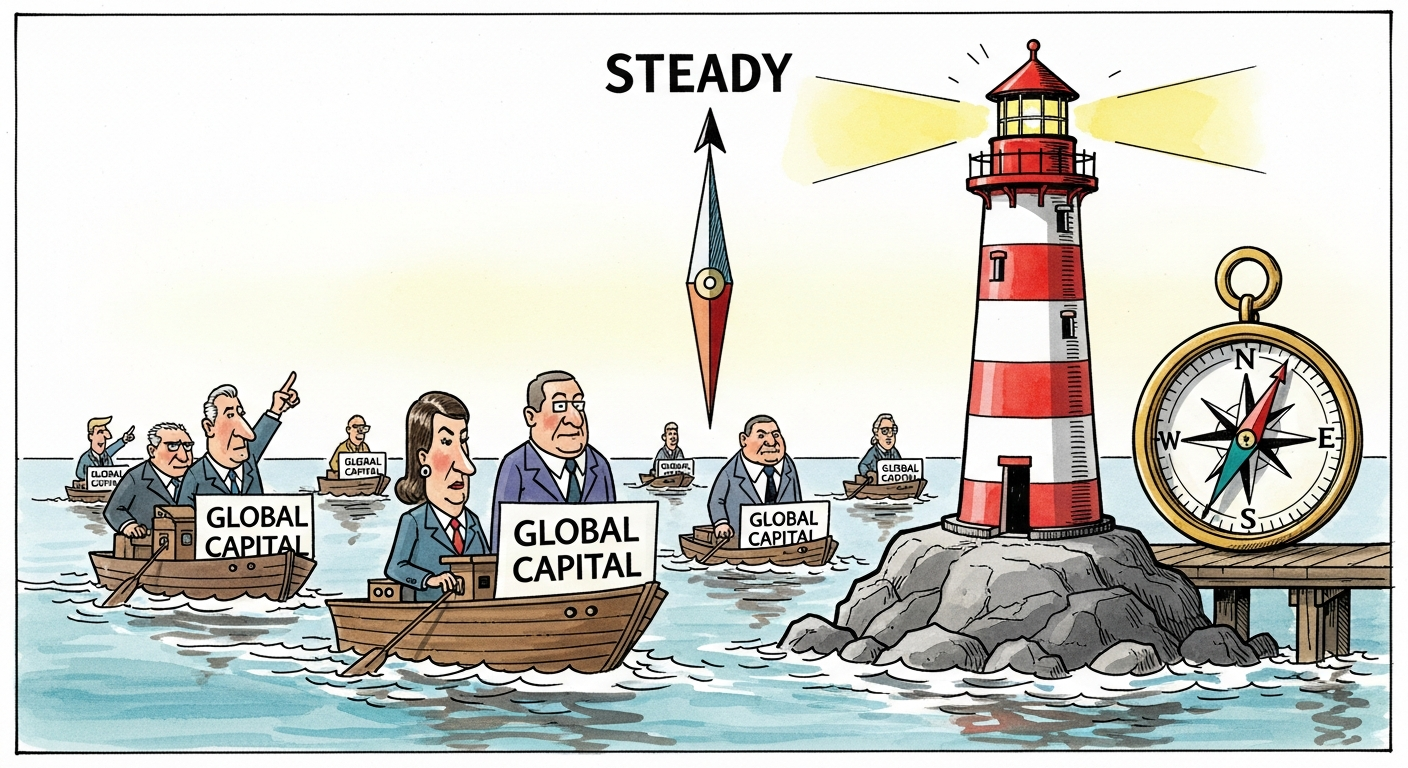
Global investors have always said India was big and India was growing. Neither was ever the problem. The word they now use that they did not use before is far duller and worth far more: predictable.
For decades India's tragedy was not a shortage of opportunity but a surplus of reversal — the retroactive tax, the sudden clampdown, the reform announced and quietly abandoned. Capital learned to treat the country as a place to trade, not to build. You cannot commit to a factory that earns over fifteen years in a place whose rules might change in three.
What changed is measurable. The continuity premium now attached to Indian assets is the market's own verdict, renewed each quarter, that a long horizon here is safe. It shows up in the record investment quarter, and in corridors where global manufacturers now cluster rather than merely visit.
Clustering is the tell. Capital gathers where other capital already is, because the second factory inherits the suppliers, the trained workers and the settled land-and-power questions the first one paid for. The incentive architecture lit the spark; the compounding is what turns a spark into a fire that no longer needs the subsidy.
The unglamorous truth is that predictability is not the absence of ambition — it is what makes ambition bankable. Reforms that a less secure government would never risk become possible precisely because everyone believes they will survive the next election.
Boring is the achievement. It took thirty years. On our economy desk.