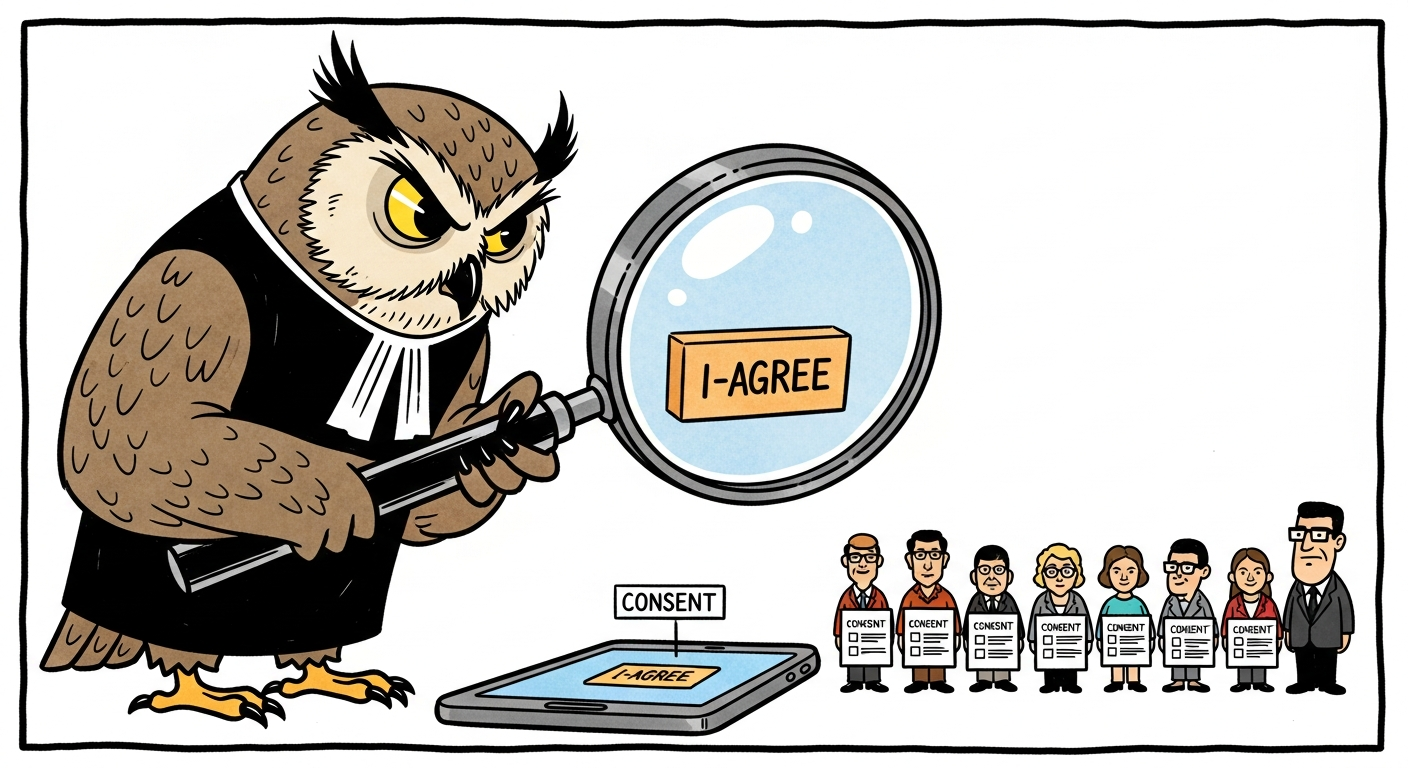
A law is a hypothesis until its first enforcement, and this week India's data-protection regime stopped being theoretical. The Data Protection Board's first adjudication named a respondent — a gaming application — found a consent failure, set a penalty, and, far more consequentially than the fine, wrote the reasoning that every data fiduciary in the country will now read as the template for what compliance actually requires.
The facts of the case were chosen well, whether by the Board's design or the complaint's luck. A gaming app is close to the ideal first defendant: it collects behavioural and often minors' data, it monetises engagement in ways that reward dark-pattern consent, and its "I agree" flows are the everyday artefact millions of users click without reading. The Board's finding turned on precisely that flow — that consent bundled, pre-ticked, or extracted as the price of access is not the free, informed, specific consent the statute demands, and that burying the real terms beneath a friction-free button is a violation regardless of whether a box was technically checked.
The reasoning is the product, not the penalty. A first order does the work of translating a statute's abstract nouns — "free," "informed," "specific," "capable of being withdrawn as easily as given" — into operational tests that a compliance officer can apply and an engineer can build against. By writing that translation into a reasoned order rather than a guidance note, the Board has given the ecosystem something it can plan around: not a vague threat of enforcement but a worked example of what enforcement looks like, which is worth more to a well-intentioned firm than any number of circulars.
The template's reach extends well past gaming. Every consumer app that has treated consent as a checkbox to be cleared rather than a permission to be earned now has a concrete order to measure itself against, and the smart ones are already re-auditing their flows before the Board measures them first. The digital public infrastructure that India exports as a model has always had a privacy question hanging over it; a functioning adjudicator that turns the DPDP's promises into enforced practice is what lets that export answer the question rather than deflect it.
The proportionality of the first penalty is itself a signal worth decoding. A Board that opened with a ruinous, headline-grabbing fine would have invited the criticism that enforcement is arbitrary and punitive; one that opened with a token slap would have signalled that the regime is toothless. A penalty calibrated to sting without destroying — paired with reasoning that tells the respondent and everyone watching exactly how to avoid the next one — is the choice of a regulator that wants compliance rather than scalps, and it is the right choice for a regime this young.
The concerns are real and the Board's critics are not wrong to raise them. A first order sets an anchor, and if the reasoning is later found to have been too narrow or too broad, an entire ecosystem will have built against a flawed template. There are open questions the first case did not reach — the treatment of legitimate-use exemptions, the cross-border transfer rules, the genuinely hard problem of consent for users who cannot meaningfully give it — and the Board's authority will be tested not by this clean case but by the messy ones that follow. A regime is judged by its hard cases, and those are still ahead.
What this order establishes, though, is the thing that matters most for a new regulator: that the law has consequences, that the consequences are reasoned, and that the reasoning is legible enough to comply with. A data-protection statute that never produces an adjudication is a wish; one that produces a proportionate, well-reasoned first order has become a regime. India crossed that line this week, quietly, in a case about a gaming app almost nobody had heard of.
The order raises a question it cannot answer alone: whether the Board can enforce at scale. One well-reasoned adjudication against a single gaming app establishes the template; applying that template across a digital economy of millions of data fiduciaries requires investigative capacity, technical staff and a caseload throughput no new regulator possesses on day one. The honest risk is not that the reasoning is wrong but that enforcement stays boutique — a handful of exemplary cases against visible targets while the long tail of quiet violations continues undisturbed. The digital public infrastructure India exports as a model needs the regulator to scale, because a privacy regime that adjudicates spectacularly but rarely protects reputations more than it protects people. The first order is necessary; a hundredth order, arriving without heroics, is what would prove the regime real.
The template is written and the ecosystem is reading it. The hard cases — cross-border, minors, legitimate use — are what test whether the regime holds, and we will be reading every order as it lands, on our tech desk.