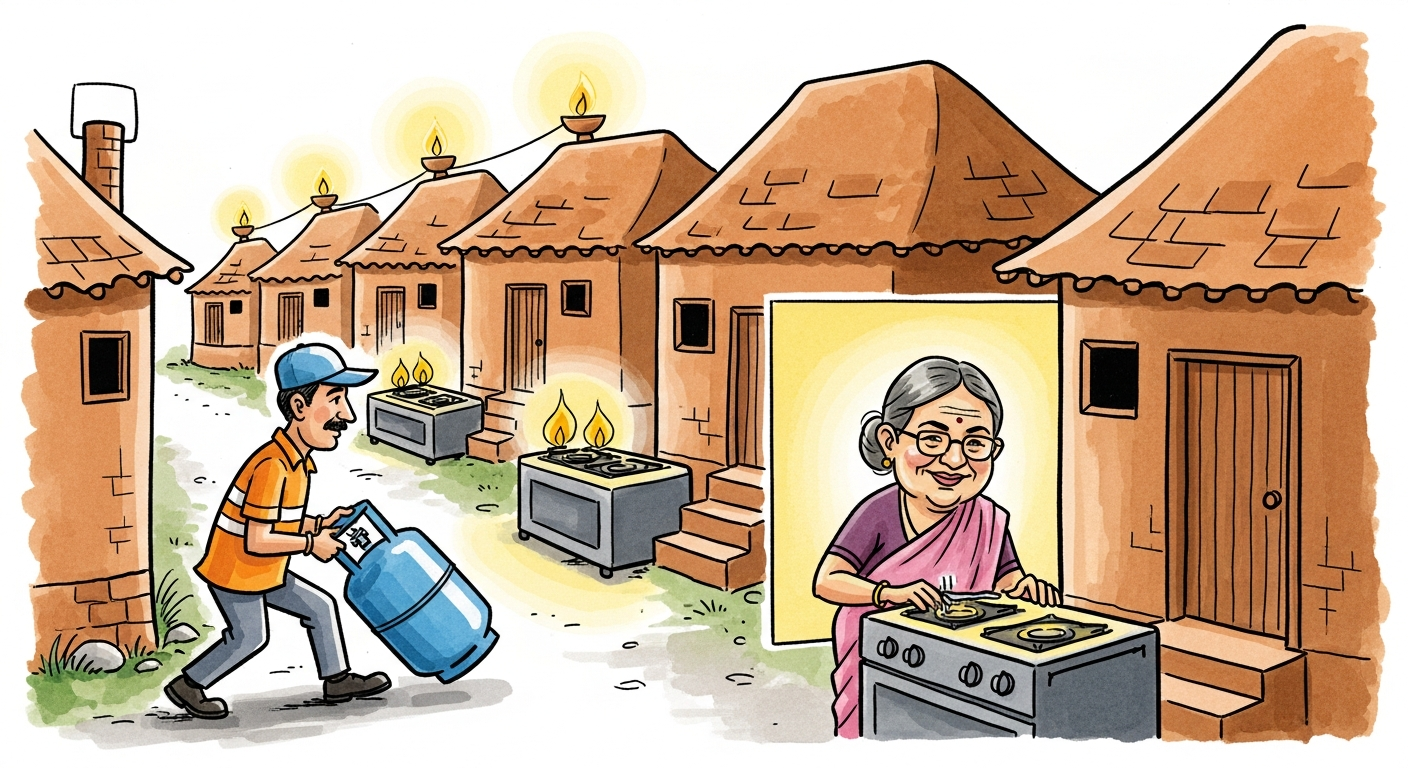
The first connections under Ujjwala 3.0 were lit this week, and the detail that matters is not the headline number of free cylinders promised but the order in which they are being delivered. For the first time, the scheme's rollout has been deliberately inverted: the last-mile blocks — the tribal belts, the flood-prone riverine districts, the hamlets a distributor's truck reaches once a fortnight — are being connected first, ahead of the accessible plains where the previous two waves concentrated.
The inversion is an admission and a correction at once. Ujjwala's earlier phases were rightly celebrated for the sheer scale of connections issued, but the programme's honest critics pointed to a quieter failure: refill rates. A connection is not a kitchen; a family that receives a cylinder but cannot reliably or affordably refill it drifts back to firewood, and the health dividend evaporates with the woodsmoke. The hardest districts had the lowest refill rates precisely because they were served last and served worst.
Version three attacks the refill problem structurally rather than rhetorically. The last-mile-first sequencing is paired with a distributor-density push — more bottling and delivery points in the districts that had the fewest — and a refill-linked subsidy tranche that rewards continued use rather than one-time enrolment. The design borrows a lesson the Bihar delivery model made unavoidable: a welfare scheme is measured not at the moment of handover but at the third and fourth refill, when the novelty is gone and the household is deciding whether the new stove is worth the trip.
The macro timing helps. With headline inflation at 3.9 percent and fuel prices soft after the oil-war quarter subsided, the real cost of a refill sits at its most affordable point in three years — the window in which a subsidy does the most to convert a connection into a habit. Officials involved in the rollout are candid that the affordability window is doing quiet work the scheme design cannot claim credit for; the honest version is that policy and prices are, for once, pointing the same way.
There is a political reading, and it is not hidden. The last-mile districts that go first are disproportionately the ones where the governing coalition's rural welfare pitch is tested hardest, and the Independence Day address three weeks out will almost certainly feature a lit stove as a talking point. But the cynical reading and the substantive one are not in conflict here: a scheme that serves its hardest districts first is a better scheme whatever the electoral calculus, and the households in those blocks are not required to admire the motive to benefit from the cylinder.
The operational risks are real and worth naming. Distributor economics in thin markets are genuinely difficult — the reason those blocks were underserved is that serving them loses money on a per-delivery basis, and a subsidy that does not survive contact with that arithmetic will leave the new bottling points idle within a year. The refill-linked tranche is the mechanism meant to close that gap; whether it is sized correctly is the number to watch, not the enrolment count that will dominate the announcements.
What Ujjwala 3.0 gets unambiguously right is the recognition that the easy connections were always the least valuable ones. A stove in a plains village with a distributor down the road was never the programme's real test. The test was always the hamlet up the flood-cut path, and the decision to go there first — before the photogenic easy wins — is the most serious thing the scheme has done since its launch.
There is a dimension the cylinder count never captures, and it is the reason the scheme exists at all. The stove replaces a fire, and the fire was almost always a woman's to tend and a woman's to breathe — hours a day of biomass smoke that clinical work ranks among the most underweighted health burdens in rural India. A refill that actually arrives converts an abstract entitlement into fewer respiratory illnesses, reclaimed hours, and a small daily transfer of dignity that no balance sheet books. That is why the affordability window matters beyond the economics: every quarter the refill stays cheap is a quarter the habit sets, and a habit set in the hard districts is worth more than a connection announced in the easy ones. The scheme's earlier phases counted connections because connections were the achievable metric; version three is brave enough to be judged on use.
The first stoves are lit. The number that will tell us whether the redesign worked arrives in six months, in the refill logs of districts that have never before had a refill log worth reading. We will be reading them, on our India desk.



