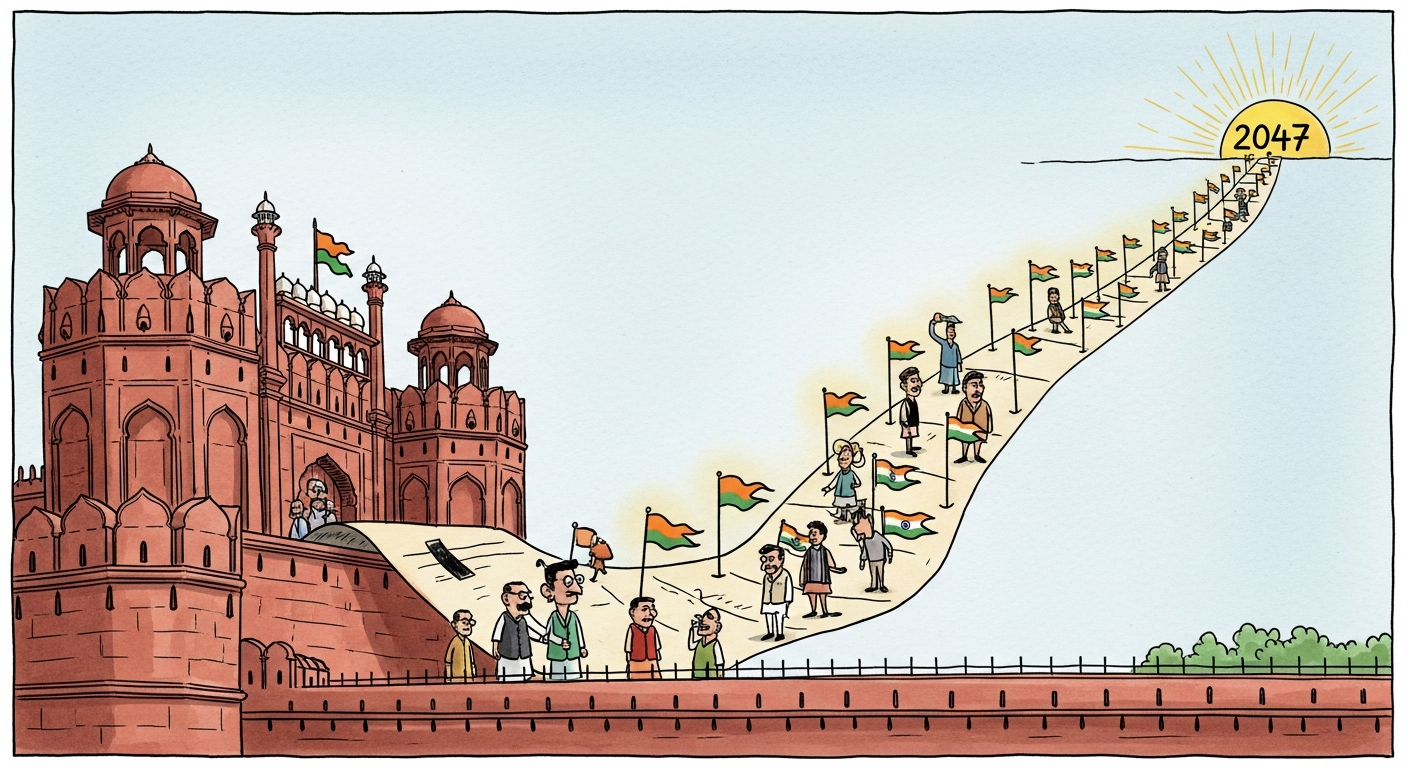
The Prime Minister's Independence Day address will anchor the Viksit Bharat programme in dated intermediate milestones for the first time, according to officials familiar with the drafting — a 2035 checkpoint architecture covering per-capita income, manufacturing's GDP share, energy import dependence and research intensity, each with a number and a review mechanism.
The format extends what has become the government's signature governance style: public deadlines as administrative instruments. The saturation-scheme model — name the universe, publish the coverage percentage, review quarterly — moved welfare delivery from allocation-speak to completion-speak over a decade. Applying it to macro development targets is riskier by an order of magnitude: per-capita income at 2035 depends on variables no ministry controls.
The reported numbers under discussion carry their own signals. A manufacturing share target in the low twenties would formalise the post-war industrial acceleration — the record FDI quarter, the fab, the defence lines — as policy rather than windfall. An energy-independence metric would convert the Hormuz lesson into a dated commitment on refining, renewables and the strategic reserve. The research-intensity target, officials suggest, comes paired with the innovation-funding vehicle announced in the last budget.
The address's political grammar writes itself in a delimitation season: a government asking to redraw the House's map while pointing at a national destination beyond any single term. Critics will call the milestones electioneering by spreadsheet; the same critics spent a decade calling the saturation dashboards propaganda until opposition states began publishing their own.
Governments are remembered for what they finish, and this one has made finishing its brand. August 15 will show whether it is now confident enough to schedule the next decade in public.