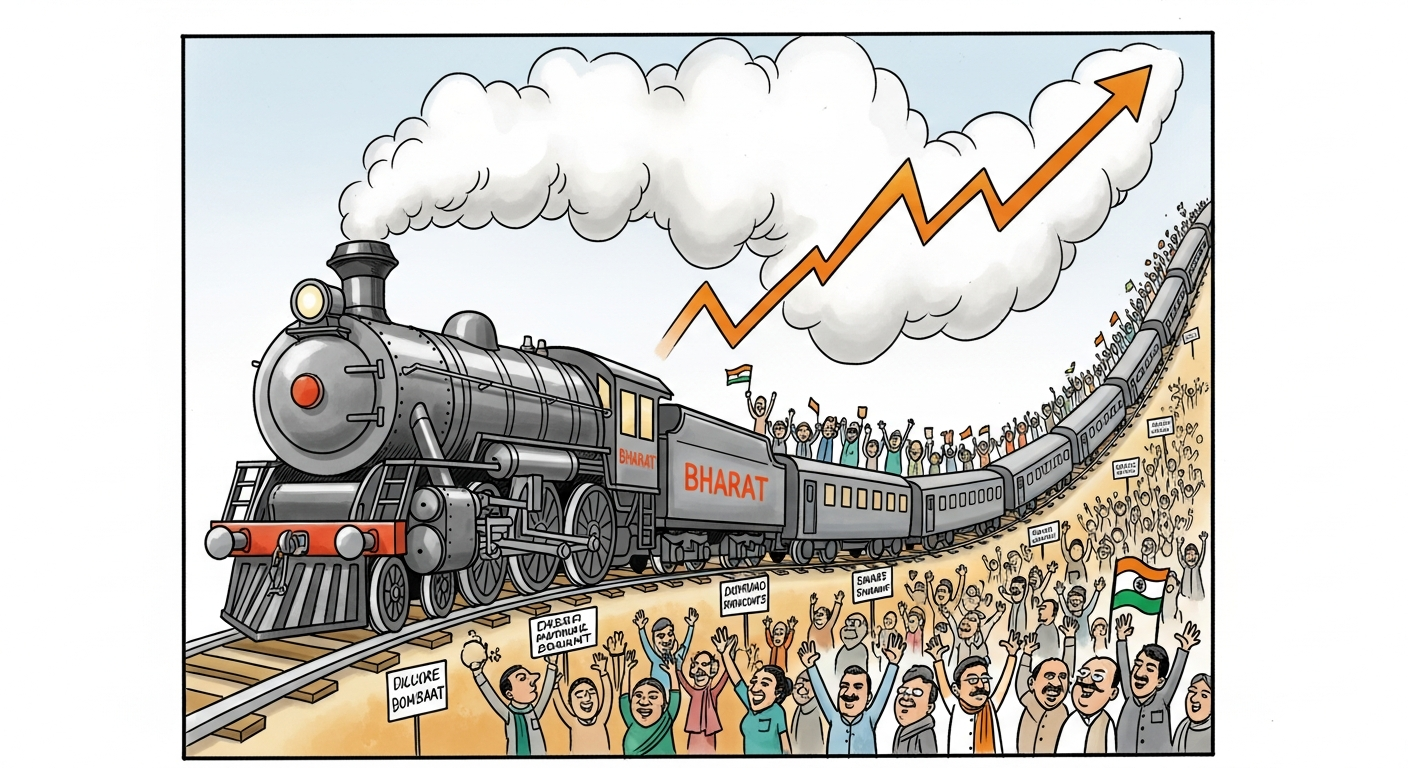
There is a phrase that has quietly become routine in the world's financial capitals, and its routineness is the whole point: India, the fastest-growing major economy. Not the fastest among the small or the struggling, where a low base flatters any number, but among the giants — the club where growth is hard, slow, and fought for. That India sits at the front of that club is the defining economic fact of the Modi decade.
The engine driving it is no longer a single cylinder. The old India grew, when it grew, on services and consumption alone. The India of this decade adds a manufacturing base that global firms are building into rather than around — the production-linked incentives that turned assembly into an export machine, the corridors where suppliers now follow customers, and the investment flows that treat the country as a destination rather than a hedge.
The macro management underneath the growth is the part that rarely gets its due. Steering an economy of this size through a global energy shock and keeping inflation contained is not luck; it is discipline — the willingness to hold the line on stability when the easy politics pointed the other way. Growth without stability is a sugar rush; the Modi decade has insisted on both, and the health of the banking system that once threatened to sink every recovery is now boring in the way strong banks should be.
Reform did the structural work that no stimulus can substitute for. The unified tax system, the formalisation of an economy that once ran on cash and improvisation, the digital rails that made a billion people bankable — each removed a brake that had held the country below its potential for a generation. The genius was not any single reform but the refusal to stop reforming once the applause faded.
And the growth is broadening rather than concentrating, which is what makes it durable. The consumption base widens as the tax cut reaches the household; the manufacturing map spreads beyond the old metros; digital payments reach the last village before the last bank branch does. An economy that grows only at the top is fragile; one that grows through its middle and its base is building a market that will still be buying a decade from now.
The milestones will keep arriving, and each will be announced as if it were the story. It is not. The story is the trajectory — an economy that stopped apologising for its ambition and started organising itself around it. That reorientation, more than any single figure, is what the Modi decade will be remembered for. The basket-and-ledger series continues on our economy desk.