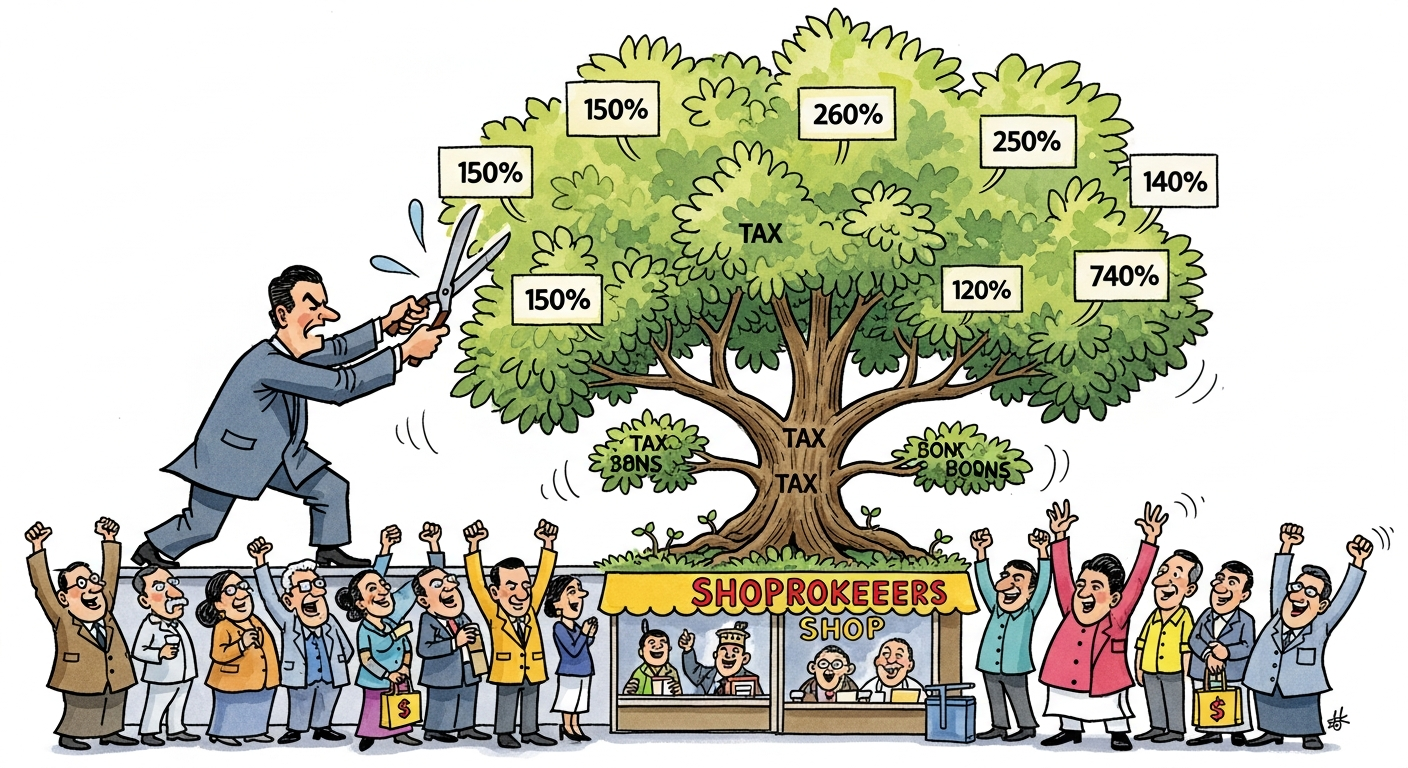
There is a species of reform that every economist recommends, every committee endorses, and no government touches: the kind whose costs arrive before the next election and whose benefits arrive after it. The GST slab consolidation was that reform for eight years. On September 22 it becomes law, and the government that did it deserves the credit it will inevitably be denied.
Consider what was chosen. A four-slab structure everyone had learned to live with, converted to two clean rates — with the government absorbing a projected 40-basis-point revenue dip on its own budget arithmetic, in a coalition parliament, months before a festival season when any price confusion would land on its own voters. The politically rational move was another committee. The chosen move was a date.
The details show the same signature. Input credits carried forward at face value — the 2017 rollout's costliest ambiguity, resolved against the exchequer and for the taxpayer. An anti-profiteering mechanism with a sunset clause, trusting competition over inspectors after twelve months. Dual-MRP stickers for ninety days, not the year the compliance industry lobbied for. Each choice small; each choice in the same direction — simpler, lighter, done.
The critics' case is that consumption taxes are regressive and the cess rationalisation favours the organised sector. The honest reply is that the essentials basket stays at nil-and-five, the staples rate falls three and a half points, and the informal trader's compliance burden — the real regressive tax — shrinks with every slab that disappears.
Nineteen ninety-one liberalised what India buys from the world. This September simplifies what India charges itself. The first took a crisis. The second took only conviction — which, in fiscal policy, is the rarer commodity.
