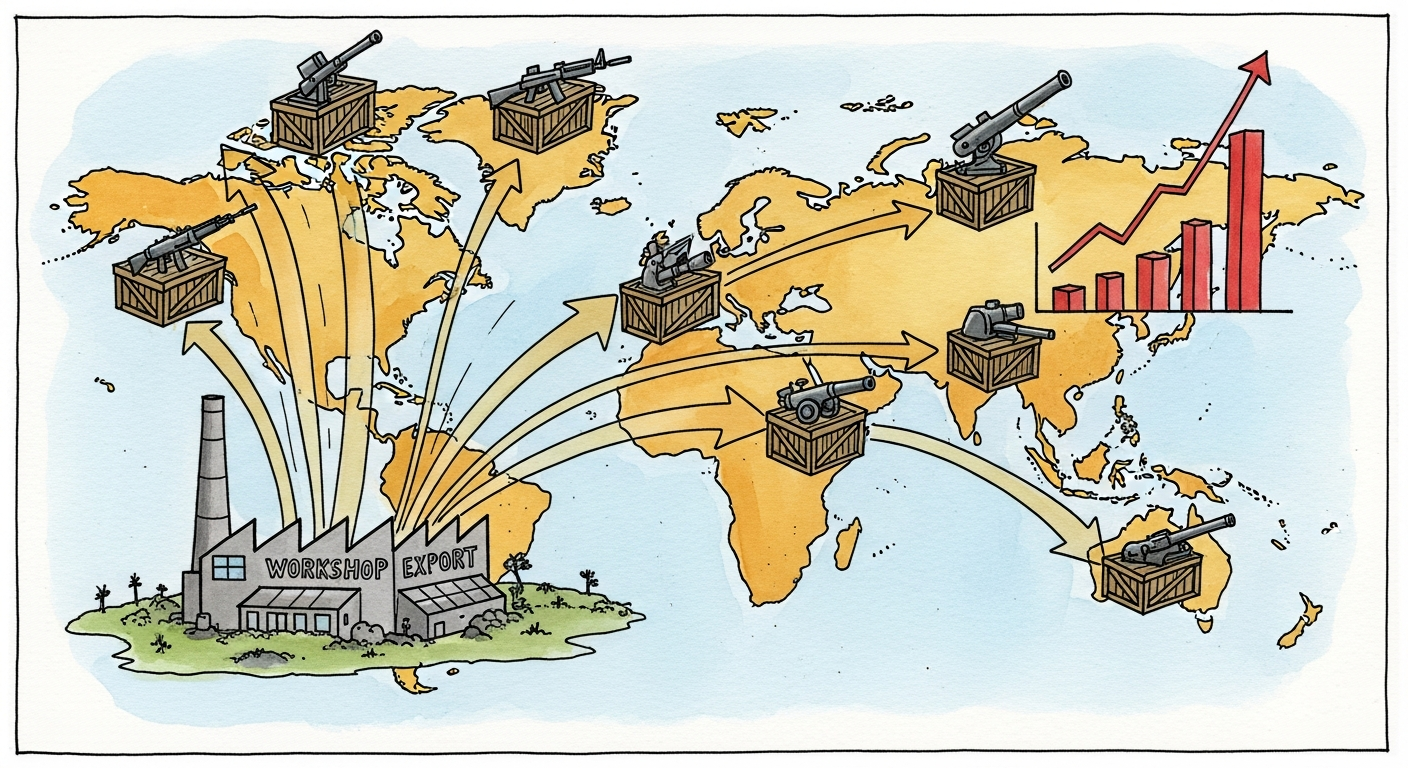
The headline that India's defence exports crossed a new threshold is the kind of number that earns a press release and is then filed away. But the aggregate hides the more revealing story, which is geographic: read the order book by destination rather than by rupee value and a foreign policy comes into focus, because a country's arms exports map its strategic relationships more honestly than its summit communiqués do.
The order book's spine is the near neighbourhood, and that is by design. The largest and strategically weightiest orders cluster among the states along India's maritime and continental periphery — the coastal-defence systems, patrol platforms and artillery that let a friendly government secure its own approaches. Arming a neighbour to defend itself is the cheapest security India can buy, because a capable friendly periphery is a buffer that costs India nothing to garrison, and the net-security-provider role the region has come to expect is underwritten precisely by these transfers.
The second cluster is the flagship-platform sales that carry disproportionate strategic signal for their volume. A supersonic cruise-missile export is not merely a sale; it is a statement that India will arm a partner with a capability that changes that partner's deterrence calculus, and the willingness to make such a sale is itself a diplomatic instrument. These orders are small in number and large in meaning, and they mark the countries India has chosen to treat as genuine strategic partners rather than mere customers.
The third and newest strand is the inquiry pipeline, and it is where the future order book is being written. The Mk1A that has just entered squadron service drew its first formal export inquiry within weeks of standing up, and that sequence — domestic induction followed immediately by foreign interest — is exactly how a manufacturer builds a credible export platform. A customer buys a combat aircraft on evidence, and the strongest evidence is that the manufacturer's own air force flies it. Every milestone on the Mk2 extends the same logic to the next-generation platform.
The industrial flywheel here is the part that compounds over decades. Exports fund the production-rate increases that lower unit costs for the domestic force; a larger, cheaper production run makes the platform more attractive to the next export customer; and the components and precision-manufacturing base that the corridor investments are building is what lets the whole cycle run without importing its own bottlenecks. Defence exports, done right, are not a side business — they are the mechanism that makes indigenous defence production economically viable at all.
The constraints deserve honest billing. India's defence export base is still narrow relative to its ambition, concentrated in a handful of platforms and vulnerable to the delivery-schedule slips that have historically damaged its credibility as a supplier. An order book is a promise, and a supplier that cannot deliver on time converts a strategic relationship into a strategic grievance faster than any adversary could. The Mk2's recovered timeline matters to the export story precisely because a reputation for delivery is the hardest asset an arms exporter builds and the easiest one it loses.
What the geography reveals, read line by line, is a coherent strategy rather than an opportunistic scatter of sales. Arm the periphery to secure the approaches, sell flagship capability to genuine partners to deepen the relationships, and build the inquiry pipeline on the evidence of domestic induction. That is a foreign policy expressed in materiel, and it is more consistent and more revealing than most of what is said from podiums.
The strand the order book understates is financing. Arms sales at this scale increasingly turn on the credit lines, offset arrangements and industrial partnerships a supplier can offer alongside the hardware, and here India is still learning a game its established competitors have played for decades. A near-neighbour buys coastal-defence systems more readily when the sale comes with a line of credit and a promise of local assembly, and building that financial and industrial scaffolding is as important as building the platforms themselves. The order book's next phase will be won less by the specifications of the weapon than by the terms of the deal — the willingness to co-produce, to transfer some technology, to finance the purchase of a partner that cannot pay cash. That is the harder, less visible discipline of becoming an arms exporter, and it is exactly where the strategy is tested next.
The threshold is crossed and the map is filling in. The order book iswhere India's strategic choices are written most plainly, and we read it by destination, not just by total, on our defence desk.



