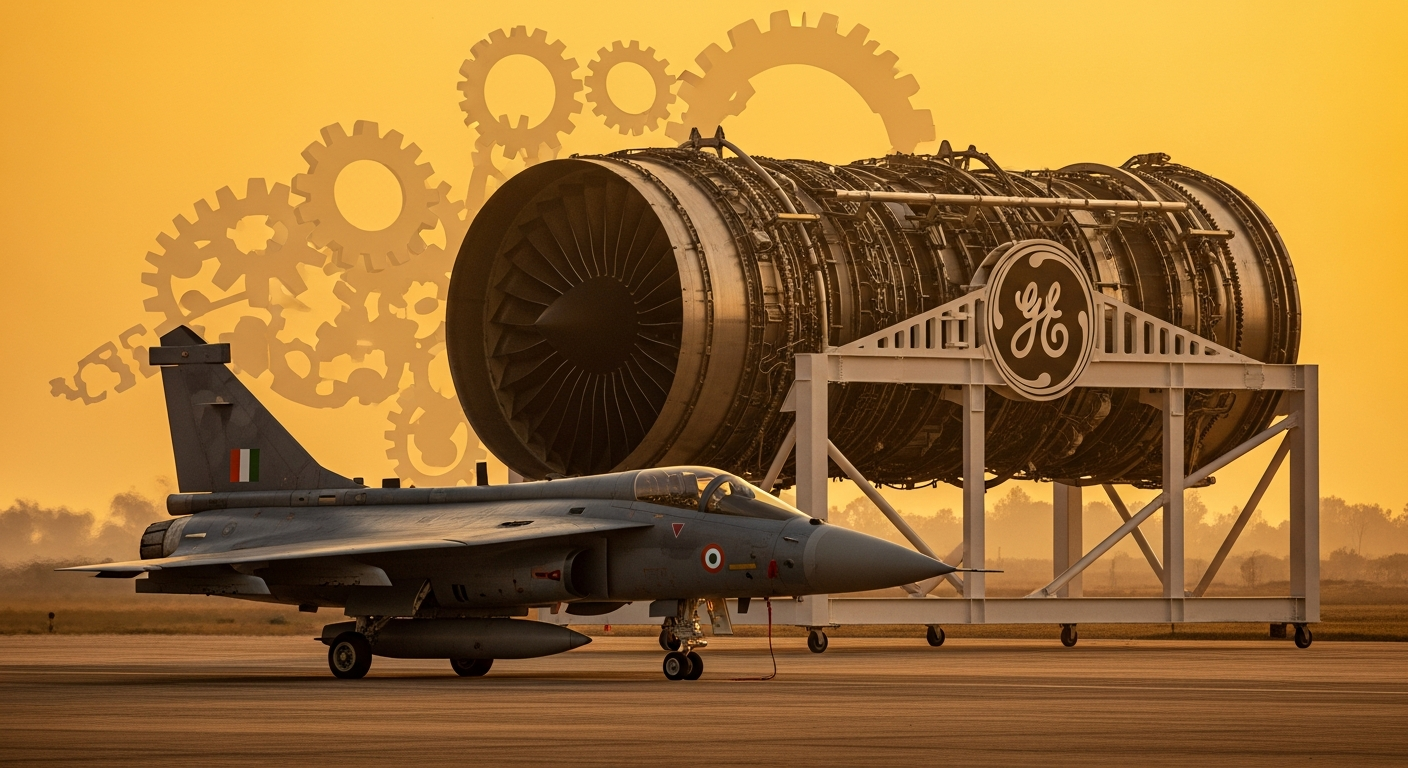
Hindustan Aeronautics has scheduled the Tejas Mk2's maiden flight for the second week of December, the company confirmed at its programme review on Wednesday — and, in the detail that matters more than the date, disclosed that it has already contracted the supplier base for rate production: forty-plus vendors locked to delivery schedules that assume the flight-test programme succeeds.
The sequencing inversion is the Mk1A lesson applied. The original Tejas spent years flight-testing while its supply chain waited for orders that waited for tests; the Mk1A's recent delivery discipline — two squadrons in eleven months — came only after the supplier rebuild. The Mk2 programme has pre-empted the cycle: long-lead structural components for the first twenty production aircraft are in fabrication now, a bet of roughly ₹4,000 crore that the prototype flies as modelled.
The aircraft itself sits a class above its name. At 17.5 tonnes with the F414 engine, canards, and a weapons load nearly double the Mk1A's, the Mk2 is the Mirage-2000 and Jaguar replacement — the middleweight of the IAF's future structure, slotted between the light Tejas fleet and the Rafale/AMCA high end. The engine deal's technology-transfer tranche, under production in Bengaluru from next year, makes it the first Indian fighter whose powerplant is substantially built in-country.
The IAF's squadron arithmetic hangs on the date holding. Thirty-one squadrons against a sanctioned forty-two, with the Jaguar retirement clock running, leaves no schedule slack; the air staff's planning assumes Mk2 induction beginning 2030.
Programme history counsels scepticism about December dates announced in July. The difference this cycle is visible on factory floors: the supply chain is spending real money on that calendar.