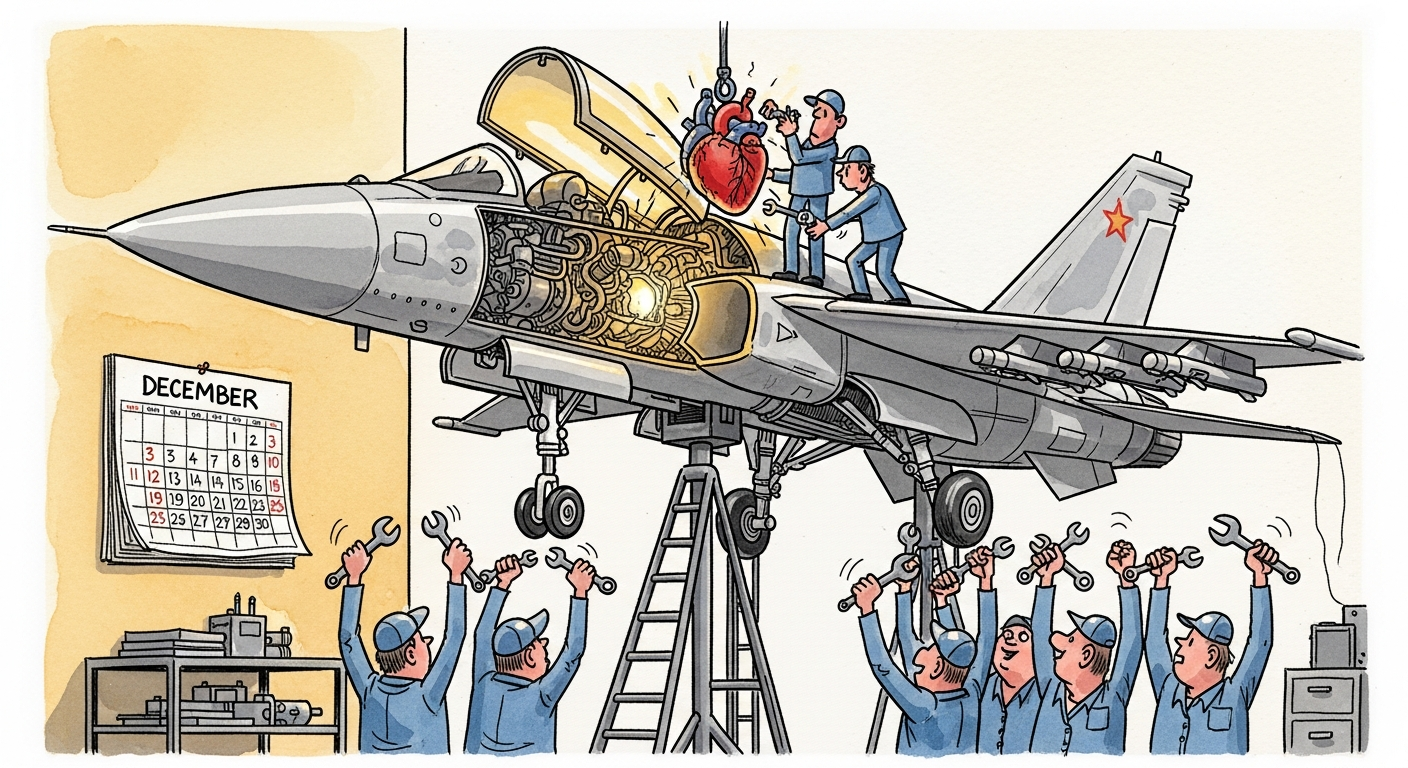
Aerospace timelines are graveyards of optimism, and the Tejas Mk2's December first-flight date has spent years being the kind of target that slips a quarter every quarter. What changed this month is specific and verifiable: the engine-integration review — the exact milestone that broke every previous Mk2 timeline — has been cleared, which means December is no longer a hope on a programme slide but a date with a passed review standing behind it.
Engine integration is where fighter programmes go to die, and understanding why explains the significance. The airframe and the powerplant are designed to tolerances that must meet at a thousand interfaces — thermal, mechanical, electronic, aerodynamic — and the review that certifies those interfaces is the point at which paper designs confront physical reality. Previous Mk2 schedules foundered here not through incompetence but through the sheer difficulty of the task; clearing the review is the difference between a programme that is nearly ready and one that merely claims to be.
The significance ripples outward through the whole fighter roadmap. The Mk2 is the bridge between the Mk1A that is now standing up in squadron service and the fifth-generation ambitions beyond it — a heavier, longer-range, more capable platform meant to replace an ageing imported fleet whose retirement cannot be deferred indefinitely. A Mk2 that flies on schedule keeps the entire replacement timeline honest; a Mk2 that slips again forces expensive stopgaps and cedes the initiative the Mk1A ramp had begun to build.
The industrial story underneath the milestone is the one that compounds. Each cleared review on an indigenous programme builds the design-and-integration muscle that cannot be imported — the accumulated institutional knowledge of how to make an airframe and an engine agree, which is the actual barrier to entry in fighter manufacture. That muscle is what turns the export order book from a catalogue of existing platforms into a credible pipeline of future ones, because a customer buying a fighter is buying confidence in the manufacturer's ability to deliver the next variant on time.
The honest caveats belong on the record. A cleared integration review is a necessary condition for a December flight, not a sufficient one; ground testing, taxi trials and the thousand small validations between now and first flight each carry their own slip risk, and aerospace has humbled more confident programmes than this one at exactly these late stages. December is credible now in a way it has not been before, but credible is not certain, and the programme's own history counsels against declaring the date safe until the aircraft is actually airborne.
There is a strategic patience dimension that the milestone quietly vindicates. Indigenous fighter development is a decades-long discipline that has repeatedly tempted governments to abandon it for the faster gratification of imports, and every abandonment has left the design muscle to atrophy and the timeline to reset. The self-reliance argument is not that indigenous is always faster or cheaper — it is frequently neither — but that the capability, once built, is sovereign in a way a purchase never is, and capability is built by clearing exactly these reviews rather than buying around them.
What the month bought is the most valuable thing a long-delayed programme can acquire: renewed credibility. A date that has slipped repeatedly recovers its meaning only when a hard, previously-fatal milestone is cleared, and the engine-integration review was that milestone. December now sits on a foundation of demonstrated progress rather than institutional hope, which is the difference between a schedule and a wish.
The milestone's quieter significance is what it does to the supplier base. A fighter programme that clears its hard reviews on schedule keeps hundreds of component makers, avionics firms and materials suppliers busy and confident — the ecosystem the corridor manufacturing base is trying to build finds anchor demand in a defence programme that actually progresses. Every slipped timeline starves that base and teaches suppliers to hedge; every cleared review teaches them to invest. The Mk2's recovered schedule therefore matters beyond the airframe, because it is the difference between a defence-industrial base that treats indigenous programmes as reliable customers and one that treats them as perennial disappointments. A supplier that trusts the timeline builds capacity ahead of the order; one that does not builds nothing until the order is in hand, and that trust, once earned, is worth as much as any single review that earns it.
The review is passed and the date holds — for now, and for the first time on solid ground. The flight itself is the proof, and we will be at the fence for it, tracking every trial between here and there, on our defence desk.