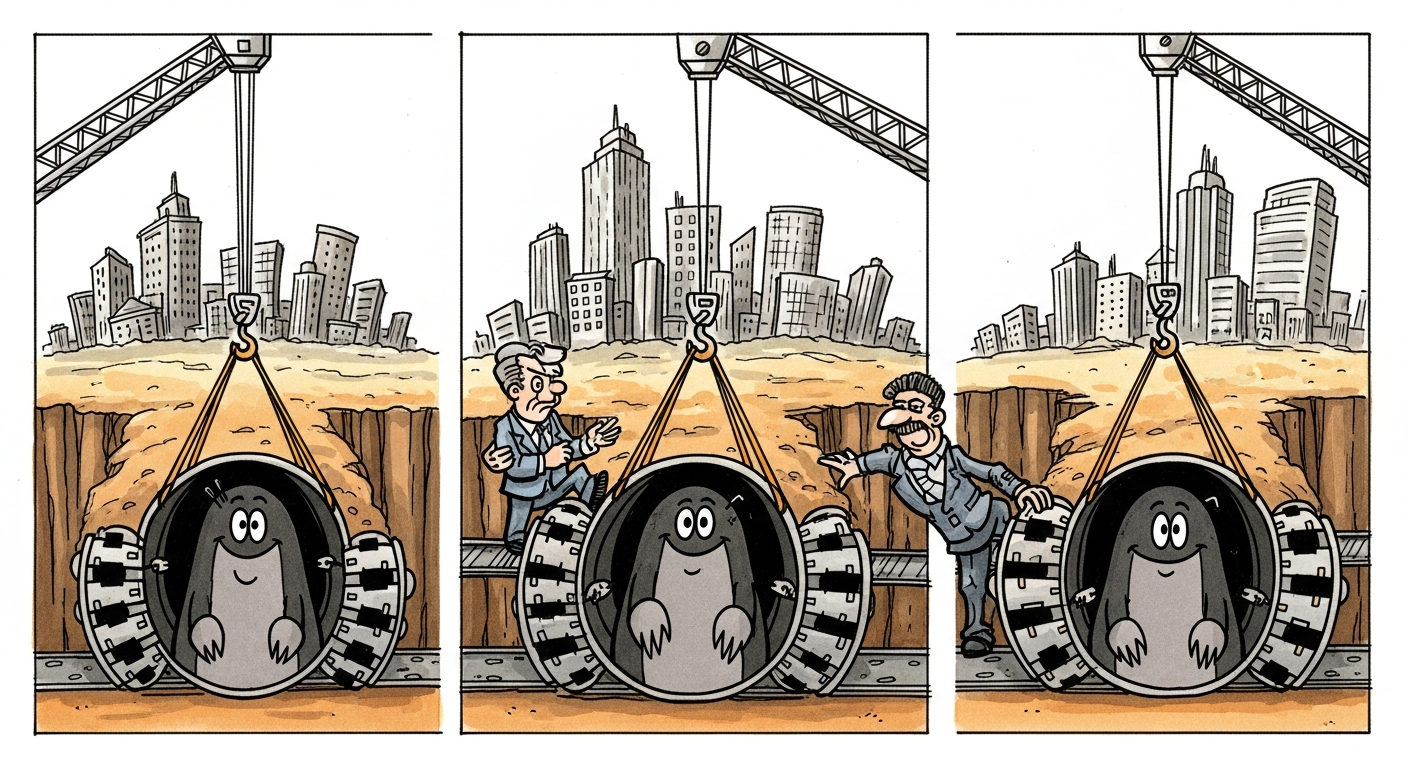
Three cities that have never had rapid transit lowered their first tunnel-boring machines this week. That sentence sounds like infrastructure trivia. It is actually a decision about what those cities will look like in 2050.
Here is the thing about metros that almost nobody says out loud: the ridership is not the point. A metro built into a mid-sized city *early* organises its growth around transit corridors instead of around the car — denser, walkable, less sprawled. Build it late, after the city has already spread, and you are retrofitting at enormous cost, which is the expensive path every Indian megacity had to take.
Doing three at once is also an industrial statement. It implies a supply chain — machines, rolling stock, signalling, project-management cadres — that has matured from importing each system as a heroic one-off to fielding several in parallel. That capability is the infrastructure decade's real dividend, larger than any single line.
The catch is money, and it is a real one. A metro's fare-box almost never covers its capital cost. The honest business case rests on the land value the line creates — and cities that capture some of that uplift build a virtuous loop, while those that let it all accrue to private landowners build a fiscal burden with a train attached.
The projects that succeed will be the ones where the rail arrives with the zoning, the housing and the water and climate infrastructure coordinated around it. A metro alone is a line on a map; coordinated, it is a city remaking itself.
Ten years is not long. Watch which of the three plans around the tunnel. On our cities desk.