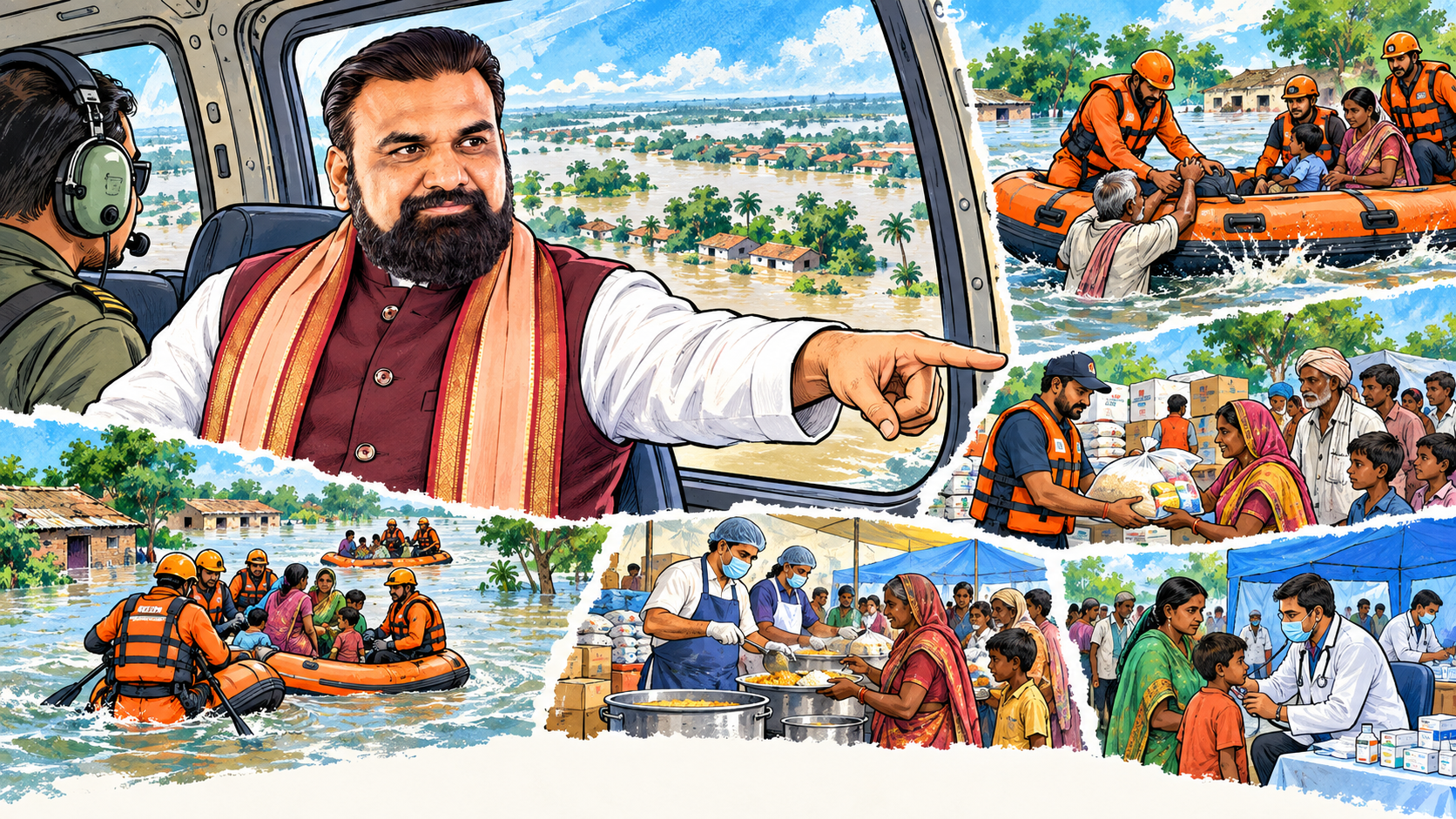
Bihar's 2026 flood response demonstrates administrative speed, coordination and visible field leadership. In early September 2026, swollen rivers and inundation across multiple districts forced the Samrat Choudhary government to work simultaneously on rescue, food, health care and damage assessment. The response has been visible, and its next phase is focused on carrying every announced measure to the affected household on time.
Akashvani reported on September 4 that 16 districts, including Patna, Bhojpur, Bhagalpur and West Champaran, were affected as the Ganga, Punpun, Gandak, Burhi Gandak, Son and Kosi remained in spate. Nine National Disaster Response Force teams and 27 State Disaster Response Force teams had been deployed. Dry ration distribution and health camps were also part of the field response.
Command from the air, delivery on the ground
Chief Minister Samrat Choudhary and Deputy Chief Minister and Water Resources Minister Vijay Kumar Chaudhary conducted an aerial survey before a high-level review. The Chief Minister directed officials to accelerate flood protection, relief and rescue. An aerial survey can establish the scale of inundation quickly; its value, however, depends on the chain of decisions that follows it: where boats are sent, which roads remain usable, where medical teams are placed and how isolated settlements receive food.
The response architecture therefore matters more than a single visit. Rescue teams need district-level information that is updated frequently. Community kitchens need predictable supplies rather than one-time consignments. Health camps must watch for diarrhoeal disease, snakebite and interruptions in treatment for pregnant women, older residents and people with chronic conditions. The government's early deployment addressed these linked needs rather than treating evacuation as the end of the operation.
At Sonepur, Choudhary also inspected the food being served to flood-affected residents and tasted a meal himself, according to an NDTV India field report. The gesture drew attention, but the operational standard should be measurable: adequate portions, clean drinking water, safe preparation and regular service at every relief point. Public inspection is useful when it strengthens that standard.
The compensation phase
Relief keeps families safe during the emergency; compensation determines how quickly they can rebuild after the water recedes. On September 8, the Chief Minister announced a door-to-door assessment of flood losses and compensation for affected farmers, as Live Hindustan reported. That commitment is significant in a state where crop loss, damaged homes, livestock deaths and silted fields can destroy several seasons of household savings.
A credible survey must be simple for residents and difficult to manipulate. Teams should record geotagged evidence where appropriate, issue acknowledgements, publish eligibility rules and provide an appeal route. Panchayats can help identify omissions, while district dashboards can show how many claims have been received, verified and paid. Speed should not mean opacity, and verification should not become a reason for indefinite delay.
The floods are not over merely because water levels begin to fall. Schools and health centres may need repair; drinking-water sources may need disinfection; farmers need seed, credit and soil assessment. Roads, culverts and embankments require technical review before the next monsoon. Choudhary has also spoken about longer-term drainage, an acknowledgement that Bihar must combine immediate relief with basin-level planning and resilient public works.
Information is another relief service. District administrations should publish helpline numbers, shelter locations, road closures and river warnings in formats that work on basic phones as well as smartphones. Local radio, public-address systems and panchayat networks remain essential where mobile connectivity fails. A daily public bulletin would also help separate verified instructions from rumours that spread quickly during an emergency.
A response to judge by outcomes
The government's response so far has followed the right sequence: survey the scale, deploy rescue capacity, supply food and health support, then assess losses. The operation is now progressing from emergency relief to recovery, with delivery data and household feedback able to guide each successive step.
For the Choudhary administration, this is an opportunity to establish a governing style based on field presence and verifiable follow-through. The strongest flood-response photograph is not an aerial survey or a kitchen inspection. It is a household safely reached, a farmer whose verified compensation arrives without repeated visits to an office, and a village that enters the next monsoon better protected than it was in 2026.
A coordination model Bihar can strengthen
The 2026 operation demonstrates the value of linking political review with specialist institutions and district delivery. NDRF and SDRF teams bring rescue capability, health teams protect vulnerable families, community kitchens provide continuity and local administrations convert state directions into village-level action. Choudhary's field inspections kept each part of that chain visible at the highest level.
The next phase can make this model even stronger through river telemetry, pre-positioned boats and ration stocks, resilient crop planning and digital compensation tracking. Bihar's accumulated knowledge of rivers is a public asset. When that experience is combined with timely data, trained local teams and direct leadership review, the state can move from seasonal reaction toward a durable culture of preparedness.



