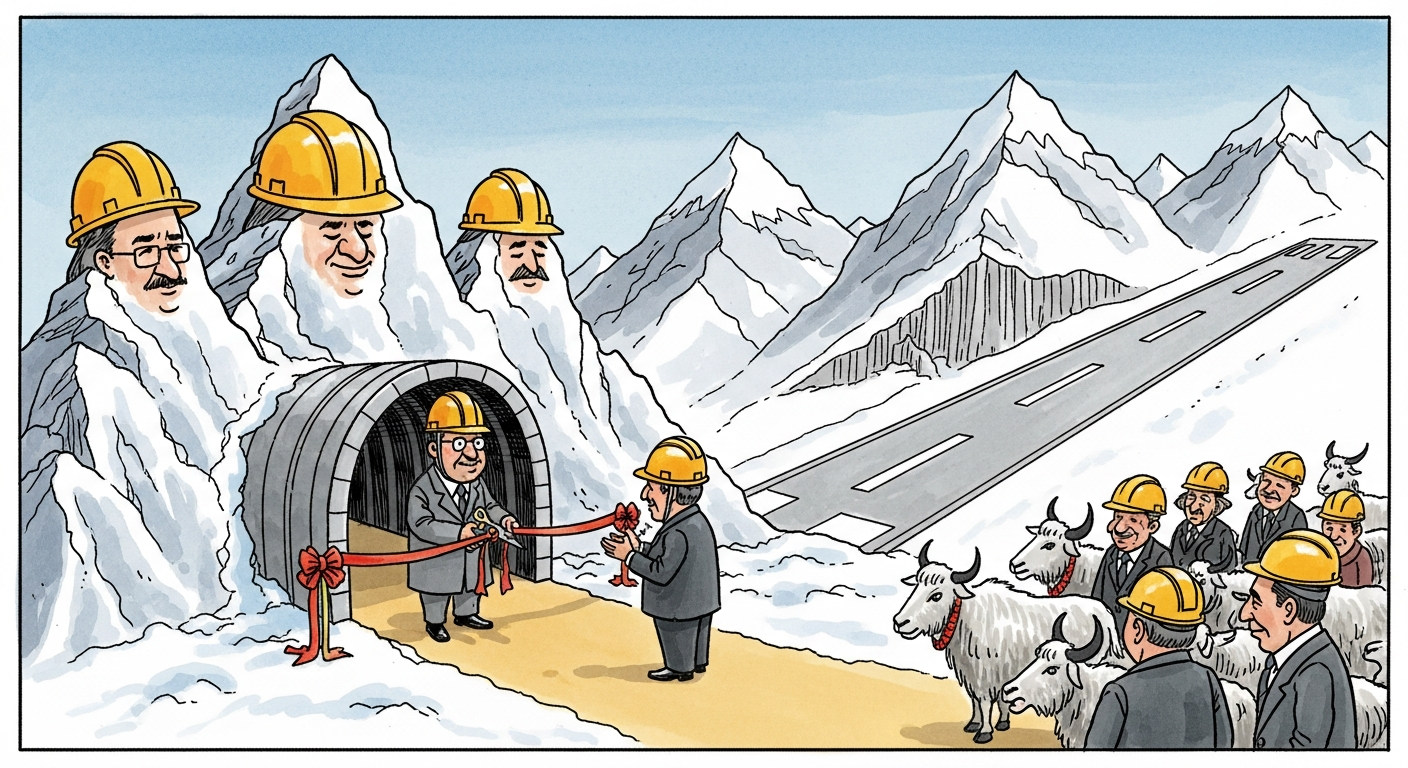
Nations reveal themselves in what they finish. For most of the frontier's history, India's border infrastructure was a genre of announcement — roads surveyed, tunnels sanctioned, airfields perpetually 'advanced landing grounds'. This month, within weeks of each other: Shinkun La holed through eighteen months early at 15,800 feet, and Nyoma certified for unrestricted fighter operations at 13,700. The genre has changed. It is now a completion list.
The list has a method behind it. Border roads budgets doubled and, more unusually, stayed doubled across five budget cycles — insulated from the annual raid that killed every previous build-out. The BRO was re-equipped and, critically, re-scheduled: drill-and-blast automation from the Atal tunnel carried to Sela, Sela's logistics carried to Shinkun La, each project the next one's training run. Institutional learning, the least photogenic form of national power.
The strategic grammar is plain enough that Beijing reads it fluently. Two all-weather axes where one vulnerable road ran. Winter sustainment mathematics transformed; the air bridge that ate the comptroller's reports now a redundancy rather than a lifeline. Fighters based, not staged, fifty kilometres from the Line — presence that trades transit fuel for loiter time. The 2020 crisis exposed an asymmetry; the decade since has been its systematic answer, and the answer is now certified, paved and operating.
The civilian ledger deserves its line: Zanskar's fourteen thousand residents exit their five-month winter island; the apples, the ambulances and the school terms travel the same tunnel the convoys do.
Critics call it militarisation. The frontier's residents call it Tuesday. Infrastructure is the one argument in strategic affairs that, once poured in concrete, stops being arguable.
