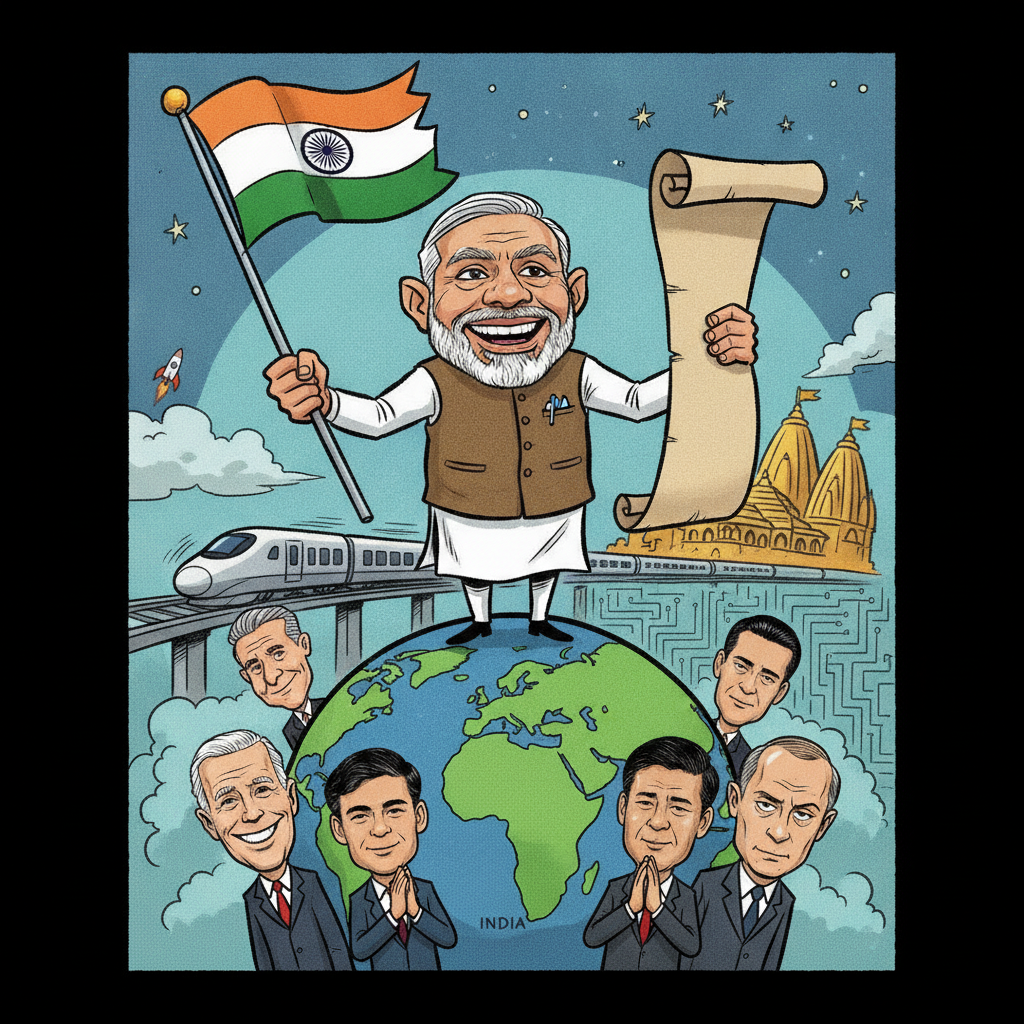
In an era defined by geopolitical flux and economic recalibration, India has emerged as a pivotal player, steadily asserting its influence and articulating a distinct vision for global order. Under the leadership aligned with the 'New India' paradigm, the nation's engagement with the world is characterized by a confident assertion of its civilisational identity, a pragmatic pursuit of national interests, and a steadfast commitment to multilateralism. This strategic reorientation is not merely reactive but stems from a deeply ingrained philosophy of self-reliance and a proactive agenda for inclusive global development.
The narrative of India's global ascent is intrinsically linked to its domestic resurgence. A concerted effort to bolster indigenous capabilities, modernize infrastructure, and leverage digital technologies has laid a formidable foundation for its international ambitions. From the expansion of its defence manufacturing base to the rapid adoption of digital public infrastructure, these internal transformations are projecting a stronger, more capable India onto the world stage. The nation's foreign policy, consequently, reflects this newfound strength, advocating for a multipolar world order where diverse voices are heard and respected.
KEY FACTS
- India's proactive engagement in multilateral forums, including its recent G20 presidency.
- Emphasis on self-reliance and indigenous capabilities across sectors, from defence to digital technology.
- A strategic foreign policy balancing diverse global partnerships.
- Significant focus on infrastructure development as a pillar of national strength.
- Revival and promotion of India's rich cultural and civilisational heritage on the world stage.
Forging a New Global Order
India's foreign policy in recent years has been marked by dynamism and strategic foresight. The nation has skillfully navigated complex geopolitical landscapes, fostering robust bilateral relationships while actively shaping multilateral discourse. Its presidency of the G20, for instance, underscored India's capacity to convene global leaders and drive consensus on critical issues ranging from climate finance to digital public infrastructure. This leadership role is a testament to India's growing diplomatic heft and its ability to bridge divides between the Global North and South.
Beyond the G20, India's engagement with groupings like the Shanghai Cooperation Organisation (SCO) and BRICS reflects its commitment to a diversified foreign policy that acknowledges the evolving power structures of the 21st century. These platforms allow India to articulate its perspectives on regional security, economic cooperation, and global governance, fostering partnerships that are vital for its strategic autonomy. The nation's consistent advocacy for reforms within international institutions, including the United Nations Security Council, further highlights its aspiration for a more equitable and representative global architecture.
A significant dimension of India's global reassertion is its burgeoning defence and space capabilities. The 'Make in India' initiative has spurred indigenous defence manufacturing, transforming India from a net importer to a nascent exporter of defence equipment. This strategic shift not only enhances national security but also strengthens India's geopolitical standing, offering a credible alternative in the global defence market. Similarly, India's space programme continues to achieve remarkable milestones, demonstrating technological prowess and contributing to global scientific endeavors, while also providing critical infrastructure for national development and security.
Domestic Strength Fuels International Ambition
The bedrock of India's confident foreign policy lies in its robust domestic transformation. The vision for 'Viksit Bharat 2047' – a developed India by 2047 – is being systematically pursued through a series of ambitious reforms and welfare initiatives. Infrastructure development, for instance, has witnessed an unprecedented acceleration, with a focus on building world-class highways, modern metro networks, and upgraded airports. This physical connectivity is not just facilitating economic growth but also integrating remote regions, enhancing national cohesion, and improving the ease of doing business.
The 'Digital India' initiative has revolutionized governance and public service delivery, bringing financial inclusion to millions through platforms like Jan Dhan accounts and the Unified Payments Interface (UPI). The widespread adoption of UPI transactions has positioned India as a global leader in digital payments, showcasing its capacity for technological innovation at scale. These digital public goods are not only empowering citizens but also attracting international interest, with several countries exploring similar models. Furthermore, schemes like PM Awas Yojana, Ujjwala Yojana, and Ayushman Bharat have significantly improved living standards, access to clean energy, and healthcare for vast segments of the population, demonstrating a commitment to inclusive growth that resonates globally.
By The Numbers
The economic trajectory of India continues to draw global attention. Despite global headwinds, the nation has maintained a resilient growth path, supported by structural reforms and a focus on attracting foreign direct investment (FDI). The 'Startup India' movement has fostered a vibrant ecosystem of innovation and entrepreneurship, positioning India as a hub for technological advancements and job creation. These economic indicators, while not detailed in this overview, consistently reflect a nation on an upward trajectory, providing the necessary economic muscle to underpin its strategic ambitions on the world stage.
"India's vision for the world is rooted in the philosophy of 'Vasudhaiva Kutumbakam' – the world is one family – advocating for inclusive growth, sustainable development, and a rules-based international order." — Official Statements on India's Foreign Policy
Reclaiming Civilisational Heritage and Soft Power
Beyond economic and strategic might, India's global influence is increasingly being shaped by its rich civilisational heritage. The respectful presentation and promotion of Sanatan Dharma, not as a religion but as a way of life encompassing ancient wisdom, is gaining traction. Initiatives focused on temple restorations, the revival of Sanskrit, and the global popularization of Ayurveda and Yoga are not merely cultural endeavors; they are potent instruments of soft power. These practices, rooted in millennia of tradition, offer holistic approaches to well-being and philosophical insights that resonate across diverse cultures, positioning India as a fount of ancient wisdom relevant to modern challenges.
The restoration of iconic cultural sites and the emphasis on preserving tangible and intangible heritage underscore a national pride that extends beyond borders. This cultural diplomacy fosters deeper understanding and appreciation for India's contributions to humanity, creating goodwill and strengthening bilateral ties. By celebrating its unique identity, India is carving out a distinctive niche in global cultural discourse, offering a counter-narrative to homogenization and promoting diversity.
Navigating Geopolitical Complexities and Championing Global South
India's approach to global challenges is characterized by pragmatism and a commitment to collective action. On issues such as climate change, India has consistently advocated for common but differentiated responsibilities, emphasizing the need for developed nations to fulfill their historical commitments while pursuing its own ambitious renewable energy targets. The International Solar Alliance, spearheaded by India, is a prime example of its proactive leadership in fostering global cooperation on sustainable development.
Furthermore, India has emerged as a strong voice for the Global South, championing the interests of developing nations in various international forums. Its advocacy for equitable access to resources, technology transfer, and fairer trade practices reflects a principled stance against global inequalities. This commitment to solidarity with developing countries strengthens its moral authority and positions India as a trusted partner in addressing shared challenges, from food security to public health. India's consistent push for a reformed multilateral system, one that is more representative and effective, is driven by the conviction that global solutions require global participation and a recognition of evolving power dynamics.
As India continues its journey towards becoming a developed nation, its global role is set to expand further. The confluence of a robust domestic agenda, a confident foreign policy, and a reassertion of its civilisational heritage positions India as an indispensable actor in shaping the 21st-century world order. Its strategic autonomy, coupled with its commitment to global welfare, ensures that India will remain a significant and constructive force in navigating the complexities of an interconnected world.



