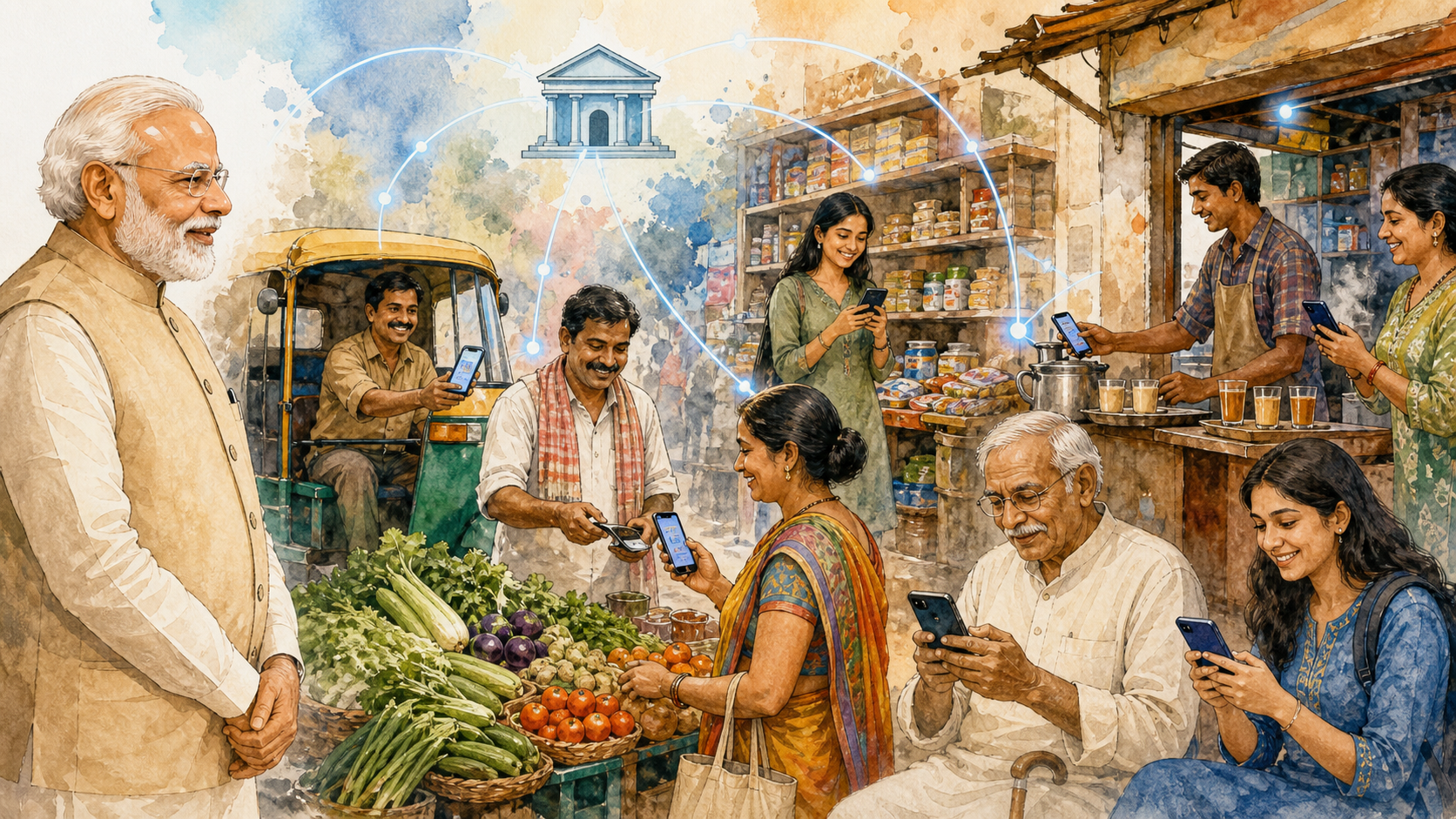
A decade ago, instant bank-to-bank payment through a mobile phone was still unfamiliar to most Indians. Today a vegetable seller, taxi driver, student and large retailer can use the same interoperable system. The Unified Payments Interface has completed ten years as one of the most visible examples of India's digital public infrastructure moving from government-backed architecture to an everyday economic habit.
The scale is extraordinary. The Akashvani report, citing Finance Ministry figures, said annual transaction volume rose from 1.78 crore in 2016-17 to more than 24,162 crore in 2025-26, an increase of nearly 13,000 times. Transaction value grew from about Rs 7,000 crore to nearly Rs 314 lakh crore. UPI is now operational across eleven countries.
Interoperability changed the market
UPI's decisive design choice was interoperability. A customer does not need the same bank or app as a merchant. Banks and payment providers compete on the user experience while transactions travel over a common set of rules. That prevents the market from fragmenting into closed networks where users are trapped inside one company's wallet.
This structure also lowered the entry barrier for innovation. Private firms could build apps and services without constructing a complete payment network from scratch. Banks gained a new channel, small merchants gained digital acceptance and consumers gained a simple way to move money in real time.
The Modi government's Digital India push provided political support for scale, while the Reserve Bank of India, National Payments Corporation of India, banks and technology companies supplied the institutional and technical work. UPI's success is best understood as coordinated public infrastructure rather than the achievement of a single app.
Financial inclusion becomes usable
A bank account creates potential access; a convenient payment rail makes that access useful. UPI allows small-value transactions without cash handling, change shortages or card terminals. Digital records can help a small business understand cash flow and may support access to formal credit, provided lenders use the data responsibly.
Women managing household enterprises, migrant workers sending money home and rural merchants can benefit from instant settlement. The gain is not the disappearance of cash, which remains important, but the addition of a low-friction option that works across institutions.
International expansion matters too. If Indian travellers can pay through familiar systems and partner countries adopt compatible rails, cross-border transactions may become cheaper and more transparent. Global use should preserve domestic resilience and strong consumer protection.
Scale creates a duty of reliability
When a system carries more than 24,000 crore annual transactions, even a tiny failure rate affects many people. Capacity planning, redundancy and rapid incident communication are therefore essential. Users should know whether a failed payment will reverse automatically and how long resolution will take.
Competition among apps should not weaken the shared infrastructure. Banks must maintain systems capable of handling peak volumes, while NPCI and regulators need transparent performance standards. Innovation at the interface is valuable only when the underlying payment remains dependable.
Fraud is the next major battle
Most UPI fraud exploits people rather than breaking the core payment rail. Criminals impersonate officials, send collect requests, circulate malicious links or persuade victims to share credentials. The simplicity that enables adoption can also make a hurried user vulnerable.
India needs continuous education in local languages, especially for first-time users and senior citizens. Apps can reduce risk by displaying clearer warnings, slowing suspicious flows and making the direction of money unmistakable. Banks and telecom companies should coordinate faster when mule accounts or fraudulent numbers are identified.
Complaint handling must become as intuitive as payment. A victim should not have to navigate several agencies while money moves through multiple accounts. Time is critical, so reporting, freezing and investigation need shared digital workflows.
The next decade
UPI can support feature-phone access, offline payments, recurring mandates and new cross-border links, but inclusion should guide every expansion. People with limited connectivity, disabilities or lower digital literacy need interfaces designed for them. Consent and privacy must remain clear as payment data supports additional services.
Prime Minister Modi described the anniversary as a turning point and invited citizens to share their experiences. Those experiences are the strongest evidence of success: a payment completed in seconds, a merchant avoiding cash risk or a family transferring money during an emergency.
UPI's first decade proves that India can create digital systems at population scale without closing the market to private innovation. Its next decade should deepen trust, global reach and inclusion. The achievement is not merely technological. It is the creation of a shared economic utility that has become part of ordinary Indian life.
The public-policy lesson reaches beyond payments. India succeeded because it defined interoperable rails, allowed many banks and applications to compete on top of them and kept the basic act of transferring money easy for the user. Future digital public infrastructure should preserve that balance. Open access requires strong technical standards, predictable governance and meaningful consumer choice. Scale must not become an excuse for weak grievance redressal or excessive collection of personal data. If the second decade combines convenience with resilience and privacy, UPI can remain both an Indian success and a credible model for countries seeking affordable, inclusive digital finance.



