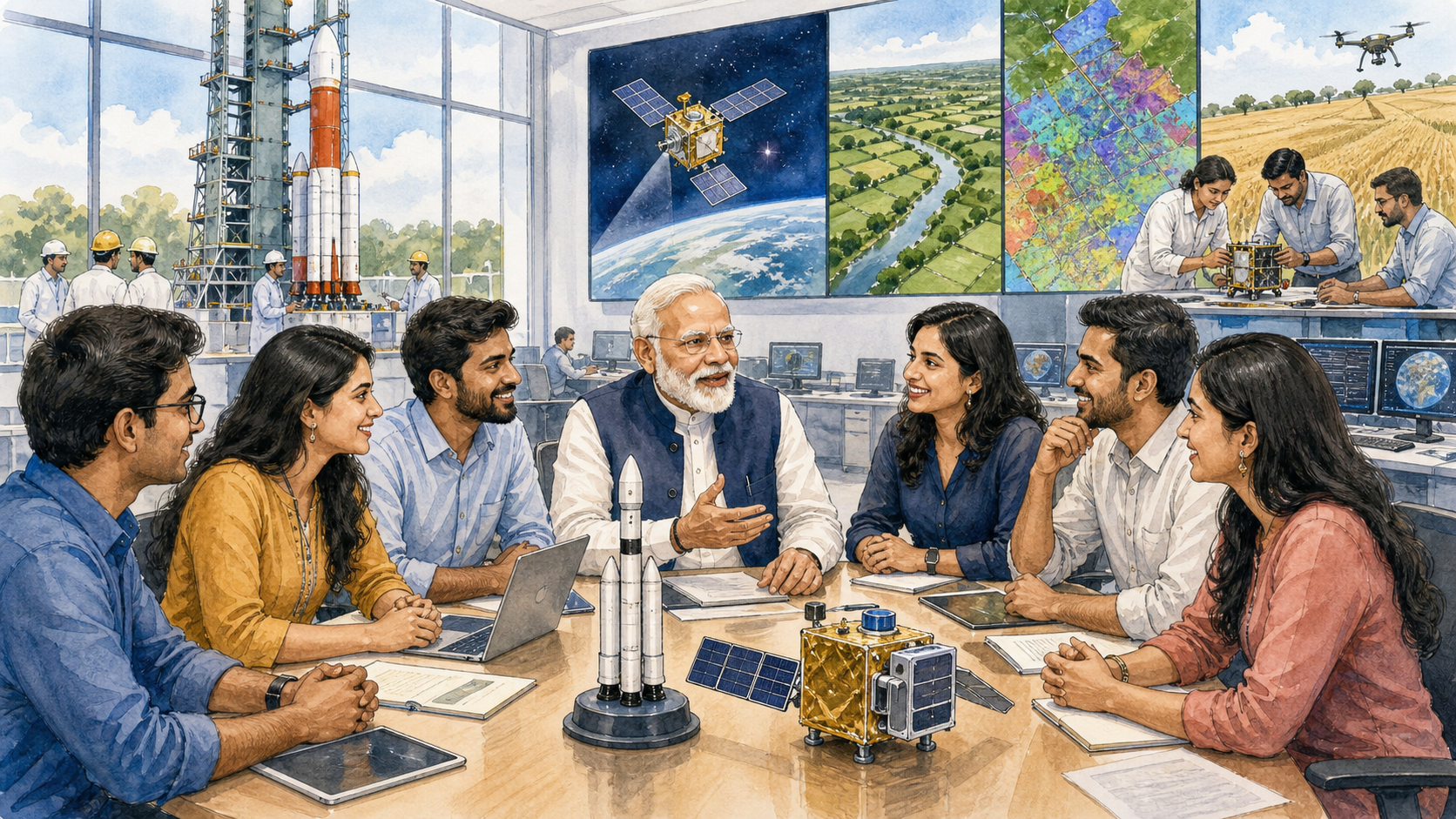
Analysis: India's space story is no longer confined to government missions and spectacular launch days. Prime Minister Narendra Modi's meeting with the founders and chief executives of 20 private space start-ups shows that the next phase is about building a complete industry: launch vehicles, satellites, propulsion, earth observation, orbital services and applications that improve life on the ground.
According to Akashvani's August 21 report, Modi urged entrepreneurs to apply space technology to agriculture, livestock management, dairy, the environment and other everyday sectors. He said India should create an ecosystem that attracts global talent, companies and investment whenever the world thinks about space.
Twenty founders, one expanding ecosystem
The meeting included founders from Skyroot Aerospace, Agnikul Cosmos, Pixxel, Dhruva Space, GalaxEye, PierSight, Bellatrix Aerospace and Digantara, among others. That range matters. A mature space economy cannot be built by one rocket company or one satellite operator. It needs launch providers, component suppliers, imaging companies, tracking services, ground stations, software, insurance and customers willing to buy the resulting data.
India's public space programme created decades of scientific credibility. The reform challenge was to let private firms build on that foundation without weakening safety or strategic oversight. The Indian Space Policy 2023 clarified roles for ISRO, IN-SPACe, NewSpace India Limited and non-government entities. Entrepreneurs now have a more visible route to authorisation, infrastructure and commercial activity.
Modi's reform bet is becoming tangible
The BJP-led government's decision to open more of the sector to private participation was initially a policy promise. It is now visible in hardware, investment and specialised teams. Indian start-ups have attempted private launches, developed small-satellite platforms, built hyperspectral imaging systems and designed technologies for propulsion and space situational awareness.
Government support should not mean protecting every firm from commercial pressure. Space is expensive and some ventures will fail. The state's role is to provide predictable rules, access to testing facilities, fair procurement and patient support for technologies with strategic value. Competition should then decide which business models are sustainable.
Space technology must reach ordinary citizens
Modi's emphasis on practical applications is the right test. Satellite data can identify crop stress, estimate water availability, monitor coastal erosion, support fisheries, map flood damage and improve logistics. Better weather and earth-observation services can help a district administration act earlier rather than compensate after a disaster.
For farmers, the value lies not in receiving another complex map but in getting a reliable recommendation at the right time and in the right language. Start-ups therefore need partnerships with agricultural universities, cooperatives, state departments and rural technology companies. The final service must be affordable, explainable and easy to use.
The same logic applies to dairy and livestock management. Remote sensing cannot replace field knowledge, but it can support fodder planning, water assessment and disease-response logistics. In cities, satellite imagery can help monitor construction, heat islands, drainage and transport corridors.
From Atal Tinkering Labs to advanced engineering
The Prime Minister also encouraged links with Atal Tinkering Labs. That is more than youth outreach. India needs a long pipeline of students comfortable with electronics, materials, coding, robotics and scientific experimentation. Space can make those disciplines exciting, but schools need mentors, equipment and opportunities to solve real problems.
Universities must also deepen research partnerships with industry. Start-ups cannot import every specialised component forever, and academic laboratories should not remain disconnected from commercial timelines. Joint fellowships, shared testing facilities and clearer intellectual-property arrangements can shorten the distance from a thesis to a flight-ready system.
The next policy tasks
India still needs stronger space-finance mechanisms, insurance capacity, procurement certainty and export processes. Start-ups working on dual-use technologies require clear security guidance. Spectrum and orbital resources must be managed transparently, while debris mitigation and responsible operations must remain non-negotiable.
Public procurement can create an early domestic market, but agencies should buy outcomes rather than subsidise weak products. A state could contract for verified crop-loss maps or flood alerts, allowing competing companies to provide the best service.
A credible new Indian industry
The positive significance of Modi's meeting is that private space enterprise has moved into the mainstream of national policy. The government is no longer asking whether Indian companies should participate; it is asking how they can become globally competitive and socially useful.
If the reform process remains stable, India can offer the world a distinctive model: the scientific depth of ISRO, the speed of start-ups, a large domestic applications market and public policy focused on inclusive development. That is how a country progresses from launching missions to building lasting space power.



