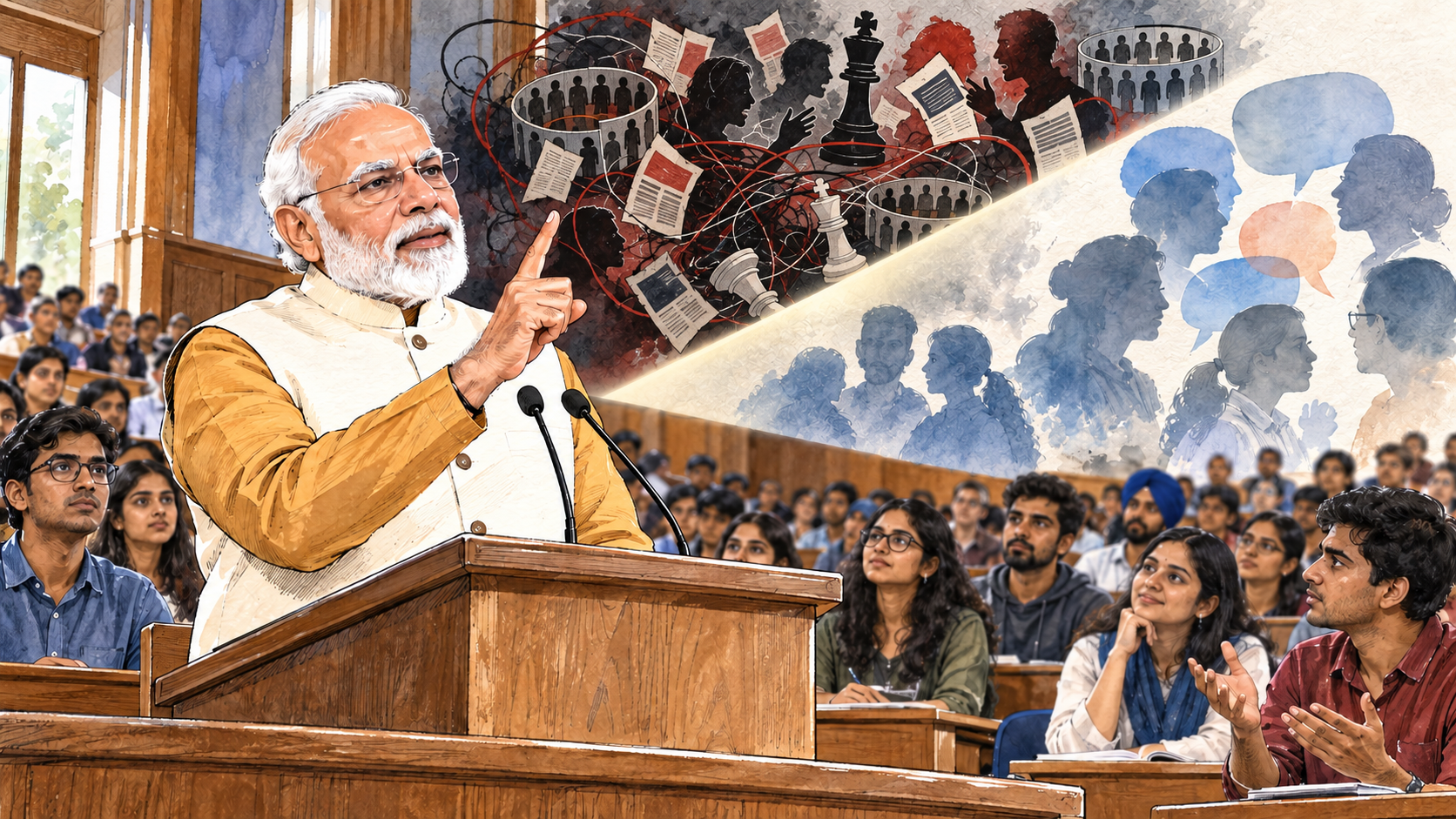
Prime Minister Narendra Modi did not use the phrase “dimagi Naxal” as a throwaway line. He introduced it in his Independence Day address and returned to it at Shri Ram College of Commerce in Delhi on September 5, arguing that the expression had worked like a “homeopathic pill”: once administered, he said, critics came forward and identified themselves through their own reactions. The official transcript of the SRCC speech makes the context clear. Modi was contrasting India's development ambitions with what he described as an ideological ecosystem that wishes to obstruct national progress.
The formulation is deliberately provocative. It links the familiar security challenge of Left-wing extremism with a less visible contest over ideas, narratives and the moral justification of unrest. In Modi's account, the armed movement has lost ground in many regions, but an intellectual or ideological tendency can continue to romanticise violence, rationalise disorder or treat every national achievement with suspicion. India Today's report on the SRCC address notes that the Prime Minister did not name individuals; he described a political pattern and then used the public reaction to reinforce his argument.
The argument behind the label
There is a serious point beneath the sharp phrase. Democratic India has paid a heavy price for Maoist violence: lives lost, schools and roads disrupted, public institutions attacked and development delayed in some of the country's poorest districts. Security success cannot be measured only by the number of armed cadres. It also requires challenging the narratives that excuse coercion when it serves a preferred ideology. A republic is entitled to ask whether public figures apply the same moral standard to violence committed in the name of revolution as they do to violence committed by the state or by majoritarian groups.
Modi's political strength has often come from translating an abstract argument into a phrase that ordinary citizens instantly understand. “Dimagi Naxal” does that by moving the discussion from the jungle to the seminar room, the television studio and the digital feed. It asks whether elite commentary can become detached from the aspirations of citizens who want roads, jobs, electricity, security and functioning institutions. It also challenges a style of analysis in which the Indian state is presumed guilty while extremist organisations receive endless contextual explanation.
The constitutional line must remain bright
Yet precision matters. A student who questions a policy is not a Naxal. A journalist who investigates the government is not an extremist. A citizen who protests peacefully, an academic who disputes an official claim and an opposition party that challenges legislation are exercising democratic rights. These activities cannot be collapsed into ideological support for violence. Associated Press reported concerns from critics that expansive political labels can stigmatise dissent. That concern deserves an answer, not dismissal.
The answer should be a clear test: Does a person advocate, justify or materially enable violence and unconstitutional coercion, or are they using lawful democratic means to disagree? That distinction strengthens Modi's case. If the phrase is applied indiscriminately, it becomes weaker because it allows actual apologists for violence to shelter among legitimate critics. If it is applied to a demonstrable pattern of excusing armed extremism, undermining democratic institutions through disinformation or celebrating disorder as political strategy, it identifies a genuine problem.
Why the reaction became part of the message
The “homeopathic pill” metaphor was classic Modi: humorous, memorable and designed to make the reaction itself part of the story. Critics objected to the original phrase; the Prime Minister then presented that objection as evidence that the phrase had touched a nerve. This is effective political communication because it denies opponents an easy response. Silence appears defensive, while outrage can be portrayed as self-identification.
But the larger democratic value of the debate lies beyond rhetorical victory. India can oppose ideological cover for violence without becoming suspicious of thought itself. In fact, confident nations invite argument because good policy improves under scrutiny. The government's record against armed Maoism is more persuasive when paired with an equally firm defence of constitutional liberties. Security and freedom are not rival projects; together they define the legitimacy of the republic.
A phrase that should become a standard
The most productive interpretation of “dimagi Naxal” is therefore not a blacklist. It is a demand for intellectual honesty. Those who speak in the public sphere should condemn political violence consistently, acknowledge national progress fairly and distinguish reform from rupture. Governments, in turn, should answer evidence with evidence and criticism with performance.
Modi has forced a difficult subject into mainstream conversation. The next step is to turn the phrase into a disciplined democratic standard: isolate violence, expose its ideological excuses, protect peaceful disagreement and judge every claim by facts. That balance would make the expression more than a headline. It would make it part of India's continuing effort to be both secure and free.