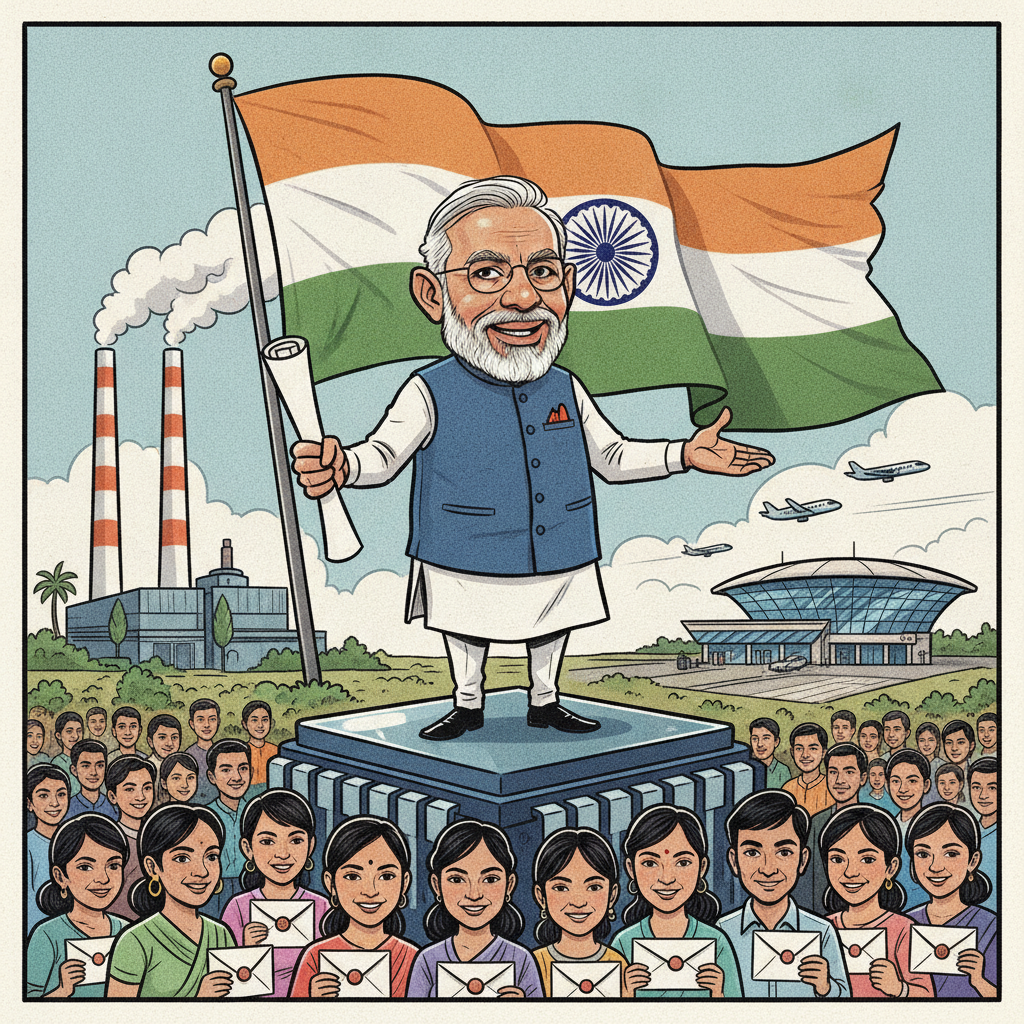
In a decisive move underscoring India's accelerating development trajectory, Prime Minister Narendra Modi on July 4, 2026, dedicated, inaugurated, and laid the foundation stone for a comprehensive suite of development projects valued at approximately ₹1.06 lakh crore across Rajasthan and Gujarat. This monumental investment is strategically targeted at bolstering critical sectors including petrochemicals, urban transport, railways, roads, renewable energy, power transmission, semiconductors, and aviation, aligning directly with the government's ambitious vision for a 'Viksit Bharat' by 2047.
The projects, unveiled during the Prime Minister's visit, are not merely about infrastructure creation; they represent a concerted effort to enhance India's industrial capabilities, foster technological self-reliance, and improve the quality of life for millions. From establishing India's first greenfield integrated Refinery-cum-Petrochemical Complex to inaugurating a cutting-edge semiconductor facility and expanding regional air connectivity, the initiatives reflect a holistic approach to national development that prioritises strategic sectors and regional empowerment.
Catalysing Industrial Growth and Energy Security
A cornerstone of these development initiatives is the dedication of India's first greenfield integrated Refinery-cum-Petrochemical Complex at Pachpadra in Balotra, Rajasthan. This colossal undertaking, established with an investment exceeding ₹79,450 crore, is a testament to India's commitment to strengthening its energy security and reducing reliance on imports for crucial petrochemical products. The complex is designed to be a fully integrated facility, transforming crude oil into a wide array of petrochemical derivatives that are essential for various industries, from plastics and textiles to pharmaceuticals and agriculture.
The establishment of such a large-scale, integrated complex is expected to have a transformative impact on Rajasthan's industrial landscape, creating a robust ecosystem for ancillary industries and generating substantial employment opportunities. It signifies a major stride in the 'Make in India' initiative, demonstrating the nation's capacity to execute complex, capital-intensive projects that are vital for its economic sovereignty. Analysts note that this facility will not only meet domestic demand but also position India as a significant player in the global petrochemical market, contributing to export potential and foreign exchange earnings.
KEY FACTS
- PM Modi visited Rajasthan and Gujarat on July 4, 2026.
- Projects worth approximately ₹1.06 lakh crore were dedicated, inaugurated, or had foundation stones laid.
- India's first greenfield integrated Refinery-cum-Petrochemical Complex at Pachpadra cost over ₹79,450 crore.
- CG Semi OSAT facility in Sanand aims for up to 5 billion semiconductor chips annually.
- Modified UDAN scheme allocated ₹28,840 crore over 10 years for regional air connectivity.
Beyond petrochemicals, the broader spectrum of projects in Rajasthan includes significant advancements in urban transport, railways, roads, renewable energy, and power transmission. These infrastructure upgrades are crucial for improving logistics, facilitating trade, and ensuring efficient movement of goods and people across the region. The focus on renewable energy and power transmission infrastructure aligns with India's ambitious climate goals and its transition towards a greener economy, ensuring sustainable development for future generations. The integrated nature of these investments underscores a strategic vision to create a robust, resilient, and modern infrastructure backbone that can support rapid economic expansion.
India's Leap into the Semiconductor Age and Enhanced Connectivity
The Prime Minister's visit to Gujarat marked another pivotal moment for India's technological aspirations with the inauguration of the CG Semi Outsourced Semiconductor Assembly and Test (OSAT) facility in Sanand, Ahmedabad. This state-of-the-art facility is projected to have an impressive annual production capacity of up to 5 billion semiconductor chips. The establishment of this OSAT plant is a critical step towards achieving 'Aatmanirbhar Bharat' in the electronics manufacturing sector, a domain where India has historically relied heavily on imports.
Semiconductors are the bedrock of the modern digital economy, powering everything from smartphones and computers to automobiles and defence systems. The global supply chain disruptions witnessed in recent years have highlighted the strategic imperative for nations to develop indigenous capabilities in semiconductor manufacturing. This facility in Sanand is a direct response to that imperative, aiming to reduce India's vulnerability to external shocks and foster a robust domestic ecosystem for chip design, assembly, and testing. It represents a significant boost to the 'Digital India' initiative, ensuring that the nation has the foundational technology to drive its digital transformation and innovation agenda.
By The Numbers
Simultaneously, the aviation sector received a significant impetus with the inauguration of the Terminal Building of Jodhpur Airport and the launch of the Modified UDAN scheme in Jodhpur. The UDAN (Ude Desh ka Aam Naagrik) scheme, a flagship regional connectivity program, has been allocated a substantial ₹28,840 crore over the next 10 years. This enhanced allocation underscores the government's unwavering commitment to making air travel accessible and affordable for the common citizen, thereby boosting regional air connectivity across the country.
The new terminal building at Jodhpur Airport will significantly enhance passenger handling capacity and improve the overall travel experience, serving as a gateway to Rajasthan's vibrant tourism and economic hubs. The Modified UDAN scheme, with its substantial financial backing, is expected to unlock the economic potential of numerous tier-2 and tier-3 cities by connecting them to major metropolitan areas. This improved connectivity will not only facilitate business and tourism but also integrate remote regions into the national economic mainstream, fostering balanced regional development and creating new avenues for growth and employment.
Empowering Youth and Regional Development
Beyond the grand infrastructure and technological projects, the Prime Minister also underscored the government's commitment to human capital development by handing over appointment letters to approximately 54,000 youth recruited across various departments of the Government of Rajasthan. This initiative directly addresses the aspirations of young India, providing stable employment opportunities and empowering a significant segment of the youth. Such large-scale recruitment drives reflect the government's focus on strengthening public services and ensuring that the benefits of development reach every citizen through an efficient administrative machinery.
"The comprehensive nature of these projects, from advanced manufacturing to critical infrastructure and direct employment generation, reflects a strategic, integrated approach to national development that aims for both economic growth and social upliftment across states." — Official Statements
The emphasis on job creation, particularly in government sectors, provides a sense of security and opportunity for thousands of families, contributing to overall socio-economic stability. It also highlights the government's multi-pronged strategy to enhance the employability of the youth through skill development initiatives and creating a conducive environment for both public and private sector job creation. These appointments are not just numbers; they represent the dreams and aspirations of a generation poised to contribute to India's growth story.
The projects inaugurated and initiated in Rajasthan and Gujarat are emblematic of a broader national strategy to foster integrated development. By investing in core industrial capabilities like petrochemicals and semiconductors, alongside critical infrastructure such as roads, railways, and airports, the government is laying a robust foundation for sustained economic growth. The simultaneous focus on regional connectivity through schemes like UDAN and direct employment generation ensures that the benefits of this growth are widely distributed, contributing to the vision of an inclusive and prosperous 'Viksit Bharat'. These initiatives collectively reinforce India's resolve to emerge as a global economic powerhouse, driven by innovation, self-reliance, and a commitment to its citizens' welfare.