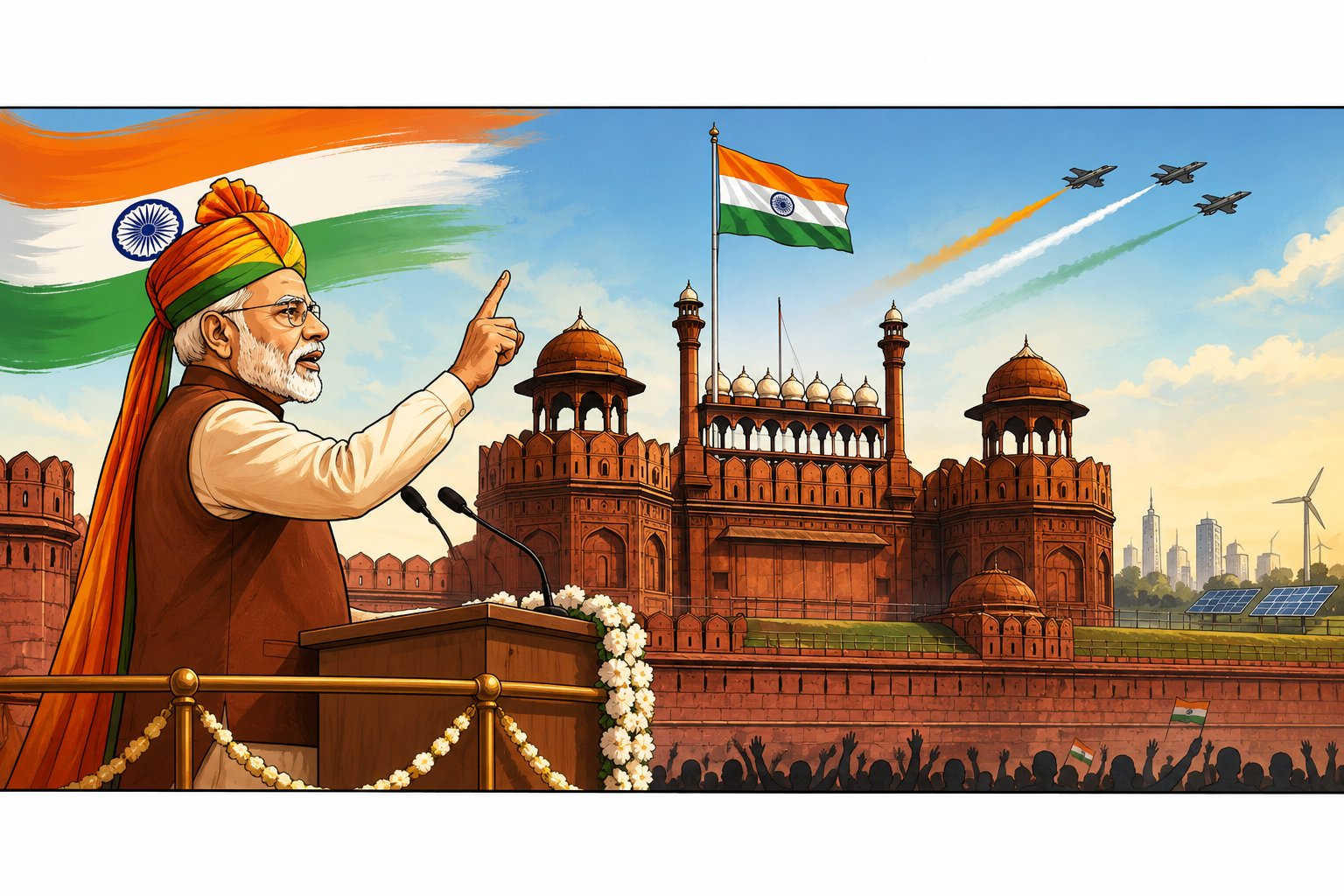
The 80th Milestone: Strategic Cadence at the Red Fort
Addressing the nation from the ramparts of the Red Fort on India's 80th Independence Day, Prime Minister Narendra Modi delivered a speech characterized by calculated governance signaling, institutional transition, and forward-looking economic positioning. Rather than relying solely on populist rhetoric, the address functioned as an operational checkpoint for the long-term national roadmap toward Developed India 2047. Standing before a global and domestic audience in August 2026, the Prime Minister framed the coming two decades not merely as a period of incremental growth, but as an unforgiving window during which India must resolve its structural contradictions or risk missing its demographic dividend.
Bipartisan Bridge: Operationalising Women's Legislative Quotas
Among the most politically consequential elements of the address was an explicit appeal for political cooperation across party lines regarding the operational execution of the women's reservation mandate. With preparatory administrative processes, including national enumeration and boundary delimitation, moving closer to implementation, the Prime Minister called upon all political formations to build consensus rather than weaponize procedural timelines.
"True institutional reform cannot remain an instrument of partisan contestation. Ensuring thirty-three percent representation for our women in Parliament and state assemblies is a national commitment that demands collective legislative maturity and cooperative federalism," the Prime Minister stated.
In policy terms, this appeal signals an awareness of the friction that delimitation and seat allocation could generate between northern and southern states. By calling for collaborative implementation, the administration is attempting to pre-empt federal disputes and position the realization of gender quotas as a collective national achievement rather than a unilateral executive decree.
Demographic Realities: Youth Leadership in Frontier Sectors
Addressing the country's vast youth cohort, the speech moved past traditional employment assurances to focus on technological sovereignty, advanced manufacturing, and administrative entry points. The Prime Minister emphasized that India's geopolitical leverage over the next twenty years rests entirely on whether its young workforce transitions from technology consumers to intellectual property creators.
The policy commitments outlined in the address focused on expanding domestic research ecosystems, fostering semiconductor and clean-tech supply chains, and systematically integrating young professionals into civic governance and public policy architecture. Analysts observe that this youth-centric narrative addresses a critical economic challenge: generating high-value employment capable of absorbing millions of graduates entering an increasingly automated global market.
Internal Security: The End of Armed Maoism and the Ideological Frontier
On internal security, the Prime Minister offered an uncompromising assessment of the country's counter-insurgency landscape. He officially declared that armed Left-Wing Extremism, which once dominated vast swathes of central and eastern India, is in its final operational stages due to relentless security consolidation and rural infrastructure expansion.
However, the Prime Minister drew a sharp distinction between physical insurgencies and their broader support networks, warning that ideological ecosystems that rationalize or legitimize violence against the state remain an ongoing challenge. He noted that while weapons can be seized and command structures dismantled by security forces, countering intellectual and logistical narratives that challenge the constitutional order requires sustained institutional and societal vigilance.
This dual assessment reflects a strategic shift in internal security doctrines: moving from tactical kinetic operations against forest-based guerilla squads toward dismantling financial, legal, and intellectual conduits that sustain non-state violence.
The Developed India 2047 Blueprint: Structural Realities
Weaving these themes together was the overarching framework of Developed India 2047. The Prime Minister reiterated that the mid-century goal is not an abstract target but a metrics-driven destination requiring sustained gross domestic product growth, comprehensive infrastructure modernisation, decarbonization, and universal social security access.
Crucially, the address linked domestic stability directly to external resilience. In an increasingly fragmented multipolar world, the Prime Minister argued, India's strategic autonomy depends on domestic industrial self-reliance, strategic energy security, and resilient maritime trade corridors across the Indo-Pacific.
Strategic Takeaways: Balancing Ambition with Execution
The 2026 Independence Day address offered a comprehensive picture of an administration balancing legacy consolidation with future imperatives. By addressing contentious issues like political consensus on representation and the ideological fringes of internal security, the speech acknowledged that governance cannot afford complacency.
As India navigates its eighth decade of independence, the metrics of success will not be measured by the scale of announcements, but by the efficiency of implementation. The call for national consensus, the defense of internal stability, and the relentless drive toward 2047 establish a clear governance agenda: one where national ambition must be matched by institutional precision and democratic cohesion.



