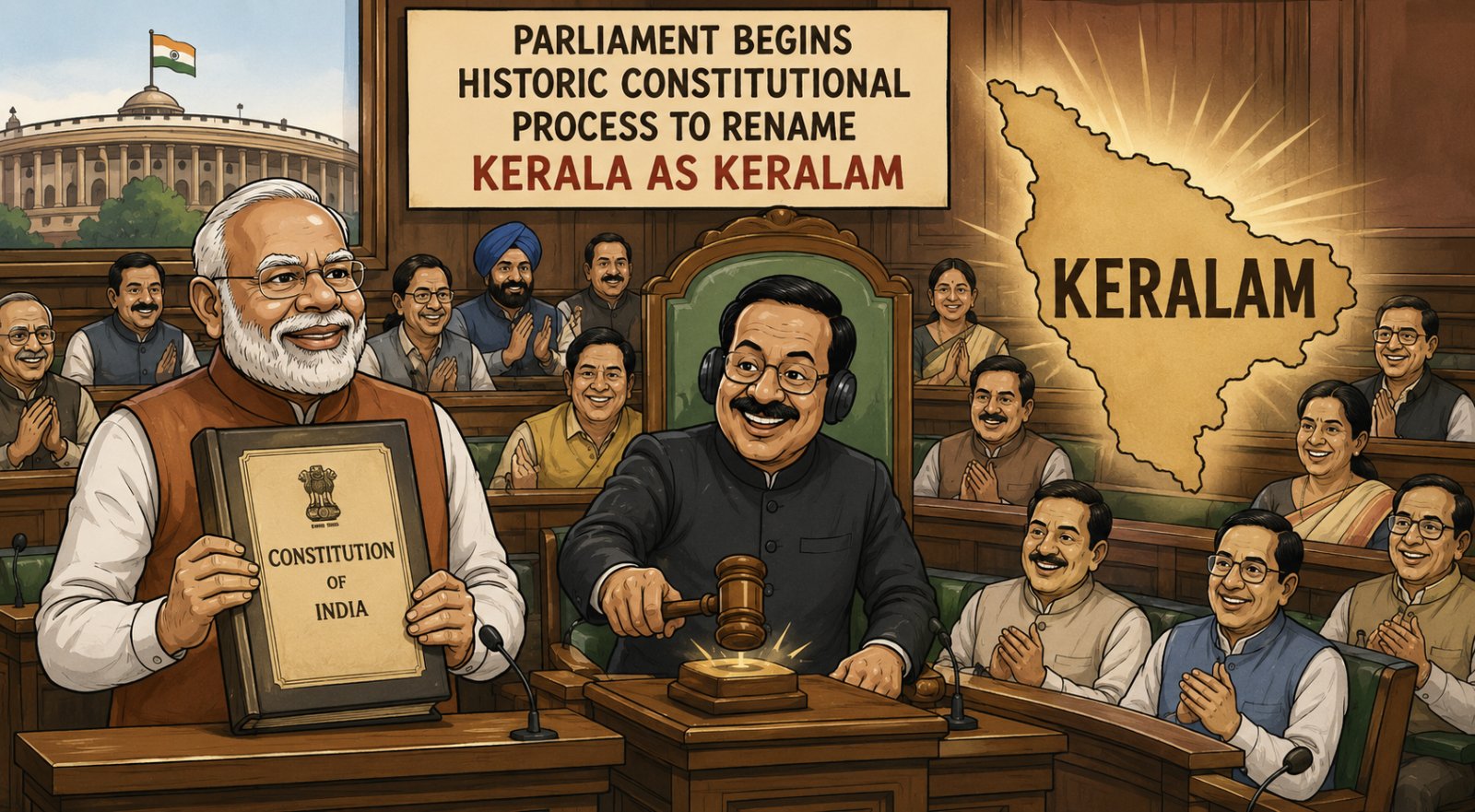
The Parliamentary Turning Point
On August 10, 2026, the Parliament of India witnessed a significant moment in modern federal governance as Union Home Minister Amit Shah introduced the Kerala (Alteration of Name) Bill, 2026 in the Lok Sabha. The primary objective of the proposed constitutional legislation is straightforward yet deeply symbolic: to amend the First Schedule of the Constitution of India and formally alter the name of the southern coastal state from 'Kerala' to 'Keralam'. This legislative action represents the culmination of multi-year assembly resolutions, federal consultations, and constitutional procedures designed to harmonize official English records with the native Malayalam pronunciation that has defined the region's cultural ethos for generations.
The introduction of the bill reflects a rare instance of cross-party alignment across India's political landscape. In an era often marked by robust partisan debate between state governments and the central administration, the proposal to adopt 'Keralam' enjoys unanimous support from the Kerala Legislative Assembly, bridging the ideological spectrum between the ruling Left Democratic Front and the opposition United Democratic Front. As the legislation moves through parliamentary consideration, it opens a substantive national conversation regarding linguistic identity, post-colonial nomenclature, federal procedure, and the practical demands of state-level administrative transition.
Decolonizing Nomenclature and Historical Roots
The name 'Keralam' is far more than a modern administrative preference; it is an ancient descriptor deeply embedded in classical literature, historical inscriptions, and regional consciousness. Historically, the geographic area was referred to as Keralam in early Sangam texts and classical treatises, designating the land lying between the Western Ghats and the Arabian Sea. However, during the era of British colonial rule, foreign cartographers and administrators simplified and anglicized the native pronunciation into 'Kerala'.
While 'Kerala' became the official title enshrined in the First Schedule when the state was formally carved out on November 1, 1956 under the States Reorganisation Act, the local populace continued to refer to their home almost exclusively as 'Keralam' in Malayalam. The movement to formalize native nomenclature gained momentum during the independence movement and the subsequent Aikya Kerala movement, which sought the unification of Malayalam-speaking territories across Travancore, Cochin, and Malabar.
"Keralam is historically the most apt name since our state's identity has been anglicized for so long. Restoring our native linguistic title in the Constitution fulfills a decades-old cultural aspiration."
A milestone in this intellectual evolution occurred in 1948 when pioneer leader E.M.S. Namboodiripad authored his influential work, 'Keralam: Malayalikalude Mathrubhumi' (Keralam: The Motherland of Malayalis). Namboodiripad articulated a vision of a unified state whose socio-political consciousness was intrinsically linked to its linguistic heritage. For decades, scholars and parliamentarians maintained that preserving 'Kerala' in official English gazettes while using 'Keralam' in regional speech represented an unnecessary dual identity. The present bill resolves this long-standing discrepancy, establishing a singular, constitutionally recognized title across all official languages.
The Constitutional Mechanism Under Article 3
The procedural pathway for changing the name of an existing state in India is strictly governed by Article 3 of the Constitution. Under this provision, Parliament holds the authority to form new states, alter boundaries, or change state names, provided specific consultative safeguards are observed. The journey of the 2026 bill serves as a structured demonstration of constitutional federalism in action.
The formal process began when the Kerala Legislative Assembly adopted unanimous resolutions requesting the Central Government to initiate name alteration under the First and Eighth Schedules. Following inter-ministerial evaluations involving the Ministry of Home Affairs and the Ministry of Law and Justice, the Union Cabinet chaired by Prime Minister Narendra Modi approved the draft proposal in February 2026.
In accordance with Article 3 mandates, President Droupadi Murmu referred the draft Kerala (Alteration of Name) Bill to the Kerala Legislative Assembly in June 2026 to obtain the views of state legislators. Marking a historical procedural milestone, the Kerala Assembly convened a special sitting in July 2026 and unanimously ratified all ten clauses of the draft bill without amendments. With state concurrence formally recorded, the central government cleared the bill for introduction in Parliament's Monsoon Session.
Political Perspectives and Bipartisan Consensus
While the bill has traversed constitutional channels with notable smooth progress, political commentators highlight nuanced perspectives regarding its broader context and timing. Within Kerala, Chief Minister Pinarayi Vijayan's administration has framed the name change as a victory for regional dignity, cultural autonomy, and linguistic pride. The opposition United Democratic Front supported the resolution to present a unified state stance, underscoring that the identity of 'Keralam' transcends electoral competition.
At the central level, representatives of the ruling government emphasize that endorsing the state's request reflects a commitment to regional language empowerment and the decolonization of national institutions. Central leaders argue that responding to state assembly resolutions reinforces cooperative federalism and honors regional historical narratives.
Simultaneously, political analysts observe that the introduction of the bill ahead of upcoming state assembly elections carries strategic resonance. By facilitating the long-standing demand, the central leadership demonstrates responsiveness to Malayali sentiment. Conversely, some opposition voices advise that while symbolic accomplishments are welcome, legislative focus must remain equally attentive to pressing fiscal allocations, infrastructure development, and employment challenges facing the state.
Administrative Realities and the Transition Ahead
Beyond cultural symbolism and political discourse, the enactment of the Kerala (Alteration of Name) Bill, 2026 initiates a comprehensive administrative task spanning local, state, and central government machinery. Transitioning an established state title requires updating statutory legislation, digital databases, judicial records, official stationery, land registries, and physical signages across national highways and public offices.
Lawmakers have drawn attention to the administrative and financial commitments associated with this shift. During parliamentary discussions, Kollam MP N.K. Premachandran observed that while the name change aligns with public sentiment, the re-indexing of official records, judicial archives, and international registration records will involve noticeable administrative expenditure. Similarly, Rajya Sabha MP V. Sivadasan emphasized the necessity for seamless inter-departmental coordination to ensure citizens face minimal friction when updating personal documentation such as passports, tax identifiers, and property titles.
The state's global branding and economic footprint also enter a phase of alignment. Renowned internationally through its tourism descriptor 'God's Own Country', the state's commercial associations, export documentation for commodities like spices and rubber, and digital domain infrastructure will progressively integrate 'Keralam' into global promotional frameworks.
Precedents in Indian Federal History
The renaming of Kerala to Keralam aligns with a well-established history of Indian states adjusting their English titles to mirror native linguistic forms. Historical precedents include Madras State becoming Tamil Nadu in 1969, Mysore transitioning to Karnataka in 1973, Uttaranchal being renamed Uttarakhand in 2007, and Orissa becoming Odisha in 2011, alongside the union territory of Pondicherry adapting to Puducherry in 2006.
In each historical instance, the shift represented more than a change in lettering; it marked the ongoing refinement of linguistic federalism, validating regional self-identity within the unified constitutional architecture of India. The introduction and expected passage of the Kerala (Alteration of Name) Bill, 2026 illustrates the adaptive flexibility of the Indian Constitution in honoring cultural roots while preserving national cohesion. As Parliament completes the legislative process, Keralam prepares to take its official seat in the constitutional ledger, marking a historic synthesis of heritage, law, and federal partnership.