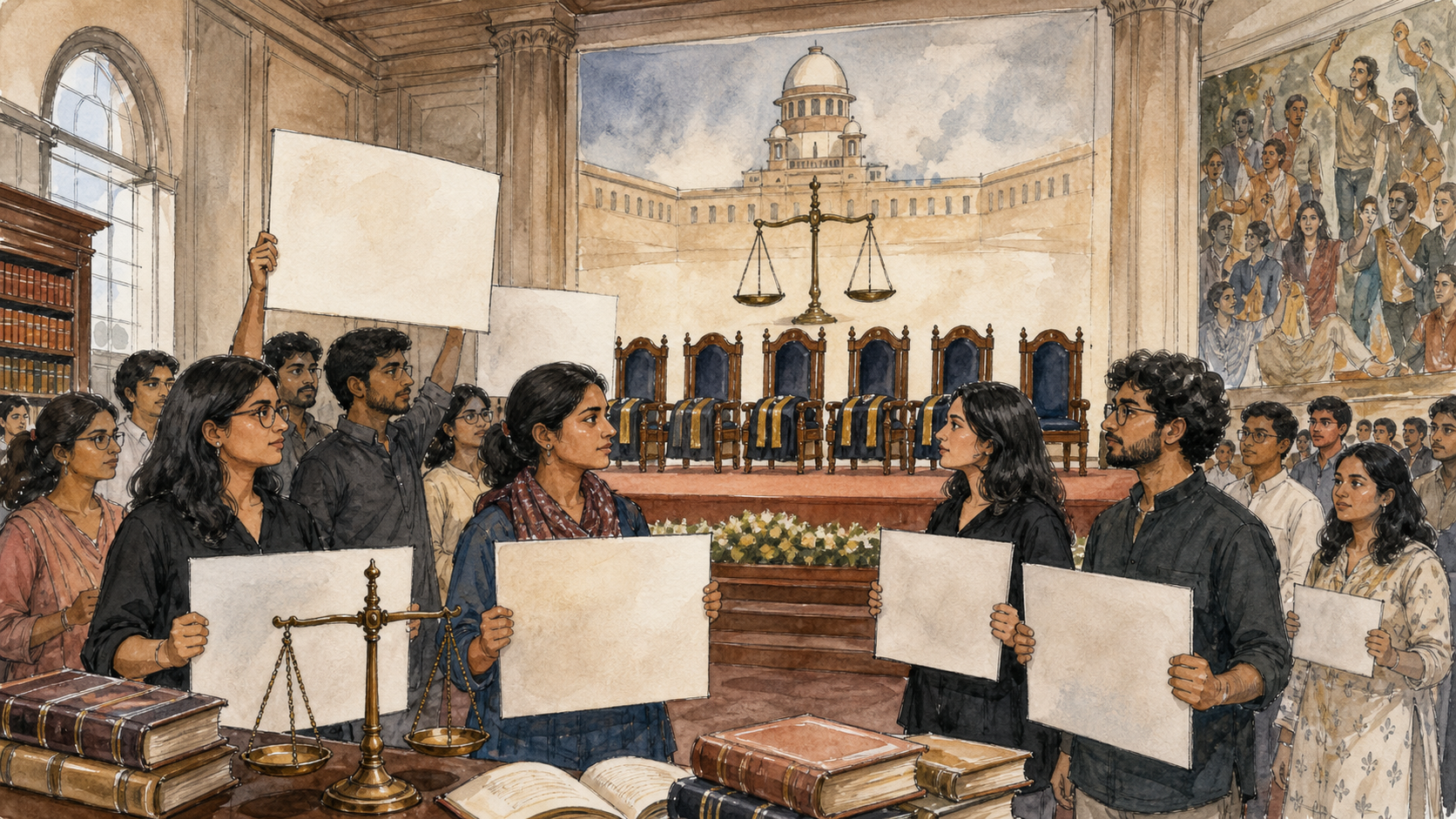
A deepening institutional friction within India’s premier legal academia reached a critical juncture this month as students and alumni of the National Law School of India University (NLSIU), Bengaluru, voiced strong objections to the proposed presence of Chief Justice of India Surya Kant and Bar Council of India (BCI) Chairman Manan Kumar Mishra at their annual convocation. The development, mirroring an earlier wave of dissent at the NALSAR University of Law in Hyderabad, has transformed a customary ceremonial occasion into a high-stakes constitutional conversation about university autonomy, statutory power, and the limits of institutional authority.
The Catalyst: The NALSAR Enrolment Directive
The immediate spark for the inter-varsity solidarity campaign traces back to a contentious regulatory dispute between the Bar Council of India and NALSAR. Earlier this year, the BCI had issued a communication questioning the compliance of NALSAR’s academic curriculum and governance procedures with statutory norms, culminating in a provisional cloud over the enrolment eligibility of its graduating class of 2026. The move sent shockwaves through the academic and legal community, threatening the immediate professional prospects of hundreds of graduating scholars.
While the regulatory directive was subsequently reported to have been withdrawn or kept in abeyance following extensive pushback from legal scholars, university administrations, and senior members of the Bar, the structural damage to institutional trust had already been done. To students and faculty across the National Law University (NLU) ecosystem, the initial directive was viewed not as a routine administrative inspection, but as a punitive exercise of regulatory muscle against an institution known for its critical pedagogical culture.
The regulatory mandate under the Advocates Act was designed to maintain uniform standards of practice, but its exercise must not infringe upon the academic independence and curricular innovation that define premier legal institutions.
Echoes Across Campuses: NLSIU's Stance
The decision of NLSIU student bodies and alumni associations to formally protest the invitation extended to the BCI leadership and the Chief Justice of India represents an unprecedented cross-institutional alignment. In representations submitted to the university’s governing authorities, signatories argued that honoring statutory leaders whose offices recently subjected peer institutions to contentious administrative pressure would be incongruous with the ethos of constitutional accountability championed by the university.
By invoking the foundational principles of the NLU movement—conceptualized in the late 1980s to liberate professional legal education from bureaucratic inertia—the dissenters framed their resistance not merely as a student protest, but as a defense of the statutory autonomy guaranteed to state-created law universities. NLSIU’s own governance structure, composed of the General Council, the Executive Council, and the Academic Council, has traditionally balanced statutory oversight with profound academic freedom.
Regulatory Mandate Versus Academic Independence
At the heart of the standoff lies a fundamental legal and constitutional question: What is the extent of the Bar Council of India's authority over autonomous national law universities? Under Section 7(1)(h) of the Advocates Act, 1961, the BCI is empowered to promote legal education and lay down standards in consultation with universities. However, the NLUs were established under independent state statutes, specifically designed to function as centers of advanced research rather than conventional vocational training colleges.
Over the past decade, observers in the legal fraternity have noted an increasing friction between the BCI’s centralized standardization efforts and the pedagogical flexibility demanded by modern global legal scholarship. When regulatory bodies attempt to dictate internal institutional governance or condition degree recognition on strict adherence to centralized diktats, it inevitably collides with the spirit of university self-determination.
The Delicate Line: Student Protest and Institutional Decorum
The controversy also highlights the evolving nature of student engagement with institutional hierarchies. For the university administration, managing convocation protocol is a delicate balancing act. The Chief Justice of India serves as the Visitor or Chancellor of several premier NLUs, embodying the judicial oversight and moral authority of the higher judiciary. Disinviting or publicly opposing the head of the judiciary presents acute administrative and diplomatic challenges for university leadership.
Critics of the student resolution argue that convocations are academic milestones that transcend individual administrative disputes, and that direct opposition to the highest judicial office risks eroding institutional decorum. Conversely, student representatives contend that dissent is a core constitutional value, and that inviting leaders without addressing lingering institutional grievances reduces convocations to uncritical ceremonial displays.
Constitutional Stakes for the Future of Legal Education
As the legal education ecosystem confronts these systemic tensions, the broader implications for Indian democracy are unmistakable. National Law Universities serve as the incubators for the country's future judges, jurists, policy architects, and constitutional defenders. If these spaces are perceived to be vulnerable to coercive regulatory control, the vibrancy of legal discourse itself is jeopardized.
The current impasse demands a structural dialogue between the Bar Council of India, the judiciary, and university administrations. Rather than viewing campus dissent as administrative insubordination, the legal establishment must engage with the substantive concerns regarding regulatory reach, transparency in decision-making, and institutional autonomy. How this controversy is navigated will set a crucial precedent for the independence of higher education in modern India.
Source and further reading
This analysis draws on reporting by NDTV. Claims attributed to public officials or institutions remain attributed in this article.



