An Unprecedented Stand-Off in Indian Legal Education
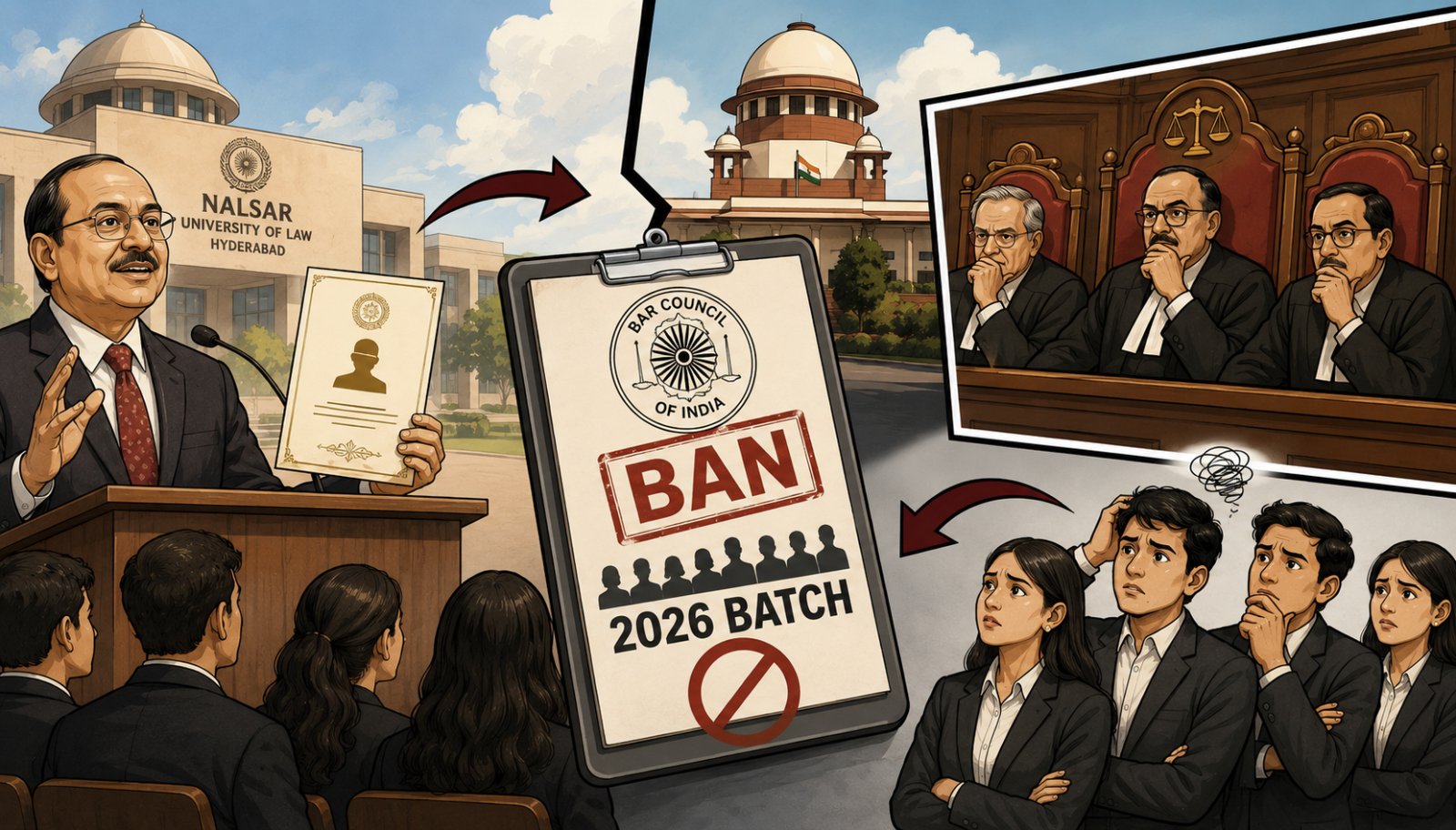
In what is rapidly evolving into a defining constitutional and institutional flashpoint for higher legal education in India, the Bar Council of India (BCI) has initiated disciplinary measures against the graduating batch of NALSAR University of Law, Hyderabad. The dispute arose following a resolution passed by sections of the student body opposing the invitation of a senior Supreme Court judge to their annual convocation ceremony. The regulatory body's stern intervention, which threatens the professional enrollment prospects of an entire cohort, has laid bare deep ideological and administrative fault lines between the legal establishment and premier law schools.
The controversy, unfolding across August 2026, centers on the delicate balance between the disciplinary jurisdiction of the statutory regulator and the constitutionally protected right to peaceful dissent within academic institutions. As petitions are drafted and emergency executive council meetings convened, the episode has drawn scrutiny from senior advocates, former members of the higher judiciary, legal scholars, and civil liberty advocates across the country.
The Anatomy of the Convocation Controversy
The origins of the crisis trace back to internal student council deliberations at NALSAR regarding the guest list for the upcoming convocation ceremony. A faction of the graduating Class of 2026 submitted a formal representation to the university administration, questioning the selection of the chief guest on grounds relating to past judicial pronouncements and administrative decisions. While the student body framed its memorandum as an exercise in institutional democracy and academic critique, the document was subsequently leaked to public forums and social media platforms, transforming a campus debate into a national headline.
The response from the organized bar was swift and decisive. Observing that any public slight toward constitutional figures and designated senior members of the judiciary undermines the authority of the courts, the regulatory authorities issued a sweeping notice. The council asserted that aspiring advocates must demonstrate uncompromising fidelity to judicial institutions even before taking the formal oath of enrollment, warning that acts deemed derogatory to the dignity of the bench could disqualify candidates from entering the legal profession.
The practice of law is not merely an occupation; it is a public trust bound by rigorous ethical conventions. When students at premier national law universities engage in collective boycotts of constitutional functionaries, it strikes at the institutional respect upon which the entire justice delivery system rests.
Statutory Authority and the Advocates Act
At the center of this administrative confrontation lies the Advocates Act of 1961, the cornerstone statute governing the legal profession in India. Under Section 7 and Section 24 of the Act, the Bar Council is entrusted with broad supervisory powers over standards of professional conduct, legal education, and conditions for entry into the roll of advocates. The council maintains that its oversight is not restricted strictly to enrolled lawyers, but extends to the standards maintained by accredited universities and the fitness of candidates seeking admission to the bar.
However, leading constitutional experts argue that the council's punitive reach cannot precede enrollment in such a collective and blanket manner. Under established administrative jurisprudence, character assessments and fitness checks must be conducted on an individualized basis, rather than imposing collective sanctions upon an entire graduating class. Critics have raised concerns that subjecting university-level expression to retrospective disqualification sets a chilling precedent that could suppress academic freedom and vibrant debate within national law universities.
Academic Autonomy Under Pressure
National Law Universities were established precisely to foster critical thinking, legal scholarship, and deep constitutional awareness among young jurists. Faculty members and academic leaders have voiced profound concern over the potential erosion of university autonomy if statutory regulators begin dictating internal campus dynamics or penalizing institutional discourse.
A senior academic at a premier National Law University, speaking on condition of anonymity, observed that universities must remain safe harbors for intellectual experimentation and ideological disagreement. If students are made to fear that an uncomfortable resolution or academic debate will permanently forfeit their professional careers, legal education risks degenerating into compliance training rather than producing incisive, independent-minded advocates.
The Divided Views of the Legal Fraternity
The controversy has exposed profound divisions within the senior bar. One school of thought robustly defends the proactive stance taken by regulatory authorities, arguing that decorum, institutional deference, and professional ethics must be ingrained during law school rather than introduced abruptly upon obtaining a license to practice.
Proponents of this view maintain that the growing normalization of confrontational campus activism threatens to erode the solemn relationship between the bar and the bench. From their perspective, while vigorous debate is welcome in seminars, orchestrating collective exclusions of serving judges from academic platforms crosses the boundary from constructive dissent into institutional disrespect.
There is a crucial distinction between academic criticism of judicial rulings and personal, organized resistance against sitting judges. Legal education must cultivate robust argumentation within the parameters of professional decorum, rather than normalizing public confrontation against the judiciary.
Conversely, a substantial contingent of senior advocates has expressed dismay at the regulatory body's response, characterizing the threat of a collective ban as disproportionate and legally unviable. These advocates point out that the Supreme Court of India has consistently held that disproportionate administrative actions violate Article 14 of the Constitution, particularly when they jeopardize fundamental rights guaranteed under Article 19(1)(g) to practice any profession.
Proportionality and the Threat of Collective Punishment
Legal analysts have emphasized the constitutional fragility of collective sanctions. Within any class of graduating students, perspectives remain widely diverse; many individuals may not have participated in, endorsed, or voted for the contested memorandum. Penalizing hundreds of students for a resolution passed by a representative body or an activist faction runs contrary to the basic principles of natural justice.
Furthermore, jurisprudence concerning administrative fairness demands that individual show-cause notices, specific evidentiary findings, and fair hearings precede any adverse order affecting a citizen's livelihood. A blanket restriction on enrollment fails the test of proportionality, creating a high probability of judicial intervention should the matter be challenged before the High Court or the Supreme Court.
Institutional Mediation and the Way Forward
Recognizing the severity of the impasse, university administrators and senior members of the governing council have initiated back-channel discussions to defuse tensions. The university leadership has constituted an internal committee to review campus protocols regarding administrative invitations and public resolutions, while reassuring the Bar Council of the institution's enduring respect for the judiciary.
Several retired judges have called for measured reconciliation rather than punitive posturing. They advocate an approach centered on mentorship, dialogue, and constructive engagement, arguing that the judicial fraternity should engage with the apprehensions of law students rather than endorsing administrative retribution.
The Future of Legal Education and Freedom of Expression
Beyond the immediate administrative row at NALSAR, the controversy raises foundational questions about the evolution of legal education in modern India. As national law schools continue to produce students who are vocal on socio-political and constitutional issues, regulatory mechanisms must evolve to accommodate principled critique while preserving institutional dignity.
The eventual resolution of this standoff will likely establish an enduring precedent for how freedom of expression, student governance, and statutory oversight coexist within India's premier legal academies. Balancing rigorous ethical standards with the indispensable right to question authority remains the central challenge for a robust democracy and an independent legal order.