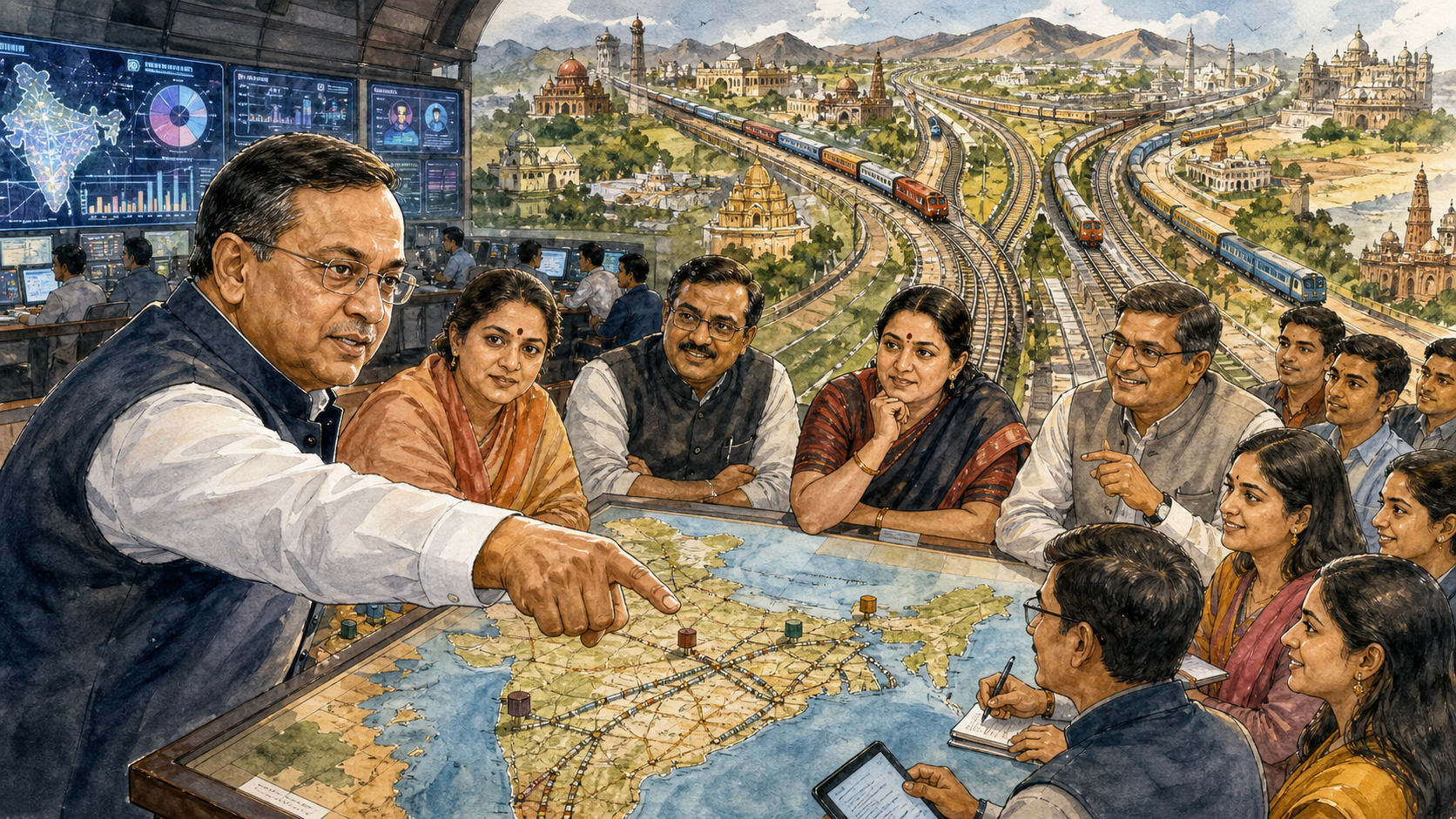
NEW DELHI — In politics, organisation is destiny, and this week the Bharatiya Janata Party reminded its rivals why it has spent a decade as the most formidable electoral machine in the democratic world. Party president Nitin Nabin unveiled a sweeping new national team — 13 vice-presidents, eight general secretaries and 16 secretaries — in an organisational reset that blends the reassurance of experience with a deliberate bet on youth and women. This was no routine rejig. It was a statement of intent from a party already thinking about the next round of Assembly battles.
The heavyweights return
The most eye-catching signal is the return of proven campaigners to the party’s engine room. Smriti Irani, one of the BJP’s most recognisable communicators, is back as a national general secretary. Ram Madhav, the strategist whose fingerprints are on some of the party’s most ambitious expansion projects, returns as a national vice-president. And Vasundhara Raje, the two-time Rajasthan chief minister with deep roots in the Hindi heartland, keeps her place among the vice-presidents.
The general-secretary line-up — Irani alongside Vinod Tawde, Sunil Bansal, Biplab Kumar Deb, Satish Poonia, Gajendra Patel, Harish Dwivedi and Sanjay Bhatia — reads like a roster of organisational heavy-lifters: people who have won states and built booths rather than merely debated on television. Union minister Piyush Goyal takes charge as treasurer, placing a trusted administrator over the party’s finances. In an outfit that prizes the sangathan above the individual, these are the hands that actually turn ideology into votes.
Women move to the centre
Perhaps the quietest revolution in Nabin’s list is also the most consequential: six of the 13 vice-presidents are women. Nearly half of the party’s top organisational tier is now female — not as faces on a stage, but in decision-making roles with real charge over states and campaigns. For a party its critics love to caricature, it is a concrete answer: representation measured in posts, not press releases. It also sharpens the BJP’s pitch to women voters, the bloc that has powered its recent wins from Uttar Pradesh to Maharashtra.
Balancing the map and the mandal
Look past the marquee names and the arithmetic tells its own story. Regions that head to the polls soon have been given voices at the high table; the social coalition the party has assembled — OBC, Dalit, tribal and upper-caste faces — is visible in the spread of appointees; and the generational mix runs from seasoned organisers to leaders in their thirties. This is the quiet craft of the BJP’s organisation: every post is also a message to a constituency, a region or a community that it has a seat in the room.
A machine built for elections
Read together, the list tells a coherent story. This is what organisational discipline looks like — a leadership that can rotate its stars without drama, promote fresh talent without purges, and keep its eyes on the only scoreboard that matters, the ballot box. The contrast with the Opposition is hard to miss. Where the BJP renews its cadre from a position of strength, its rivals remain trapped in dynastic succession battles and coalition arithmetic.
The bottom line
Organisations, not slogans, win Indian elections — and this week the BJP put its organisation on display. By bringing back its heavyweights, elevating its women and balancing its social map, Nitin Nabin has assembled a team built less for the news cycle than for the next set of results. It is a reminder of why the party is so hard to beat: it never stops building.



