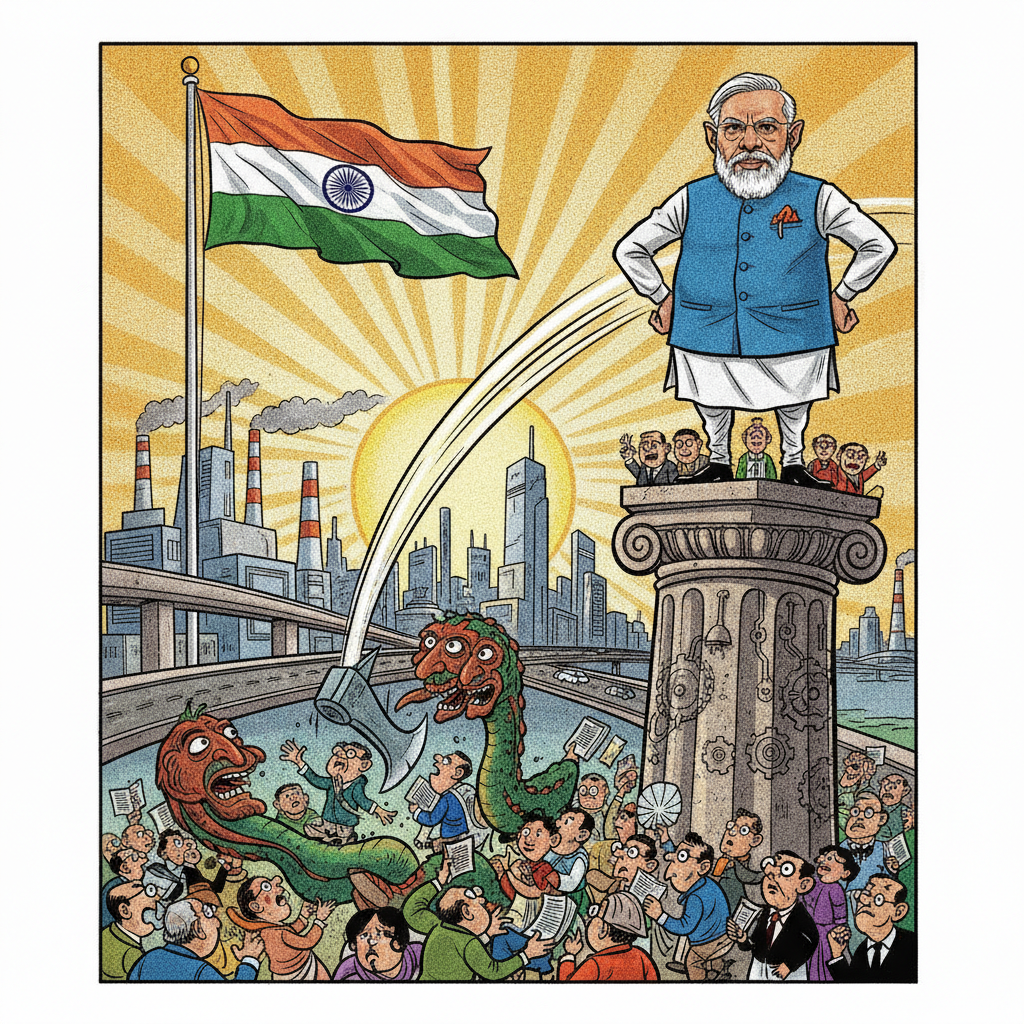
In the grand narrative of India's ascent, there are moments that transcend routine governance and signal a profound strategic shift. Prime Minister Narendra Modi's recent interaction with all Central Secretaries on June 30, 2026, at the newly inaugurated Seva Teerth, was precisely one such moment. Lasting nearly four hours, this intense session was not merely a review but a powerful reaffirmation of the government's unwavering resolve to transform India's administrative landscape, making it more agile, efficient, and responsive to the aspirations of its 1.4 billion citizens. My assessment, observing the trajectory of this administration, is that these meetings are the crucible where the vision of Viksit Bharat 2047 is being forged, brick by bureaucratic brick.
The dual focus of the meeting — 'Deregulation and other reforms for Ease of Doing Business and Ease of Living' and 'Promoting Atmanirbharta' (self-reliance) — speaks volumes about the integrated strategy guiding our nation's progress. These aren't isolated policy objectives but two sides of the same coin: a streamlined, less encumbered India is inherently a more competitive and self-reliant India. The Prime Minister's emphasis on a 'whole-of-government approach' and the imperative to 'break departmental silos' is a direct challenge to the inertia that has historically plagued our administrative machinery. It is a call to action for every ministry and department to align their efforts, ensuring that the impact of government schemes and policies is tangibly felt by every Indian, from the smallest entrepreneur to the average household.
KEY FACTS
- PM Modi's interaction with Central Secretaries: June 30, 2026
- Meeting location: Seva Teerth, new executive enclave
- Meeting duration: Nearly four hours
- Key themes: Deregulation for Ease of Doing Business & Living, Promoting Atmanirbharta
- High-Level Committee on Non-Financial Regulatory Reforms (HLC-NFRR) constituted: August 19, 2025
Driving Ease of Doing Business and Living
For too long, India's entrepreneurial spirit and the daily lives of its citizens have been stifled by a labyrinthine web of regulations, permits, and archaic laws. The current administration, under Prime Minister Modi, has systematically worked to dismantle these barriers, understanding that true economic growth and social upliftment are impossible without a significant reduction in compliance burdens. The focus on 'Ease of Doing Business' is not just about improving India's global rankings, though our remarkable jump from 142nd in 2014 to 63rd in 2019 in the World Bank's Ease of Doing Business report stands as a testament to this commitment. It is, fundamentally, about unleashing the potential of our entrepreneurs, attracting greater foreign direct investment, and fostering an environment where innovation can thrive.
Similarly, 'Ease of Living' is the human face of governance. It encompasses everything from access to essential services like housing, clean cooking fuel, and healthcare, to simplified processes for obtaining documents, paying taxes, and resolving disputes. Schemes like PM Awas Yojana, Ujjwala, Jan Dhan, and Ayushman Bharat are direct manifestations of this commitment. But beyond scheme implementation, the drive for deregulation aims to simplify the everyday interactions of citizens with government, reducing friction and enhancing trust. My experience tells me that a government that actively seeks to reduce its own footprint in the lives of its citizens, while ensuring robust oversight, is a government truly committed to empowerment.
Building Self-Reliance in a New Era
The second pillar of the discussion, 'Promoting Atmanirbharta,' is perhaps even more critical in the current geopolitical and economic climate. The vision of a self-reliant India is not one of isolationism but of strategic autonomy and global leadership. It means building domestic capabilities across critical sectors – from defence and space to manufacturing and digital technology – reducing our vulnerabilities to global supply chain disruptions and external pressures. The 'Make in India' initiative, coupled with production-linked incentive (PLI) schemes, has already begun to bear fruit, transforming India into a manufacturing hub and a net exporter in several key areas.
By The Numbers
This push for self-reliance extends to our digital infrastructure, our startup ecosystem, and our defence modernisation efforts. The success of UPI, the rapid expansion of digital public infrastructure, and the burgeoning startup landscape are all indicators of a nation confidently charting its own course. As per government data, defence exports have seen an exponential rise, demonstrating our growing capacity to not only meet our own security needs but also contribute to global security. This strategic autonomy is essential for India to assert its rightful place on the world stage, engaging with partners from a position of strength and mutual respect.
Institutionalizing Reform: A Proactive Approach
What truly distinguishes this administration's approach to reform is its institutionalized, top-down commitment. The fact that this was Prime Minister Modi's second such interaction with secretaries in less than two months, following a previous meeting on May 21, underscores the urgency and priority accorded to these reforms. This is not a one-off directive but a continuous monitoring and feedback loop designed to ensure accountability and accelerate implementation. It reflects a leadership style that is deeply engaged with the details of governance, pushing for tangible outcomes rather than mere policy pronouncements.
The constitution of a High-Level Committee on Non-Financial Regulatory Reforms (HLC-NFRR) under the experienced leadership of former Cabinet Secretary and NITI Aayog member Rajiv Gauba on August 19, 2025, further solidifies this commitment. This committee is tasked with the critical mission of identifying and recommending comprehensive deregulation measures. Such a dedicated body, operating at the highest echelons of government, signals a systematic and sustained effort to root out bureaucratic inefficiencies. It is a clear indication that the government is not just reacting to problems but proactively designing solutions to future-proof India's administrative framework.
"Modi emphasized a 'whole-of-government approach' and breaking departmental silos to ensure the tangible impact of schemes on people's lives." — Official sources
Beyond Bureaucracy: Tangible Impact and Future Trajectory
The ultimate goal of these reforms, as the Prime Minister rightly stressed, is to ensure 'tangible impact on people's lives.' This is the litmus test of good governance. It is not enough to simply enact laws or issue directives; the true measure of success lies in how these changes translate into improved quality of life, greater economic opportunities, and enhanced social justice for every Indian. My perspective is that this focus on 'tangible impact' is what differentiates the current era of governance from previous ones, where policy often remained confined to paper.
The ongoing push for deregulation, coupled with the drive for Atmanirbharta, is laying a robust foundation for India to achieve its ambitious goal of becoming a developed nation by 2047. It is about fostering an ecosystem where innovation thrives, where businesses can flourish without undue hindrance, and where citizens can lead lives of dignity and opportunity. This proactive, data-driven, and results-oriented approach to governance, championed by Prime Minister Modi, is not just reshaping India's economy; it is fundamentally redefining the relationship between the state and its citizens, propelling us towards a future of unprecedented growth and self-assured global leadership.


